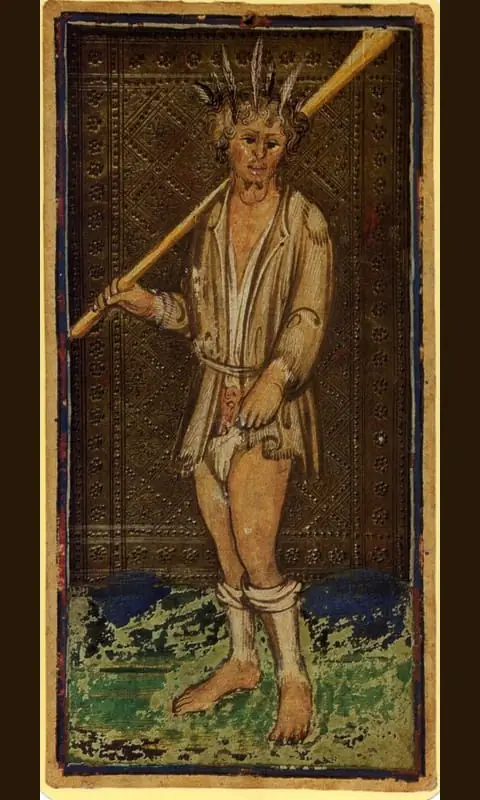
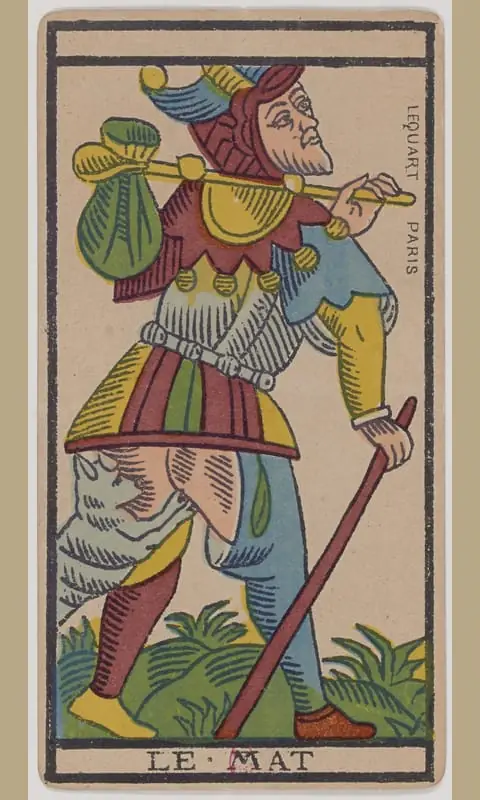
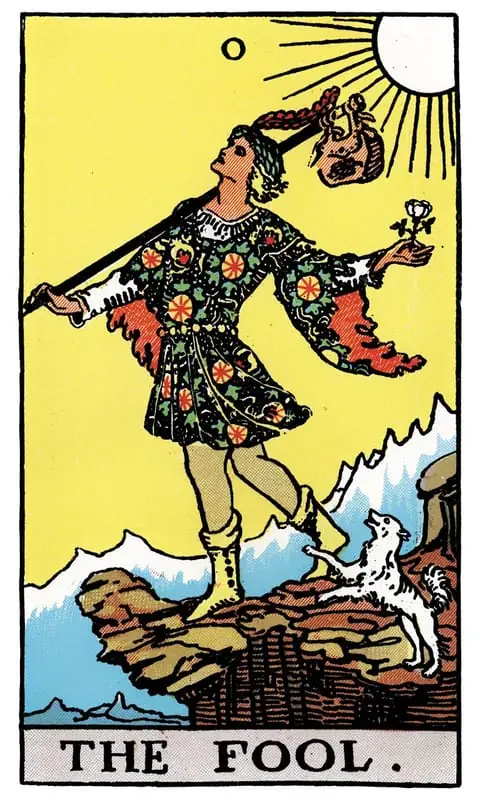
Tarot history at a glance
- 1370s · Playing cards reach Europe, probably from the Mamluk sultanate of Egypt and Syria.
- 1440 · The first record of "triumph" cards, in a Florentine notary's diary.
- c. 1450 · The Visconti-Sforza cards are painted for the rulers of Milan.
- c. 1491 · The Sola Busca deck is engraved, with a scene on every card.
- 1505 · The name tarocchi appears in records at Ferrara.
- c. 1650 · The oldest surviving French tarots are printed in Paris.
- c. 1730–1750 · The earliest known list of tarot meanings is written in Bologna.
- 1781 · Court de Gébelin claims tarot is an ancient Egyptian book.
- 1789 · Etteilla publishes the first deck made for reading.
- 1855–56 · Éliphas Lévi ties the trumps to the Kabbalah.
- 1888 · The Hermetic Order of the Golden Dawn is founded in London.
- 1909 · Pamela Colman Smith and A. E. Waite's deck is published by Rider.
- 1969 · Aleister Crowley and Frieda Harris's Thoth deck is published.
- 1971 · U.S. Games starts printing the Rider-Waite-Smith deck for the American market.
Where the suits come from
Ordinary playing cards came first, and they spread quickly. In 1377 Florence banned a card game called naibbe, which the city's ban described as having only recently arrived. The same year, a monk in Basel wrote that cards had only just reached the upper Rhine.
They most likely came from the Mamluk sultanate, which ruled Egypt and Syria. Mamluk packs used four suits: cups, coins, swords and polo sticks. Polo meant little to Europeans, so the sticks became batons, and those are the suits tarot still has. Coins later became Pentacles and batons became Wands in the English occult decks.
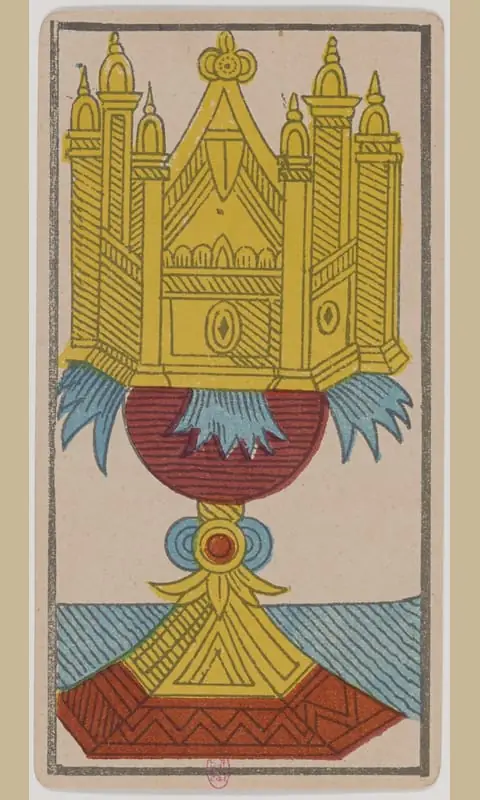
Cups
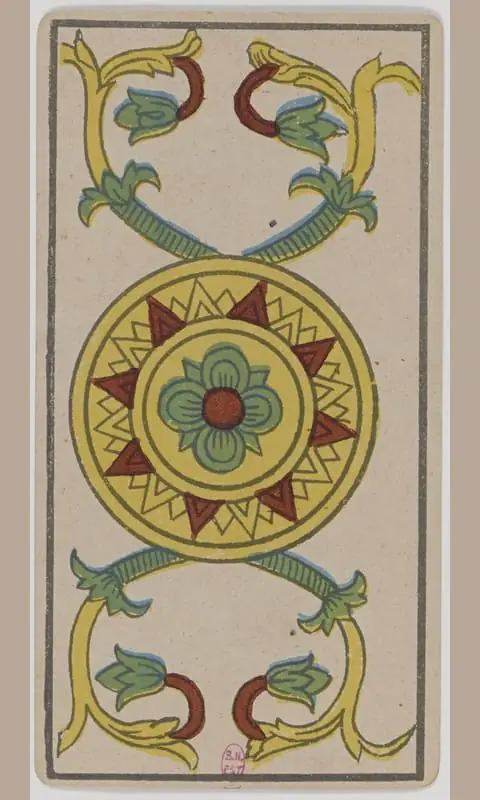
Coins
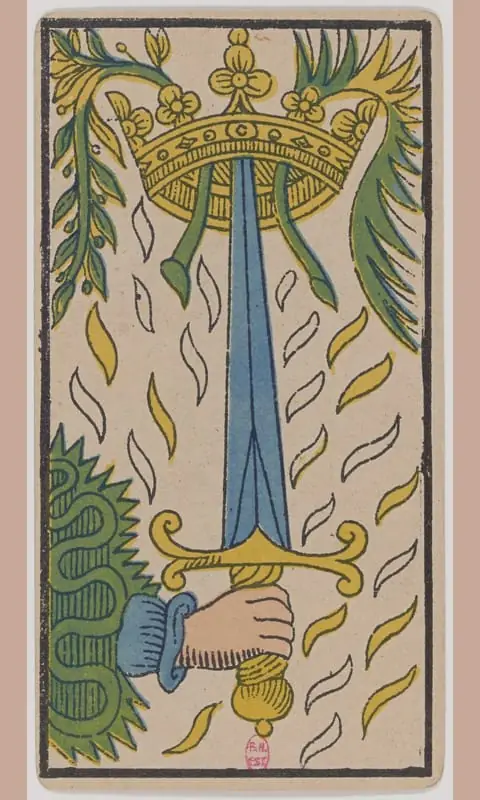
Swords
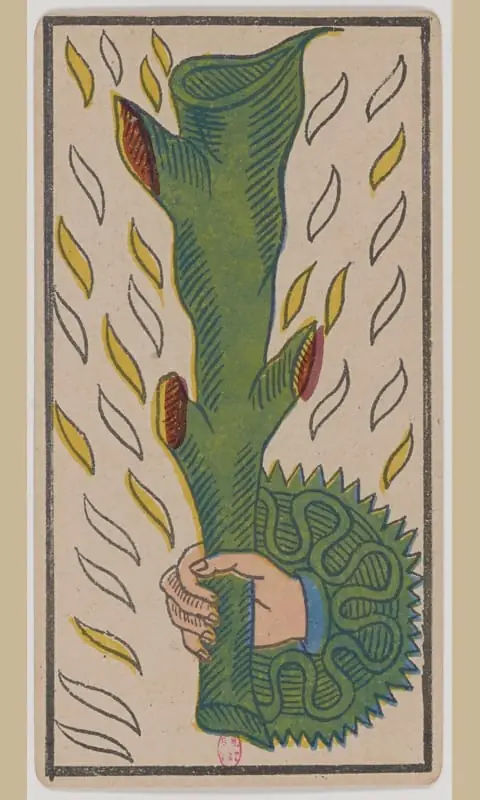
Batons
Triumphs: the first tarot cards
Early in the fifteenth century, someone in northern Italy added a fifth set of cards to the pack: a row of pictures that outranked every suit card. The first certain mention is from September 1440, when a Florentine notary, Giusto Giusti, recorded giving Sigismondo Malatesta, lord of Rimini, a pack of "triumph" cards painted with Malatesta's arms. They cost four and a half ducats. The court at Ferrara was paying for them by 1442.
Triumph is where English gets the word trump. In the game each picture card beat the one below it, much like the triumphal processions Italian cities staged, or Petrarch's poem I Trionfi, where Love is beaten by Chastity, Chastity by Death, and so on up to Eternity.
To someone in 1450 the pictures were familiar. Virtues, the Wheel of Fortune, Death, the Pope and the Emperor, the sun and moon and the Last Judgement were the stock images of sermons, frescoes and books. They were meant to be read as lessons about rank, luck and death, and no writer of the period treats them as secret.
Some meanings have shifted a long way since. In the Milanese cards the Hermit holds an hourglass and stands for Time, the slow work of age and patience. By 1909 the hourglass was a lantern and the card was about searching.
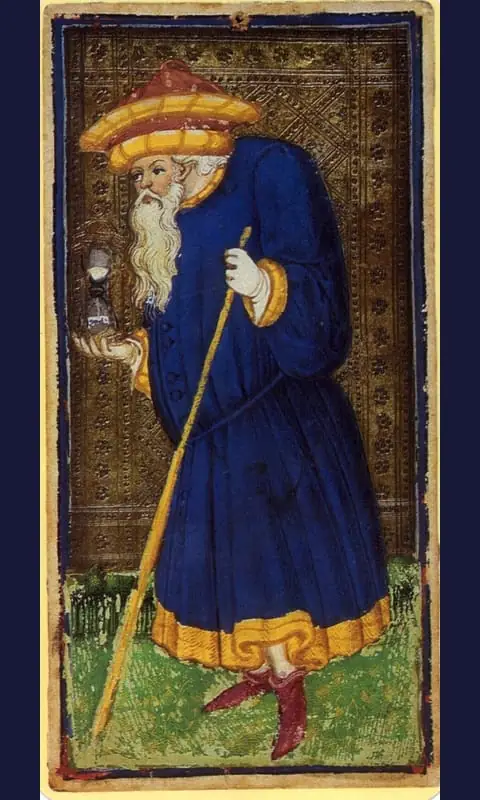
Visconti-Sforza: an hourglass
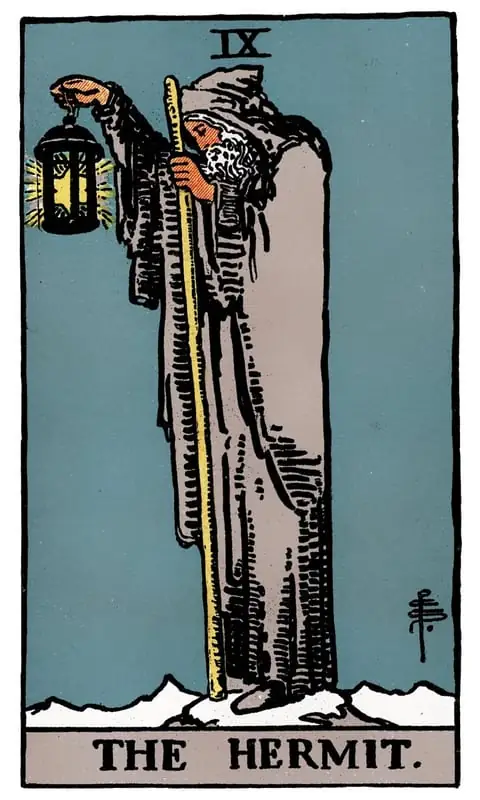
Rider-Waite-Smith: a lantern
The painted decks of Milan
The oldest tarot cards still in existence were painted for the dukes of Milan in the 1440s and 1450s, on thick card with gold and silver leaf. None is complete. The best known, the Visconti-Sforza deck, is shared between the Morgan Library in New York, the Accademia Carrara in Bergamo and a private collection, and four of its cards are lost, among them the Devil and the Tower. In a reading here, those gaps are filled from the Rider-Waite-Smith deck.
The early packs differ from each other. The Cary-Yale deck at Yale has trumps for Faith, Hope and Charity that later decks dropped, and its knights and pages include women. By about 1500 the pack had settled at 78 cards: four suits of fourteen (ace to ten, Page, Knight, Queen and King), twenty-one numbered trumps, and the Fool.
Three hundred years as a game
For most of its life tarot was played, usually for money. It is a trick-taking game, related to bridge and whist. You follow the suit that was led if you can, any trump beats any suit card, and in most versions the Fool lets you off following suit, which is why French players still call it l'Excuse.
The game travelled with Italian influence into France and Switzerland, then into Germany, Austria and Hungary. Around 1505 the cards picked up the name tarocchi, which became tarot in French and Tarock in German; nobody knows where the word comes from. Tarot is still a popular game in France, Austrian players use packs whose trumps show nineteenth-century country scenes, and Bologna keeps its own shortened pack.
Churchmen did complain, and that is sometimes quoted as proof that tarot was considered dangerous. Their objection was gambling. A Franciscan sermon from about 1500 groups the triumphs with dice as inventions of the devil, and usefully for historians it lists the trumps in order.
The Tarot de Marseille, and why Justice is sometimes 8
Once woodcut printing made cards cheap, French card makers took over. The oldest French tarots that survive were printed in Paris around 1650, and the design that dominated is clear in Jean Noblet's deck from that time, Jean Dodal's from Lyon around 1701 and Nicolas Conver's from Marseille in 1760. Conver's was copied for two centuries. The name Tarot de Marseille came later; Marseille was one card-making town among several.
These decks put pictures on the trumps and court cards only. The number cards show their suit signs in patterns, five cups or seven swords and nothing else, so people who read with a Marseille deck today work mainly from number and suit.
They also fix several details that now look symbolic: the Fool without a number, card XIII printed without a name (it was rarely labelled Death), and Justice at VIII with Strength at XI. The Golden Dawn swapped those two in the 1880s, as you will see below, which is why most modern decks have Strength at 8.
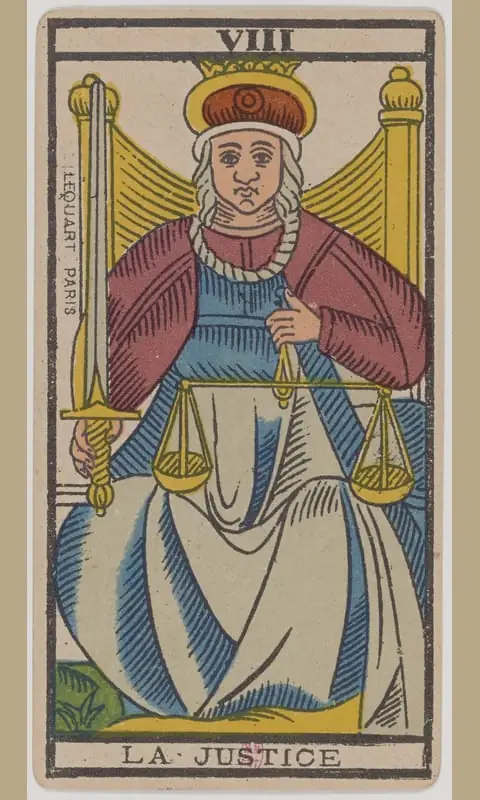
Marseille: Justice is VIII
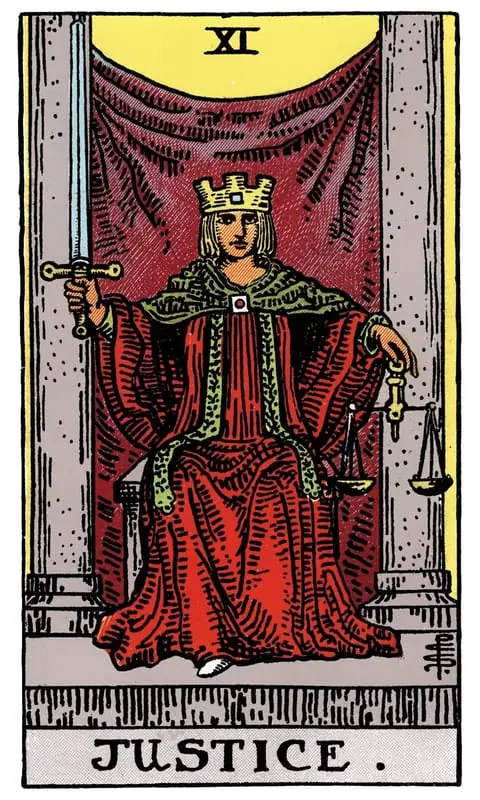
Rider-Waite-Smith: Justice is XI
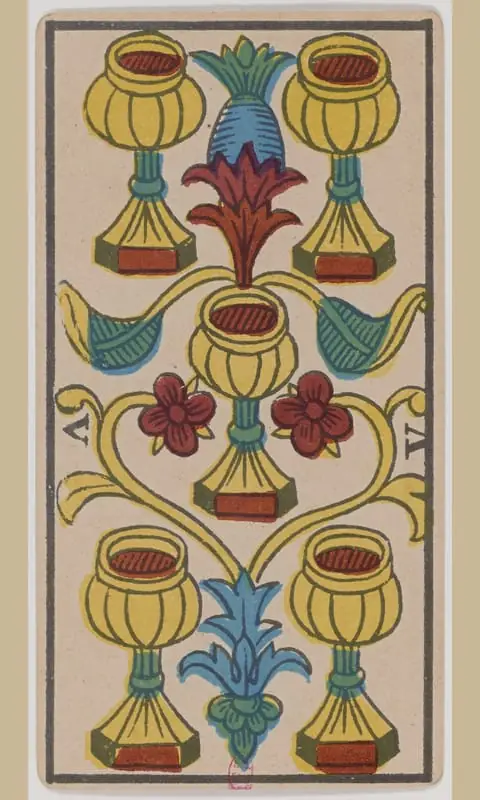
Marseille: Five of Cups
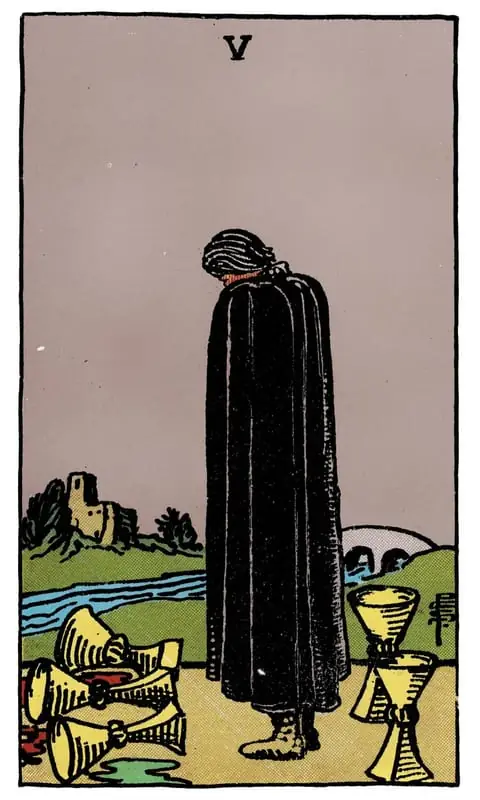
Rider-Waite-Smith: Five of Cups
When people started reading tarot
Later than most people assume. Italians played fortune-telling games with ordinary cards in the 1500s, but the earliest known list of meanings for tarot cards is a single sheet now in the University of Bologna's library, written somewhere between about 1730 and 1750. It gives a short meaning for thirty-five cards of the local pack and looks like a working reader's crib sheet.
Paris made card reading fashionable. Jean-Baptiste Alliette, a professional reader who published as Etteilla (Alliette backwards), started out with the ordinary 32-card piquet pack and turned to tarot in the 1780s. In 1789 Etteilla produced the first deck designed for reading, with an upright and a reversed meaning printed on each card. If you read reversals, this is the first place the practice was set down in a system.
Where the Egyptian story came from
In 1781 Antoine Court de Gébelin, a Paris scholar writing an enormous study of a supposed lost first civilisation, described watching friends play tarot and recognising the cards at once as an ancient Egyptian book, the Book of Thoth, hidden inside a game so that it would survive. In the same volume the Comte de Mellet matched the twenty-two trumps to the twenty-two letters of the Hebrew alphabet.
Neither had any evidence, and in 1781 no one could check, because hieroglyphs could not yet be read. Champollion deciphered them in 1822. Nothing in the Egyptian writing read since then resembles tarot (the one real Egyptian link is the Mamluk origin of the suits), but by then the story had spread, and it is still the first thing many people hear about the cards.
The idea that Romani travellers brought tarot to Europe, made popular in 1889, has the same problem in a different form: playing cards were circulating in Europe before Romani people are recorded in the west.
Magicians and secret societies
In the 1850s the French writer Alphonse-Louis Constant, publishing as Éliphas Lévi, made tarot part of a complete system of ceremonial magic, tying the trumps to the Kabbalah and to the Hebrew letters, with the Magician first. The names Major Arcana and Minor Arcana come from this French occult circle. Card players had called them trumps and suit cards. In 1889 Oswald Wirth redrew the Marseille trumps along Lévi's lines, with a Hebrew letter on each.
In London the Hermetic Order of the Golden Dawn, founded in 1888, took this further. It put the Fool first, linked every trump to a planet, a sign or an element, and gave each number card a slice of the zodiac and a title (the Three of Swords is the Lord of Sorrow). To make the astrology fit, it swapped Strength and Justice, so that Strength sat with Leo and Justice with Libra. Members copied the order's designs into their own hand-drawn decks. Among them were W. B. Yeats, Aleister Crowley, Arthur Edward Waite and an illustrator named Pamela Colman Smith.
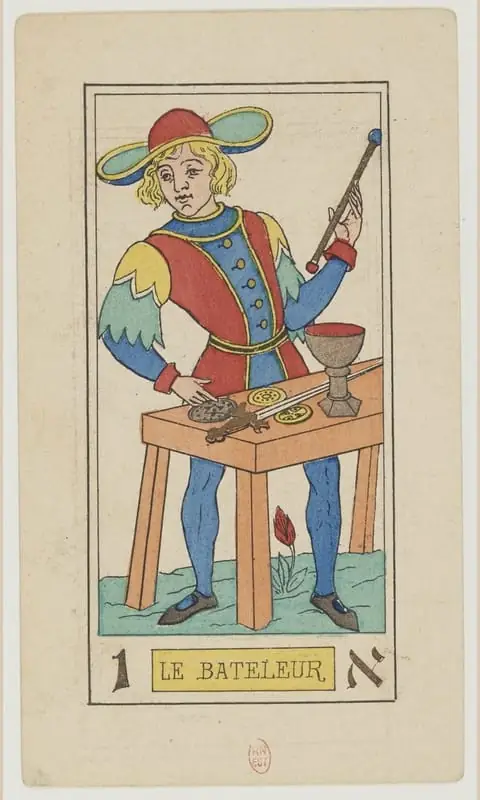
Oswald Wirth, 1889
Pamela Colman Smith's deck
In 1909 Waite asked Smith to draw a new deck for the London publisher William Rider & Son. Smith, an American illustrator and stage designer who had grown up partly in Jamaica, drew all 78 cards in about six months, and the deck came out that December with a short book by Waite, expanded in 1911 as The Pictorial Key to the Tarot.
Waite directed the trumps closely, in the Golden Dawn order. The number cards were left largely to Smith, and Smith gave every one of them a scene: someone grieving over spilled cups, someone bent under ten staves, a heart pierced by three swords in the rain. Only one earlier deck had done anything like it, the Sola Busca, engraved in Italy around 1491. Photographs of it went to the British Museum in 1907, and the Three of Swords suggests Smith saw them.
Smith was paid a flat fee, and called the job "a big job for very little cash" in a letter that year. For most of the century the deck was sold as the Rider-Waite tarot, although Smith's initials are on every card. Many readers now call it Rider-Waite-Smith or Waite-Smith. Smith died poor in 1951.
The scenes are why this deck won. You can turn up the Five of Cups, see the three spilled cups and the two still standing behind the cloaked figure, and start reading before you open a book. Most decks sold today are redrawings of Smith's 78 pictures.
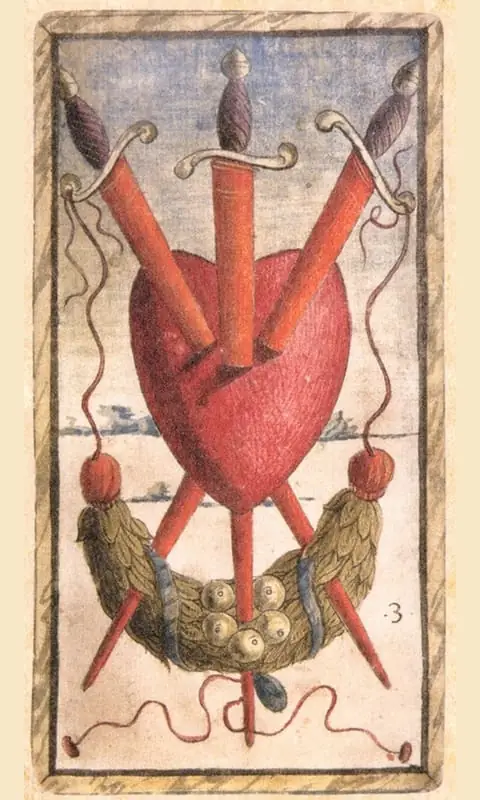
Sola Busca, c. 1491
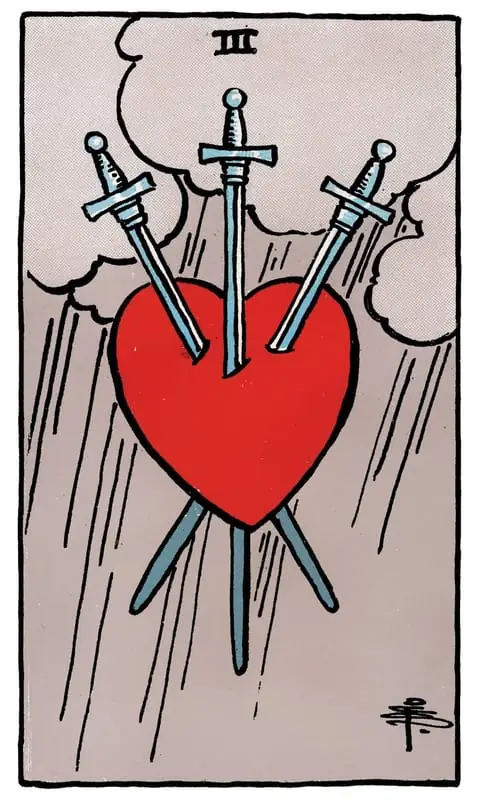
Rider-Waite-Smith, 1909
Tarot in the twentieth century
The other influential occult deck of the century was the Thoth Tarot, which Aleister Crowley designed and Frieda Harris painted between 1938 and 1943. It was published in 1969, after both had died, and it renames some trumps (Strength is Lust, Temperance is Art).
The Rider-Waite-Smith deck sold modestly for fifty years, mostly to people already interested in the occult. Eden Gray's plain-spoken books, from The Tarot Revealed in 1960, brought it to ordinary readers, and from 1971 the American publisher U.S. Games kept it in print in very large numbers. Around the same time, partly under the influence of Carl Jung's writing on archetypes, many readers began using the cards to think through their own lives and cared less about predicting events. Decks such as Motherpeace (1981), with its round cards, opened the door to the thousands of independent decks in print now.
Historians caught up too. The philosopher Michael Dummett's The Game of Tarot (1980) and A Wicked Pack of Cards (1996, with Ronald Decker and Thierry Depaulis) sorted the documented history from the legends, and much of this guide rests on their work.
Myths you will still hear
- Tarot comes from ancient Egypt. First claimed in 1781, with no evidence; the cards first appear in fifteenth-century Italy.
- Romani people brought tarot to Europe. Playing cards were in Europe first, and the claim dates from the nineteenth century.
- The trumps were designed around the Hebrew alphabet. The match was proposed in 1781 and has been redrawn more than once. The Italian cards carry no letters.
- The Church banned tarot as witchcraft. Preachers condemned card games along with dice, as gambling.
- The minor cards were always illustrated. Before 1909 nearly every deck showed suit signs only, with the Sola Busca as the famous exception.
Seeing the history in your own readings
Any reading on this site can be dealt with an older deck. Try the Visconti-Sforza for the Milanese cards, the Tarot de Marseille or the Viéville for the French woodcuts, the Sola Busca for the scenes Smith drew on, or the Oswald Wirth for the occult revival. The written meanings follow the Rider-Waite-Smith deck, so Strength and Justice are matched by name whatever number a deck prints on them.