Three of Wands in 6 decks
The same card as 6 decks draw it, five and a half centuries apart. What stays the same is the card’s core; what changes is where a reading can find something new. The meanings are written for the Rider–Waite–Smith picture; the descriptions here are of each deck’s own. Not in Oswald Wirth, which has no Three of Wands card.
Side by side
Choose any two decks and read the pictures against each other.
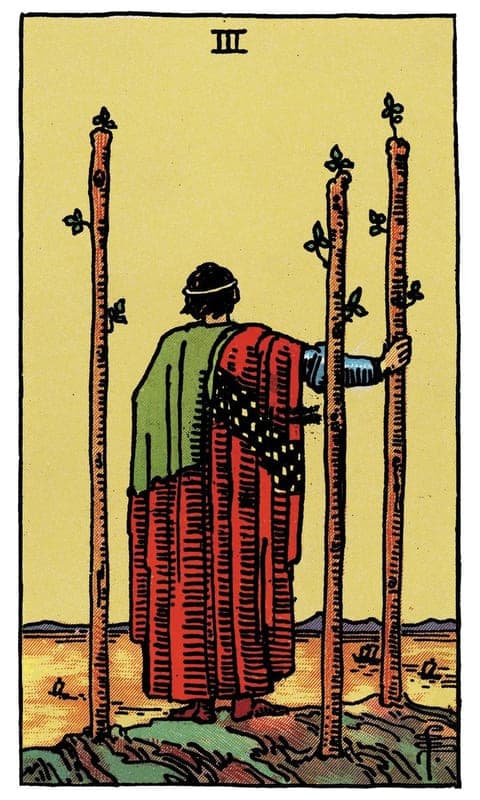
Pamela Colman Smith, 1909
A man in a red cloak stands on a cliff with his back to the viewer, one hand resting on a staff while two more stand planted beside him. Below, three small ships sail across a golden sea. He has sent them out and is watching for their return.
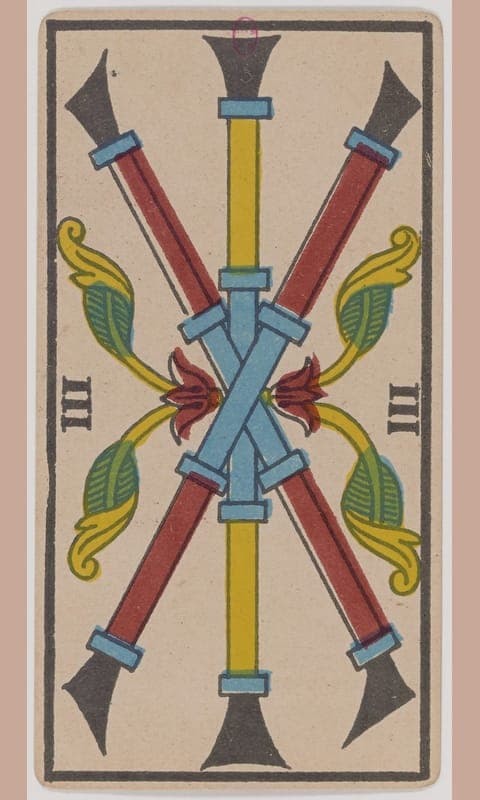
Lequart, Paris, 19th century
Two red staves cross in an X behind a single upright yellow staff, all with blue bands and grey flared ends, bound together by blue straps at the centre. A curling yellow and green leaf and a red bud sprout from each side. The numeral III is printed on both sides.
Marseille number cards are read through their number and suit; the written meaning here gives the scene the Rider-Waite-Smith card adds.
Rider–Waite–Smith
Pamela Colman Smith, 1909
A man in a red cloak stands on a cliff with his back to the viewer, one hand resting on a staff while two more stand planted beside him. Below, three small ships sail across a golden sea. He has sent them out and is watching for their return.
Tarot de Marseille
Lequart, Paris, 19th century
Two red staves cross in an X behind a single upright yellow staff, all with blue bands and grey flared ends, bound together by blue straps at the centre. A curling yellow and green leaf and a red bud sprout from each side. The numeral III is printed on both sides.
Marseille number cards are read through their number and suit; the written meaning here gives the scene the Rider-Waite-Smith card adds.
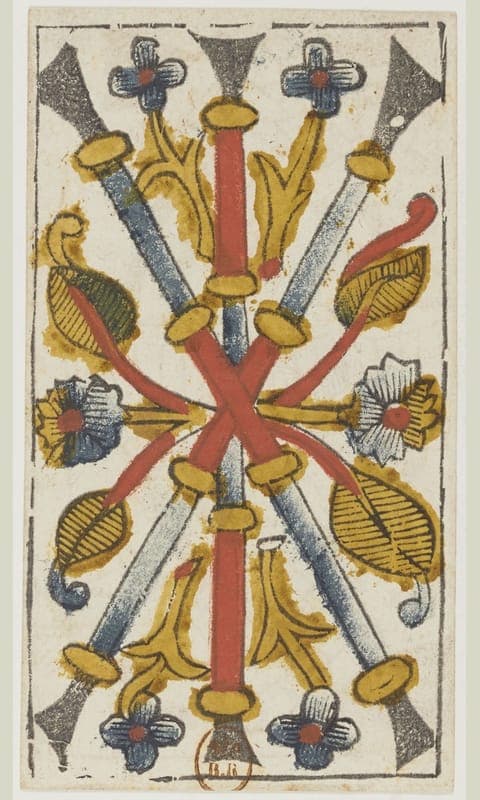
Tarot de Viéville
Jacques Viéville, c. 1650
A red baton runs straight down the centre while two grey batons cross over it in an X. Leafy sprays and red stems grow from the crossing, with blue-grey flowers at the sides and small four-petalled flowers in each corner.
Viéville number cards show only their suit symbols; read them through number and suit, with the written meaning as a guide.
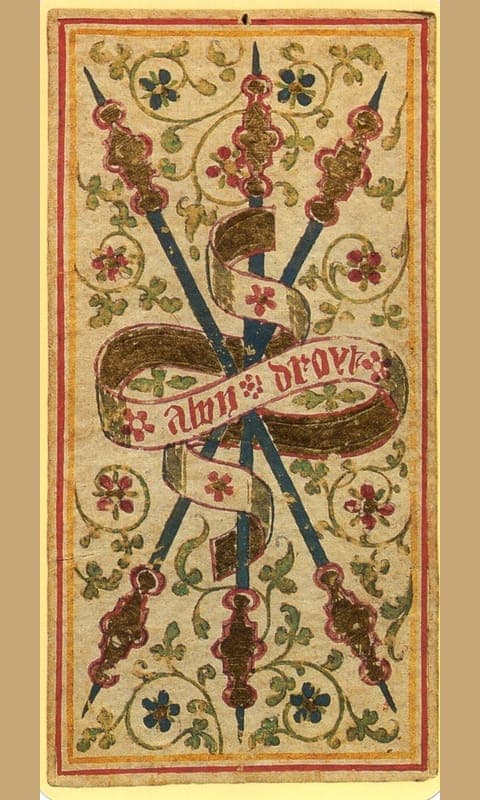
Visconti-Sforza
Bonifacio Bembo, c. 1450
Three blue staves with gold baluster ends cross at the centre, one upright and two diagonal. A gold and white ribbon wraps round them, lettered 'abon droyt' in red with small flowers between the words. Green leaves and red and blue flowers decorate the cream ground inside red and yellow borders.
In the Visconti-Sforza deck the number cards show only their suit symbols, and the trumps are unnamed and unnumbered.
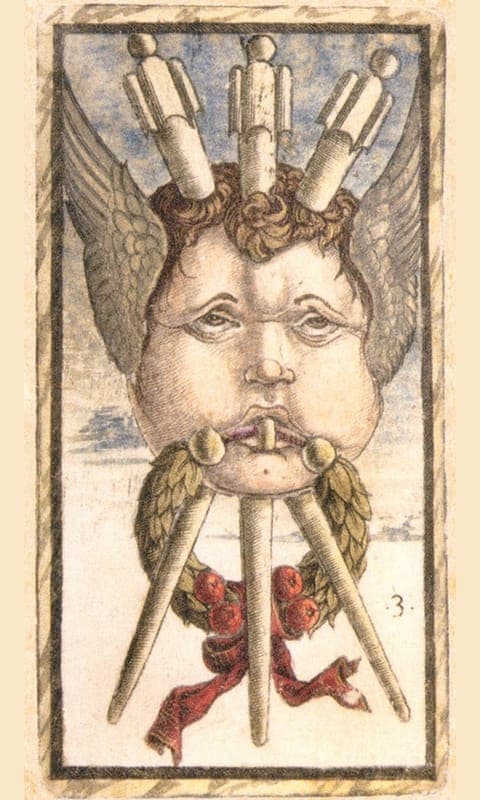
Sola Busca
c. 1491
A large winged child's head with curly hair is pierced by three staves, their ends rising from its curls and emerging through its mouth below. Beneath hangs a laurel wreath with red fruit and a red ribbon. The small numeral 3 is at the right.

Soimoi
Mike Koz, 2025
A young man with a topknot, in a red jacket, dark trousers and sandals, stands on a grassy hilltop leaning on one wooden staff while two more stand planted beside him. He holds out an unrolled map and gazes across layered blue mountains toward a red setting sun. A tanuki sits at his feet, a fish-shaped kite floats by, and yellow leaves blow past.