Four of Wands in 6 decks
The same card as 6 decks draw it, five and a half centuries apart. What stays the same is the card’s core; what changes is where a reading can find something new. The meanings are written for the Rider–Waite–Smith picture; the descriptions here are of each deck’s own. Not in Oswald Wirth, which has no Four of Wands card.
Side by side
Choose any two decks and read the pictures against each other.
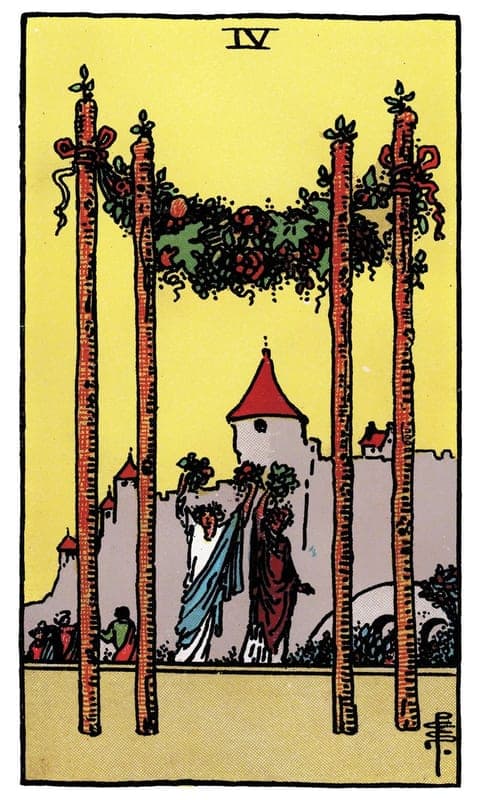
Pamela Colman Smith, 1909
Four tall wands stand planted in the ground, and a garland of fruit and flowers is strung between them like a canopy. Beneath it two figures raise bouquets in welcome, and behind them stands a castle with more people gathered. The sky is clear and the colours are warm.
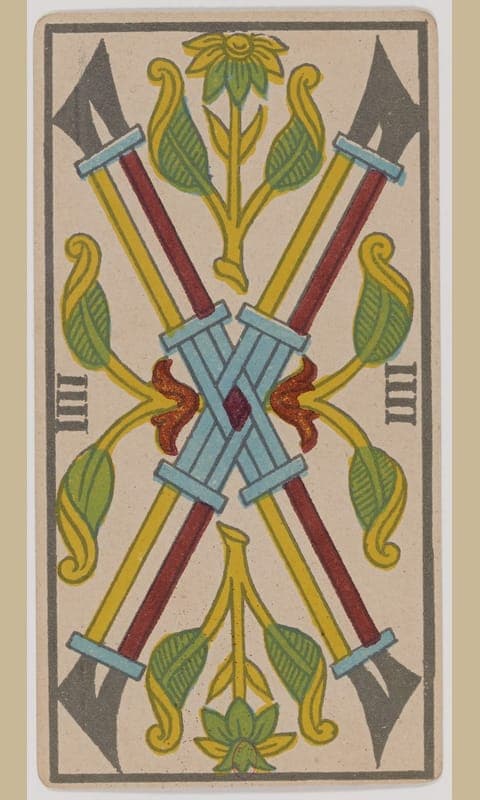
Lequart, Paris, 19th century
Four staves, two red and two yellow, cross in two pairs and are woven together at the centre by blue straps around a small red diamond. A yellow flower on a leafy stem stands at the top and another hangs below, with curling leaves and red buds at each side. The numeral IIII appears on both sides.
Marseille number cards are read through their number and suit; the written meaning here gives the scene the Rider-Waite-Smith card adds.
Rider–Waite–Smith
Pamela Colman Smith, 1909
Four tall wands stand planted in the ground, and a garland of fruit and flowers is strung between them like a canopy. Beneath it two figures raise bouquets in welcome, and behind them stands a castle with more people gathered. The sky is clear and the colours are warm.
Tarot de Marseille
Lequart, Paris, 19th century
Four staves, two red and two yellow, cross in two pairs and are woven together at the centre by blue straps around a small red diamond. A yellow flower on a leafy stem stands at the top and another hangs below, with curling leaves and red buds at each side. The numeral IIII appears on both sides.
Marseille number cards are read through their number and suit; the written meaning here gives the scene the Rider-Waite-Smith card adds.
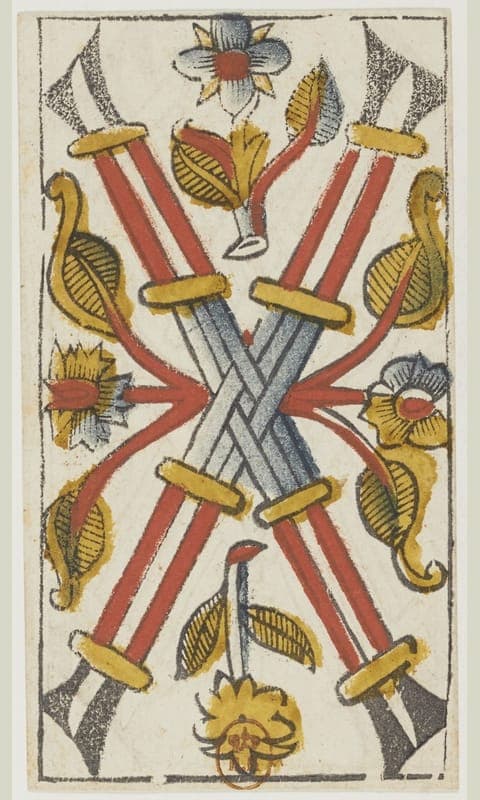
Tarot de Viéville
Jacques Viéville, c. 1650
Four batons cross in two pairs, interlaced at the centre in a woven grey band, with red outer shafts and yellow ferrules. A flower with a leafy stem stands above and below, and curling yellow leaves and blossoms fill the sides.
Viéville number cards show only their suit symbols; read them through number and suit, with the written meaning as a guide.
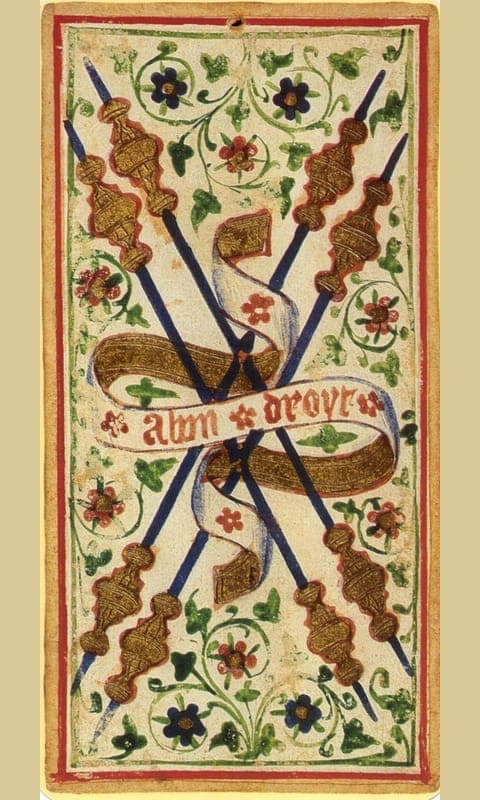
Visconti-Sforza
Bonifacio Bembo, c. 1450
Four blue staves with gold baluster ends cross in two pairs, forming a broad X. A gold and white ribbon curls through the centre, inscribed 'abon droyt' in red. Green leafy scrolls and blue and red flowers fill the cream ground within a red border.
In the Visconti-Sforza deck the number cards show only their suit symbols, and the trumps are unnamed and unnumbered.
Sola Busca
c. 1491
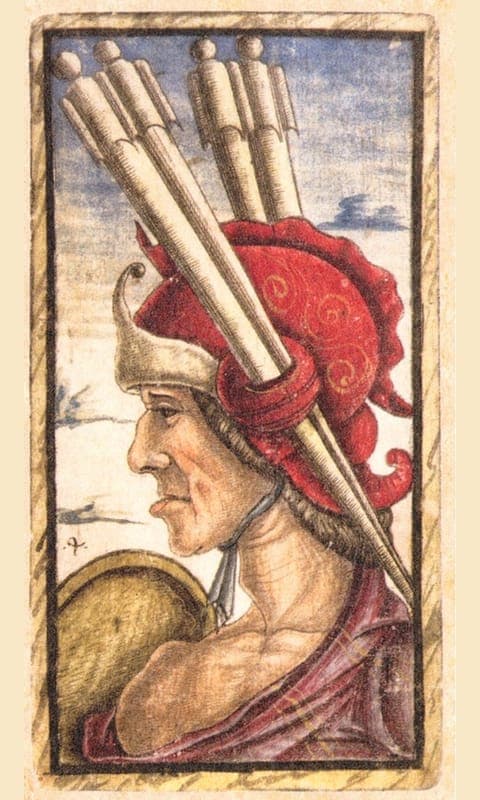
The head and shoulders of a man in profile, wearing a pale cap wrapped in a red turban patterned with gold. Four staves pass diagonally behind his head, and a round golden shield and a red cloak show below. A small numeral 4 sits at the left.

Soimoi
Mike Koz, 2025
Seen from behind, a man in a red kimono with his hair in a topknot walks down a forest path, his head bowed under a stack of thick bamboo poles roped together across his shoulders. Bamboo stalks rise at left and a red maple tree spreads at right. Red maple leaves fall around him and lie on the path; unlike the Rider-Waite-Smith card, there is no garland or celebration.