Five of Wands in 6 decks
The same card as 6 decks draw it, five and a half centuries apart. What stays the same is the card’s core; what changes is where a reading can find something new. The meanings are written for the Rider–Waite–Smith picture; the descriptions here are of each deck’s own. Not in Oswald Wirth, which has no Five of Wands card.
Side by side
Choose any two decks and read the pictures against each other.
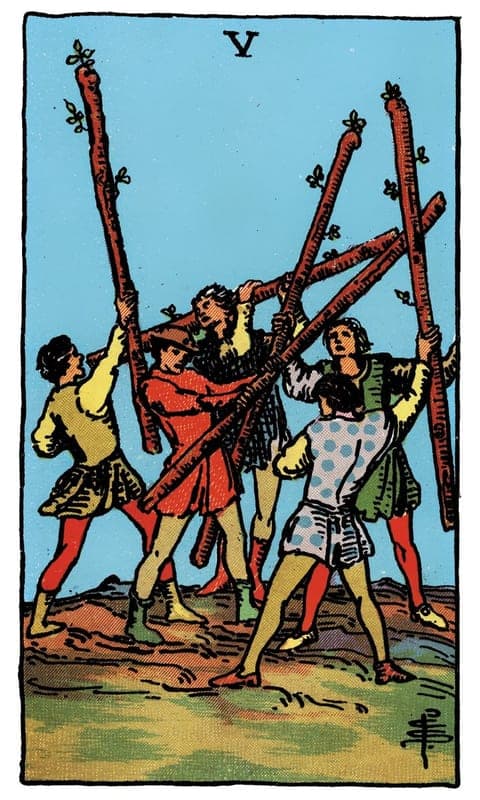
Pamela Colman Smith, 1909
Five young men in different coloured tunics swing staffs at one another in an open field. No one is wounded and no one is winning; the staffs cross in a tangle. It is impossible to tell whether they are fighting, sparring or building something together badly.
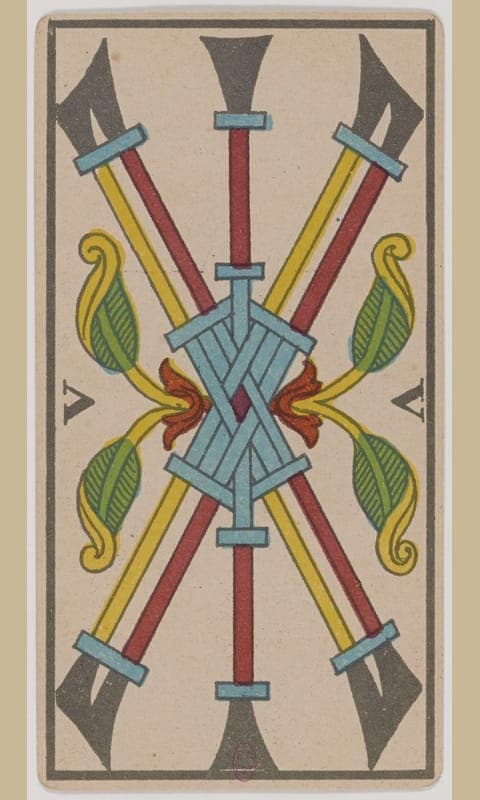
Lequart, Paris, 19th century
Four crossed staves of red and yellow and one upright red staff meet at a blue woven knot with a red diamond at its heart. Curling green and yellow leaves with red buds grow from either side of the crossing. The staves end in grey flared tips, and the numeral V is printed on each side.
Marseille number cards are read through their number and suit; the written meaning here gives the scene the Rider-Waite-Smith card adds.
Rider–Waite–Smith
Pamela Colman Smith, 1909
Five young men in different coloured tunics swing staffs at one another in an open field. No one is wounded and no one is winning; the staffs cross in a tangle. It is impossible to tell whether they are fighting, sparring or building something together badly.
Tarot de Marseille
Lequart, Paris, 19th century
Four crossed staves of red and yellow and one upright red staff meet at a blue woven knot with a red diamond at its heart. Curling green and yellow leaves with red buds grow from either side of the crossing. The staves end in grey flared tips, and the numeral V is printed on each side.
Marseille number cards are read through their number and suit; the written meaning here gives the scene the Rider-Waite-Smith card adds.
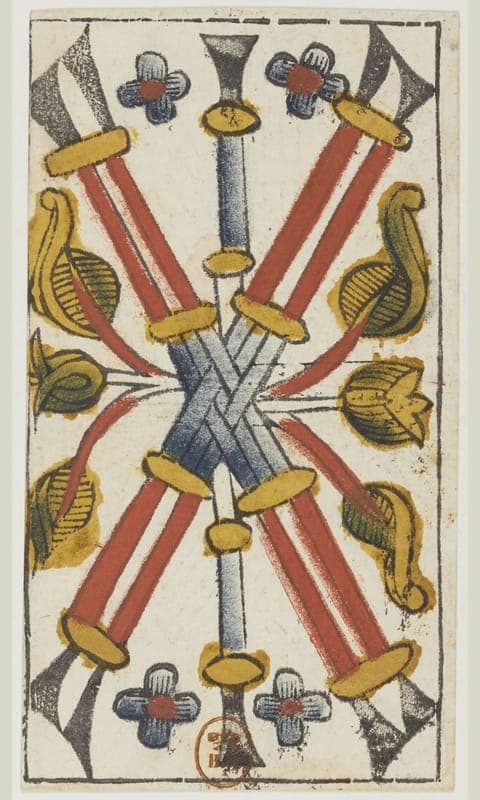
Tarot de Viéville
Jacques Viéville, c. 1650
Four red-edged batons cross in two pairs, woven together at the centre, while a fifth grey baton runs straight down the middle. Yellow leaves and tulip-like buds grow at the sides and a small blue four-petalled flower sits in each corner.
Viéville number cards show only their suit symbols; read them through number and suit, with the written meaning as a guide.
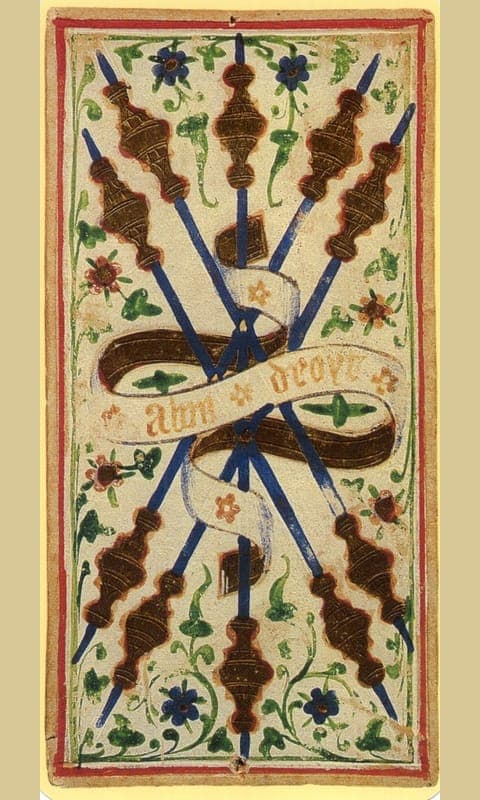
Visconti-Sforza
Bonifacio Bembo, c. 1450
Five blue staves with dark gold baluster ends cross at the centre: two pairs on the diagonals and one upright. A gold and white ribbon winds through them with the motto 'abon droyt', its letters partly faded. Sprigs of green leaves and blue and red flowers fill the spaces around.
In the Visconti-Sforza deck the number cards show only their suit symbols, and the trumps are unnamed and unnumbered.
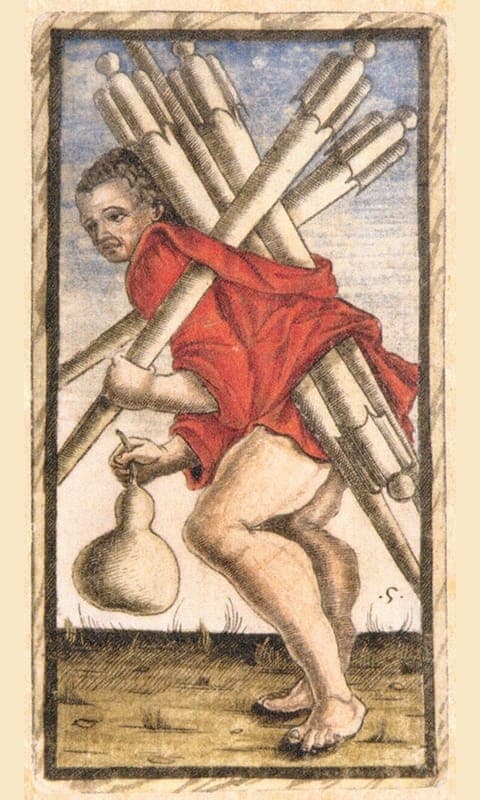
Sola Busca
c. 1491
A barefoot man in a red cloak trudges forward, bent under a bundle of five staves on his back. He holds a gourd-shaped flask by its neck in one hand and grips a stave with the other. Grass grows on the ground, and the numeral 5 is at the lower right.
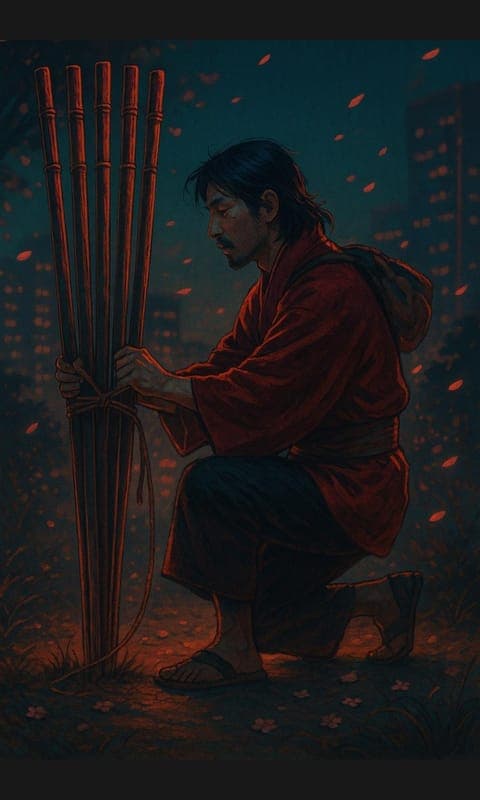
Soimoi
Mike Koz, 2025
A man in a red jacket and dark trousers kneels on one knee at night, tying a cord around a bundle of five upright red bamboo poles. A hooded pack hangs on his back. Red petals drift through the air and small pale blossoms dot the ground, while dim tower blocks with lit windows rise in the background.