Two of Wands in 6 decks
The same card as 6 decks draw it, five and a half centuries apart. What stays the same is the card’s core; what changes is where a reading can find something new. The meanings are written for the Rider–Waite–Smith picture; the descriptions here are of each deck’s own. Not in Oswald Wirth, which has no Two of Wands card.
Side by side
Choose any two decks and read the pictures against each other.
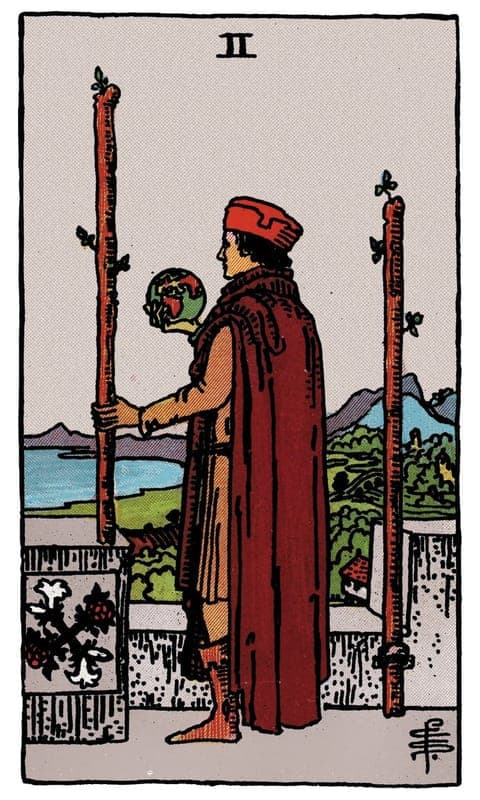
Pamela Colman Smith, 1909
A man in a red cloak stands on a castle rampart holding a small globe in one hand and a staff in the other, while a second staff is fixed to the wall beside him. He looks out over the sea toward distant hills. Everything he needs is behind him; everything he wants is ahead.
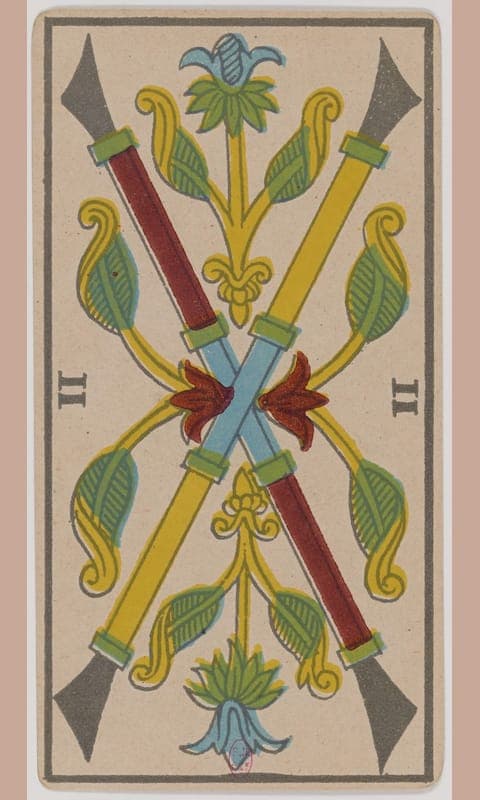
Lequart, Paris, 19th century
Two staves cross in an X, each half red and half yellow with a blue middle section and grey flared ends, bound by green bands. A blue flower on a leafy stem rises at the top and another hangs at the bottom, with curling yellow and green leaves and red buds beside the crossing. The numeral II is printed at each side.
Marseille number cards are read through their number and suit; the written meaning here gives the scene the Rider-Waite-Smith card adds.
Rider–Waite–Smith
Pamela Colman Smith, 1909
A man in a red cloak stands on a castle rampart holding a small globe in one hand and a staff in the other, while a second staff is fixed to the wall beside him. He looks out over the sea toward distant hills. Everything he needs is behind him; everything he wants is ahead.
Tarot de Marseille
Lequart, Paris, 19th century
Two staves cross in an X, each half red and half yellow with a blue middle section and grey flared ends, bound by green bands. A blue flower on a leafy stem rises at the top and another hangs at the bottom, with curling yellow and green leaves and red buds beside the crossing. The numeral II is printed at each side.
Marseille number cards are read through their number and suit; the written meaning here gives the scene the Rider-Waite-Smith card adds.
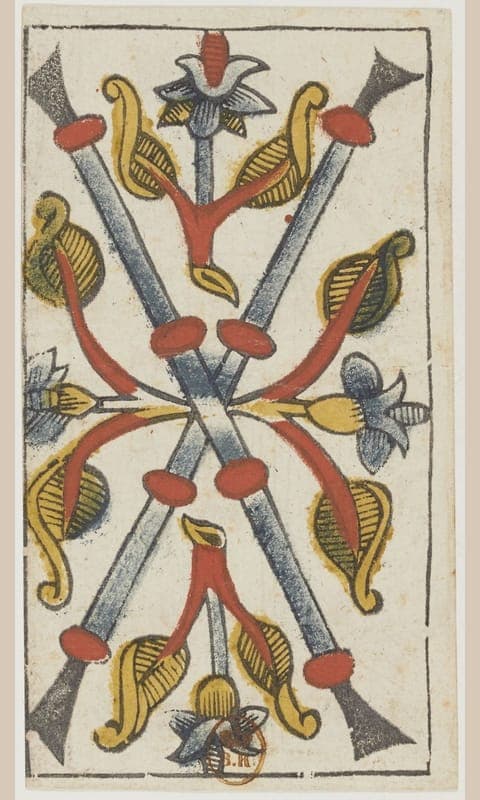
Tarot de Viéville
Jacques Viéville, c. 1650
Two long grey batons cross in a tall X with red bands at their ends and middles. Red stems spring from the crossing to blue flowers on either side, with yellow leaves curling in the gaps and a flower at the top and bottom.
Viéville number cards show only their suit symbols; read them through number and suit, with the written meaning as a guide.
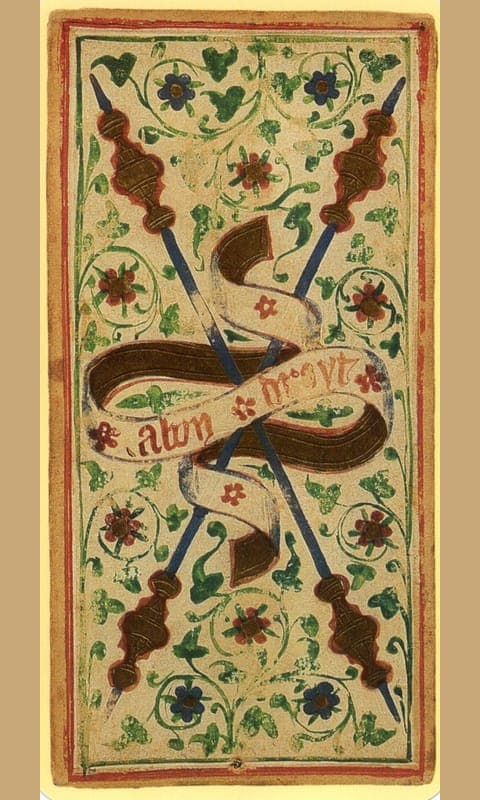
Visconti-Sforza
Bonifacio Bembo, c. 1450
Two blue staves with gold baluster ends cross in an X. A gold and white ribbon winds through the crossing, inscribed 'abon droyt' in red. Green leafy tendrils with blue and red flowers fill the cream ground, framed by a red line border.
In the Visconti-Sforza deck the number cards show only their suit symbols, and the trumps are unnamed and unnumbered.
Sola Busca
c. 1491
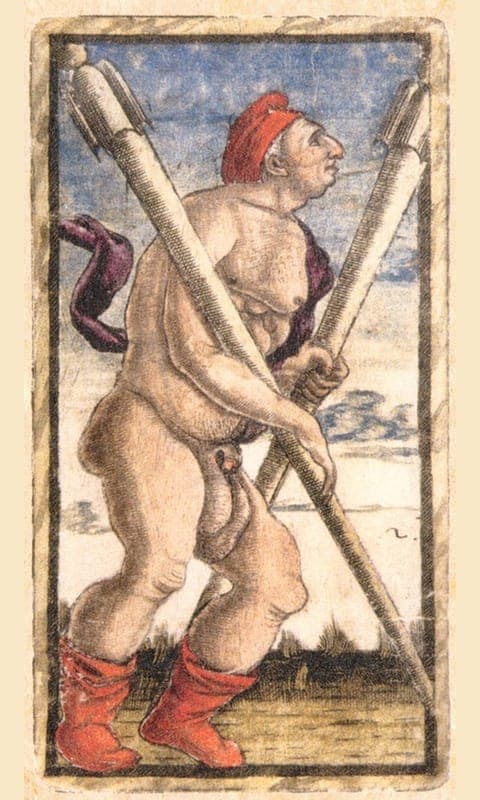
A naked man in a red cap and red boots walks holding two long crossed staves, a purple cloth flying behind him. He has a large swelling at the groin, and grass grows on the ground behind him. A small numeral 2 is at the right.
Soimoi
Mike Koz, 2025
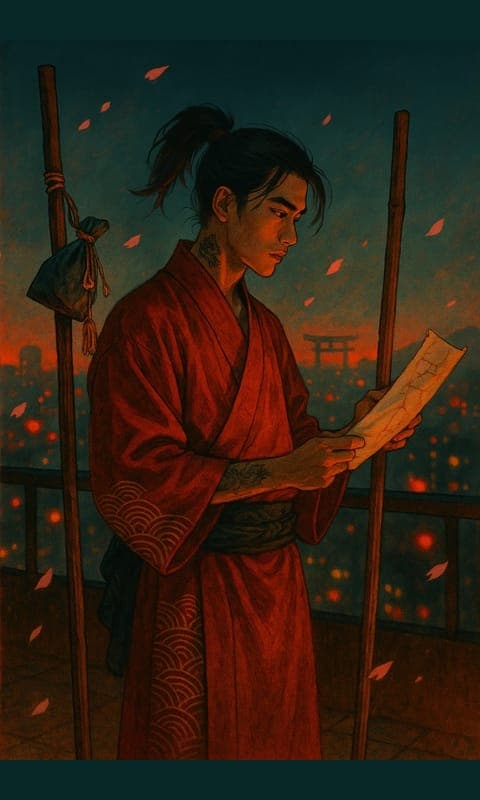
A young man with his hair in a ponytail and a tattoo on his neck stands on a balcony in a red kimono patterned with waves, studying an unrolled map. Two tall wooden staffs stand at either side, one with a small cloth pouch tied to it. Petals drift past, and a torii is silhouetted against a red evening sky above the city lights.