Six of Swords in 6 decks
The same card as 6 decks draw it, five and a half centuries apart. What stays the same is the card’s core; what changes is where a reading can find something new. The meanings are written for the Rider–Waite–Smith picture; the descriptions here are of each deck’s own. Not in Oswald Wirth, which has no Six of Swords card.
Side by side
Choose any two decks and read the pictures against each other.
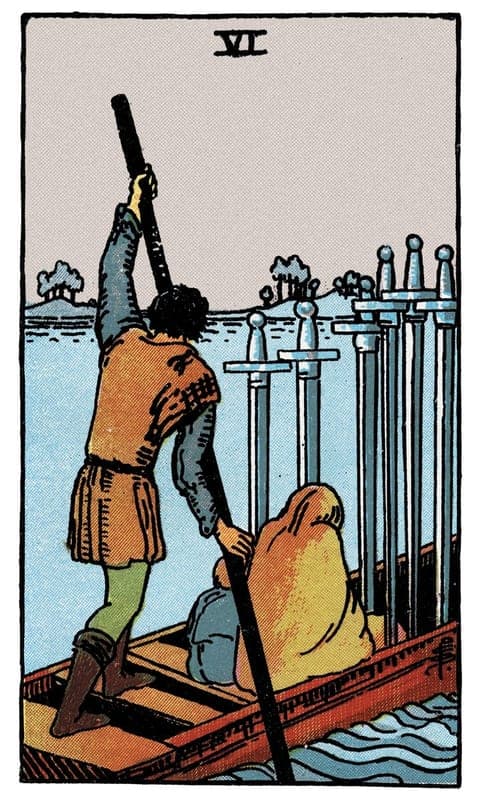
Pamela Colman Smith, 1909
A ferryman poles a boat across grey water carrying a cloaked woman and a child, who sit with their backs to the viewer. Six swords stand upright in the boat in front of them. The water on the near side is choppy; on the far side, toward a wooded shore, it lies smooth.
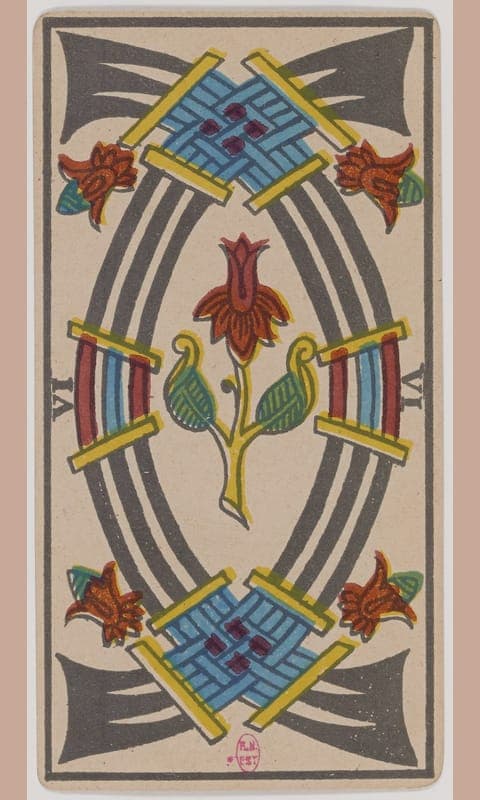
Lequart, Paris, 19th century
Six curved grey blades form a triple oval, crossing at top and bottom in blue weaves with red diamonds and bound at the sides by red and blue bands. A red flower on a yellow stem with two green leaves stands in the centre. Red flowers fill the corners. Numeral VI at both sides.
Marseille number cards are read through their number and suit; the written meaning here gives the scene the Rider-Waite-Smith card adds.
Rider–Waite–Smith
Pamela Colman Smith, 1909
A ferryman poles a boat across grey water carrying a cloaked woman and a child, who sit with their backs to the viewer. Six swords stand upright in the boat in front of them. The water on the near side is choppy; on the far side, toward a wooded shore, it lies smooth.
Tarot de Marseille
Lequart, Paris, 19th century
Six curved grey blades form a triple oval, crossing at top and bottom in blue weaves with red diamonds and bound at the sides by red and blue bands. A red flower on a yellow stem with two green leaves stands in the centre. Red flowers fill the corners. Numeral VI at both sides.
Marseille number cards are read through their number and suit; the written meaning here gives the scene the Rider-Waite-Smith card adds.
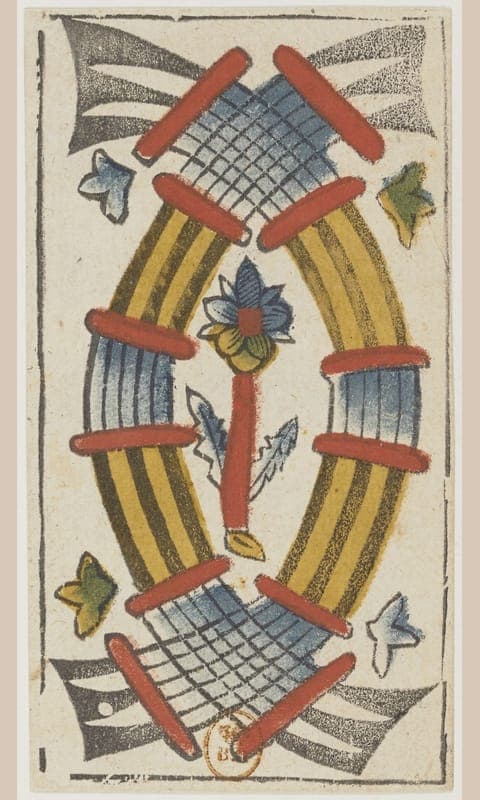
Tarot de Viéville
Jacques Viéville, c. 1650
Six curved blades, three on each side, form a striped yellow and grey oval interlaced at top and bottom. A blue and yellow flower on a red stem with two grey leaves stands at the centre, and small flowers fill the corners.
Viéville number cards show only their suit symbols; read them through number and suit, with the written meaning as a guide.
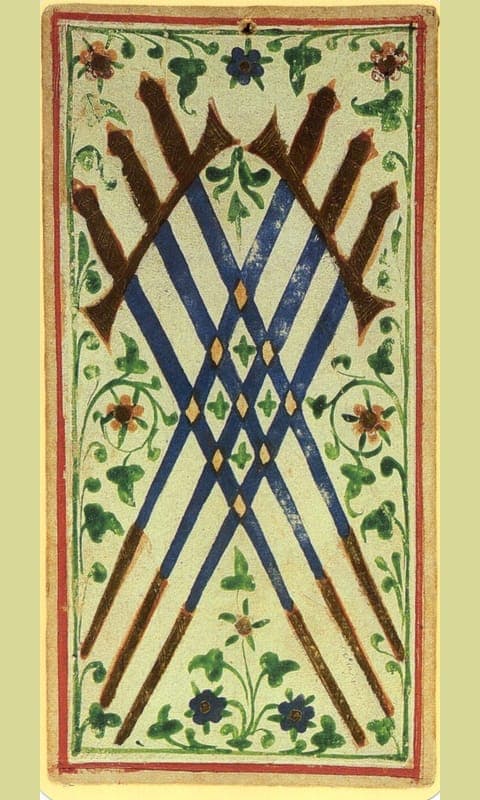
Visconti-Sforza
Bonifacio Bembo, c. 1450
Six swords cross three by three, their brown hilts meeting in two arches at the top and their blue blades forming a diamond lattice with small gold lozenges at the crossings. The points, shaded brown, splay out below. There is no ribbon; green vines and a few flowers edge the cream ground.
In the Visconti-Sforza deck the number cards show only their suit symbols, and the trumps are unnamed and unnumbered.
Sola Busca
c. 1491
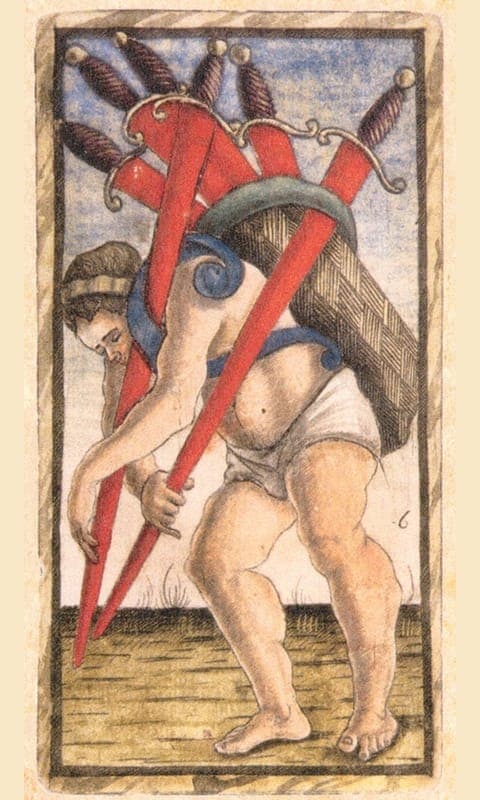
A heavy man with a headband and a white loincloth stoops forward, a wicker basket of swords on his back held by a blue strap. He grips two long red swords that point down to the ground. The numeral 6 is at the right.
Soimoi
Mike Koz, 2025
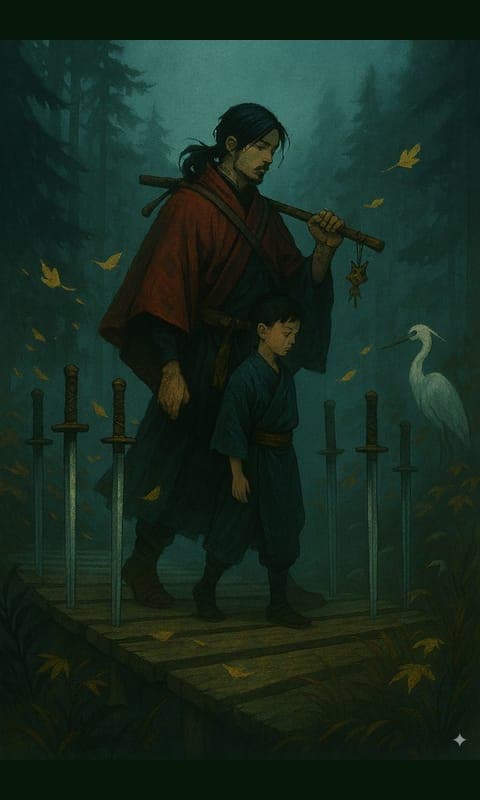
A long-haired man in a red cloak, carrying a pole over his shoulder with a small charm hanging from it, walks with a boy in dark blue across a wooden boardwalk in a misty forest. Six upright swords stand along the edges, three on each side of the path. A white heron stands at right and yellow leaves drift through the gloom.