Five of Swords in 6 decks
The same card as 6 decks draw it, five and a half centuries apart. What stays the same is the card’s core; what changes is where a reading can find something new. The meanings are written for the Rider–Waite–Smith picture; the descriptions here are of each deck’s own. Not in Oswald Wirth, which has no Five of Swords card.
Side by side
Choose any two decks and read the pictures against each other.
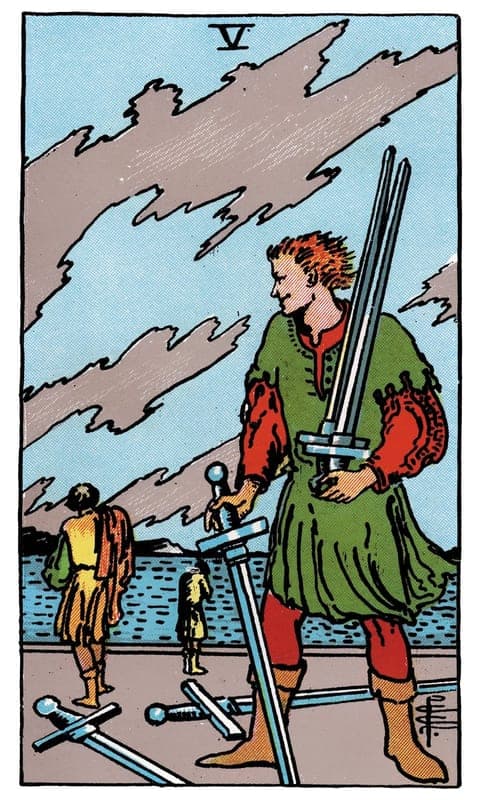
Pamela Colman Smith, 1909
A man with a smirk gathers up three swords while two more lie at his feet, and two other figures walk away from him toward the water with their backs bowed. The sky is streaked with ragged clouds. He has won and he is alone with his swords.
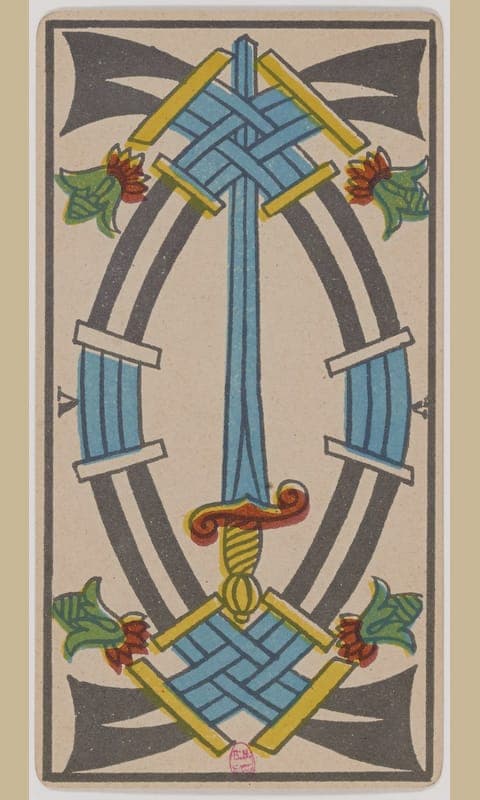
Lequart, Paris, 19th century
Four curved grey blades form a double oval with blue woven crossings at top and bottom. A straight blue sword stands upright in the centre, its point running up through the top weave and its yellow grip with a red guard near the bottom. Small flowers sit in the corners. A small V shows at each side.
Marseille number cards are read through their number and suit; the written meaning here gives the scene the Rider-Waite-Smith card adds.
Rider–Waite–Smith
Pamela Colman Smith, 1909
A man with a smirk gathers up three swords while two more lie at his feet, and two other figures walk away from him toward the water with their backs bowed. The sky is streaked with ragged clouds. He has won and he is alone with his swords.
Tarot de Marseille
Lequart, Paris, 19th century
Four curved grey blades form a double oval with blue woven crossings at top and bottom. A straight blue sword stands upright in the centre, its point running up through the top weave and its yellow grip with a red guard near the bottom. Small flowers sit in the corners. A small V shows at each side.
Marseille number cards are read through their number and suit; the written meaning here gives the scene the Rider-Waite-Smith card adds.
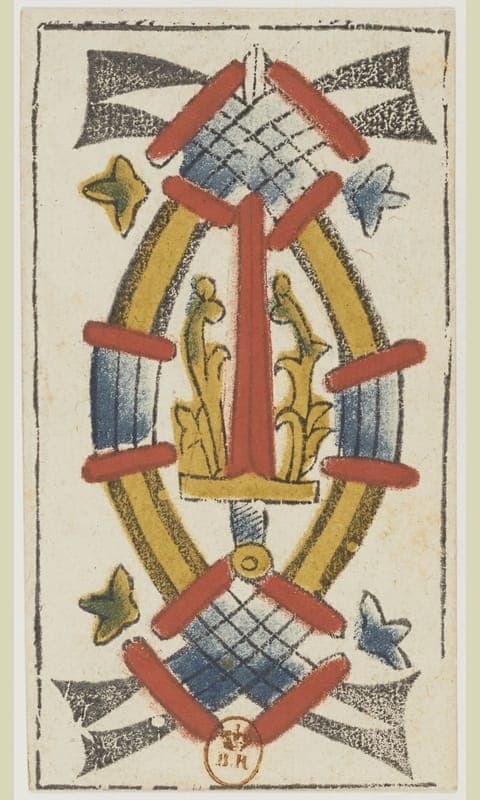
Tarot de Viéville
Jacques Viéville, c. 1650
Four curved swords, grey and yellow with red bands, form an oval interlaced at top and bottom. A fifth straight sword with a red blade stands upright in the centre between two yellow plant sprigs, with small flowers in the corners.
Viéville number cards show only their suit symbols; read them through number and suit, with the written meaning as a guide.
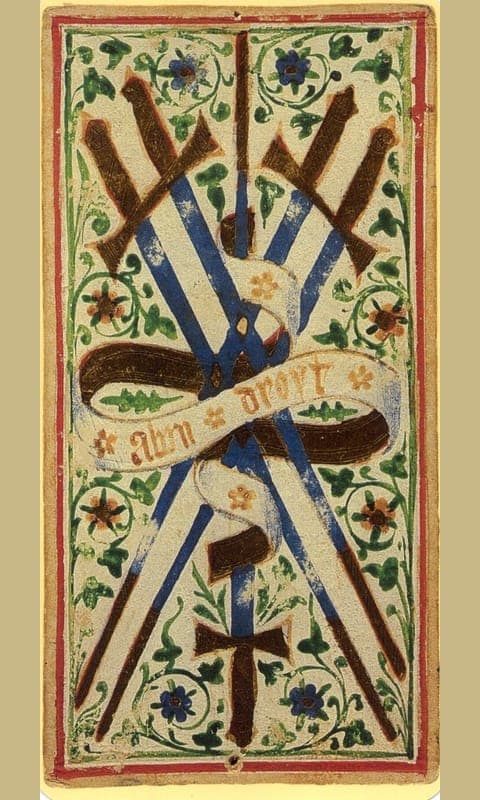
Visconti-Sforza
Bonifacio Bembo, c. 1450
Four swords cross in two pairs with hilts at the top, and a fifth runs straight down the centre with its hilt at the bottom. Their blades are blue shading to brown. A gold and white ribbon lettered 'abon droyt' curls through them, and green vines with flowers fill the ground.
In the Visconti-Sforza deck the number cards show only their suit symbols, and the trumps are unnamed and unnumbered.
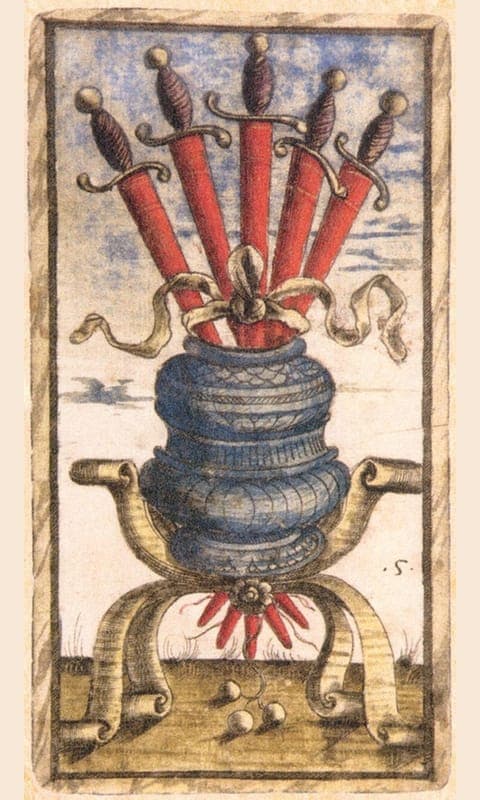
Sola Busca
c. 1491
Five red swords stand upright in a ribbed blue vessel tied with a pale ribbon. The vessel rests on a scrolled stand with red flames burning beneath it, and three small balls lie on the ground. The numeral 5 is at the right.
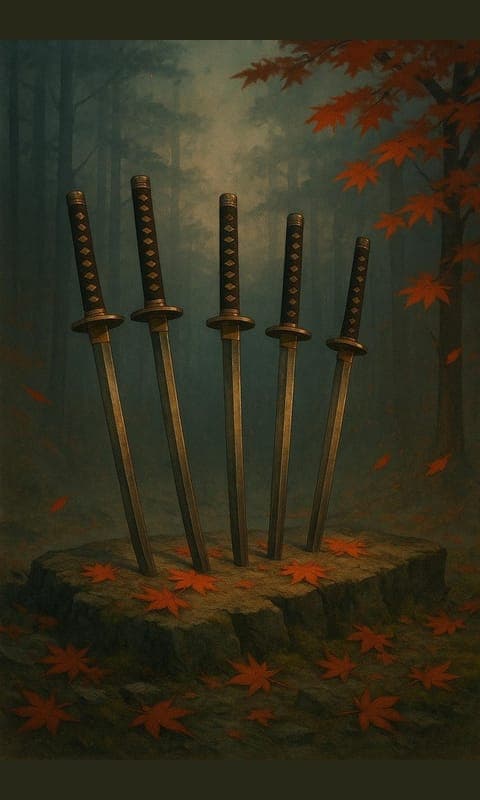
Soimoi
Mike Koz, 2025
Five swords with dark diamond-wrapped hilts and round guards stand point down in a flat mossy rock, splayed slightly like a fan. No figure appears. A misty forest of tall trunks fills the background, and a red maple tree at right sheds leaves over the rock and the ground.