Four of Swords in 6 decks
The same card as 6 decks draw it, five and a half centuries apart. What stays the same is the card’s core; what changes is where a reading can find something new. The meanings are written for the Rider–Waite–Smith picture; the descriptions here are of each deck’s own. Not in Oswald Wirth, which has no Four of Swords card.
Side by side
Choose any two decks and read the pictures against each other.
Pamela Colman Smith, 1909
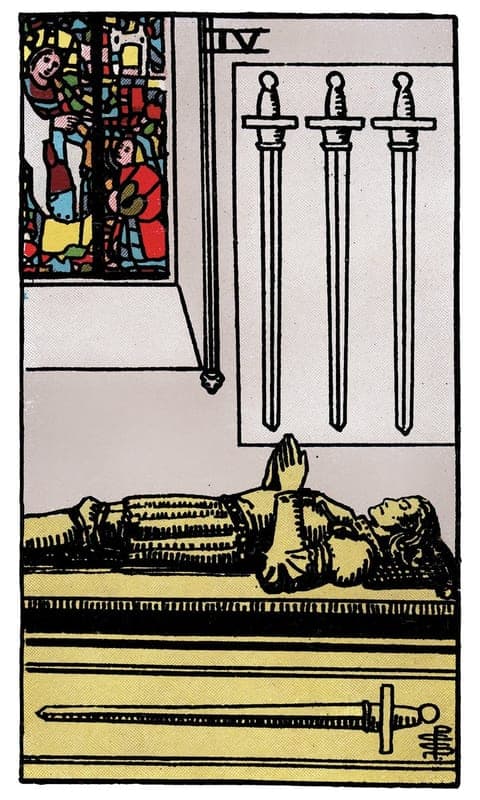
A knight lies at full length on a stone tomb in a church, hands pressed together in prayer, with three swords hanging on the wall above him and a fourth carved along the side of the tomb. A stained glass window shows a figure blessing a kneeling child. The light is dim and the room is utterly still.
Lequart, Paris, 19th century
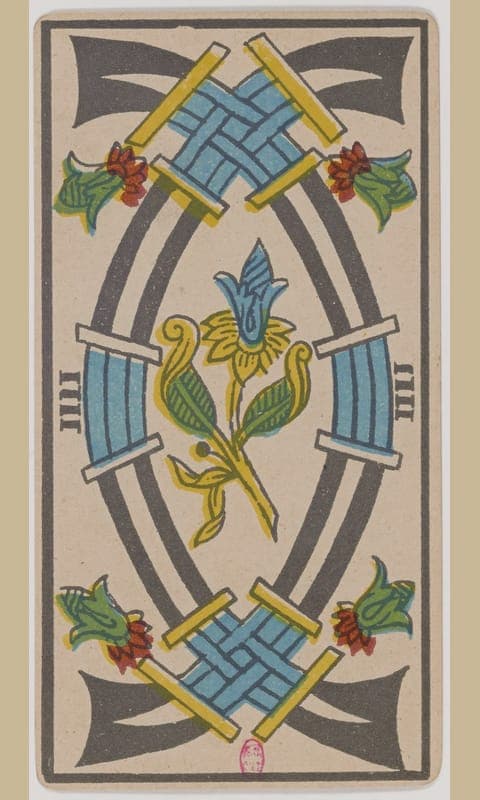
Four curved grey blades bow out into a double oval, their crossings at top and bottom woven together in blue with yellow crossguards. In the centre stands a blue flower on a yellow stem with two green leaves. Small green and red flowers fill the corners. Numeral IIII at both sides.
Marseille number cards are read through their number and suit; the written meaning here gives the scene the Rider-Waite-Smith card adds.
Rider–Waite–Smith
Pamela Colman Smith, 1909
A knight lies at full length on a stone tomb in a church, hands pressed together in prayer, with three swords hanging on the wall above him and a fourth carved along the side of the tomb. A stained glass window shows a figure blessing a kneeling child. The light is dim and the room is utterly still.
Tarot de Marseille
Lequart, Paris, 19th century
Four curved grey blades bow out into a double oval, their crossings at top and bottom woven together in blue with yellow crossguards. In the centre stands a blue flower on a yellow stem with two green leaves. Small green and red flowers fill the corners. Numeral IIII at both sides.
Marseille number cards are read through their number and suit; the written meaning here gives the scene the Rider-Waite-Smith card adds.
Tarot de Viéville
Jacques Viéville, c. 1650
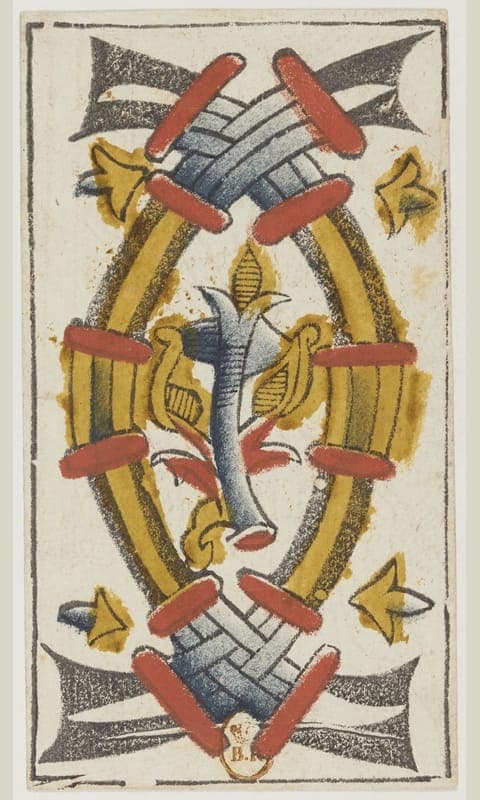
Four curved swords form an oval in two crossing pairs, their red-banded blades woven together at top and bottom. A grey branch with yellow leaves and red sprigs grows at the centre, and small yellow flowers sit in the corners.
Viéville number cards show only their suit symbols; read them through number and suit, with the written meaning as a guide.
Visconti-Sforza
Bonifacio Bembo, c. 1450
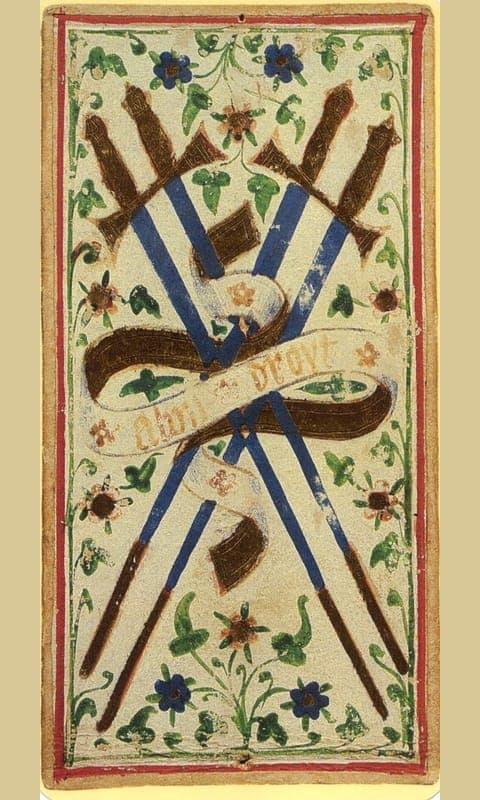
Four swords with brown hilts cross in two pairs, hilts at the top and blue blades turning brown towards the points below. A gold and white ribbon lettered 'abon droyt' winds through the centre. Leafy sprigs with blue and orange flowers fill the cream ground inside a red border.
In the Visconti-Sforza deck the number cards show only their suit symbols, and the trumps are unnamed and unnumbered.
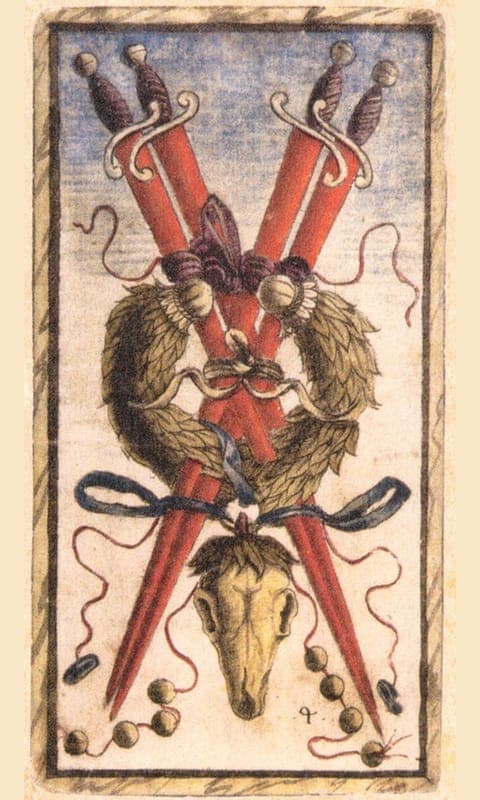
Sola Busca
c. 1491
Four red swords cross in an X, tied at the centre and set in a laurel wreath with a blue ribbon. An animal's skull hangs below, and strings of beads and red cords trail around it. The small numeral 4 is near the bottom.

Soimoi
Mike Koz, 2025
A long-haired man in a red kimono, with tattoos on his chest and arm, sits on a stone bench beneath a tree, eyes closed and head bowed. A sheathed sword lies across his lap, and three more swords lean against the bench beside him. Red maple leaves fall on the paving, and a torii, a pine and a lit lantern stand against the night city behind.