Seven of Swords in 6 decks
The same card as 6 decks draw it, five and a half centuries apart. What stays the same is the card’s core; what changes is where a reading can find something new. The meanings are written for the Rider–Waite–Smith picture; the descriptions here are of each deck’s own. Not in Oswald Wirth, which has no Seven of Swords card.
Side by side
Choose any two decks and read the pictures against each other.
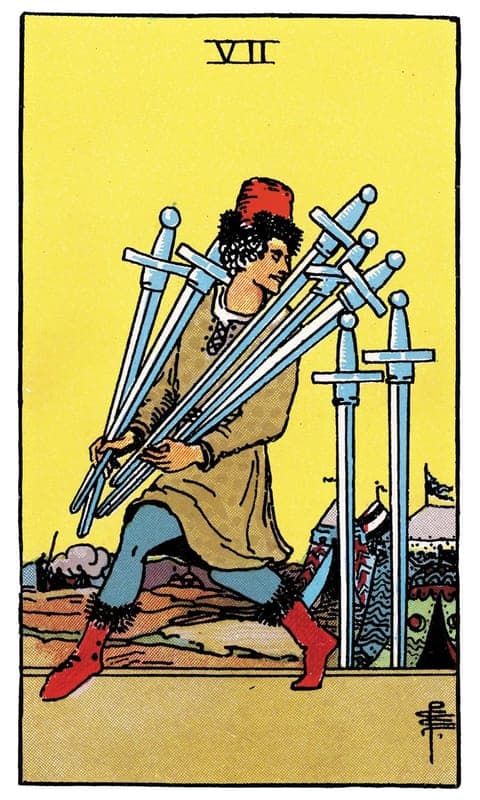
Pamela Colman Smith, 1909
A man tiptoes away from a camp of bright tents carrying five swords awkwardly in his arms, looking back over his shoulder with a sly smile. Two swords remain stuck in the ground behind him. In the distance a small group of soldiers has not yet noticed.
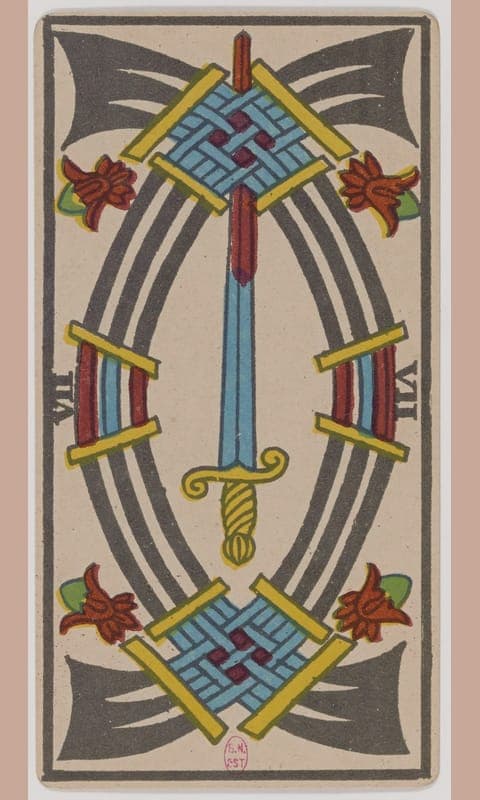
Lequart, Paris, 19th century
Six curved grey blades form a triple oval with woven blue crossings marked by red diamonds. A straight blue sword with a red tip stands point up in the centre, its yellow crossguard curling. Red flowers sit in the corners. The numeral VII is printed at both sides.
Marseille number cards are read through their number and suit; the written meaning here gives the scene the Rider-Waite-Smith card adds.
Rider–Waite–Smith
Pamela Colman Smith, 1909
A man tiptoes away from a camp of bright tents carrying five swords awkwardly in his arms, looking back over his shoulder with a sly smile. Two swords remain stuck in the ground behind him. In the distance a small group of soldiers has not yet noticed.
Tarot de Marseille
Lequart, Paris, 19th century
Six curved grey blades form a triple oval with woven blue crossings marked by red diamonds. A straight blue sword with a red tip stands point up in the centre, its yellow crossguard curling. Red flowers sit in the corners. The numeral VII is printed at both sides.
Marseille number cards are read through their number and suit; the written meaning here gives the scene the Rider-Waite-Smith card adds.
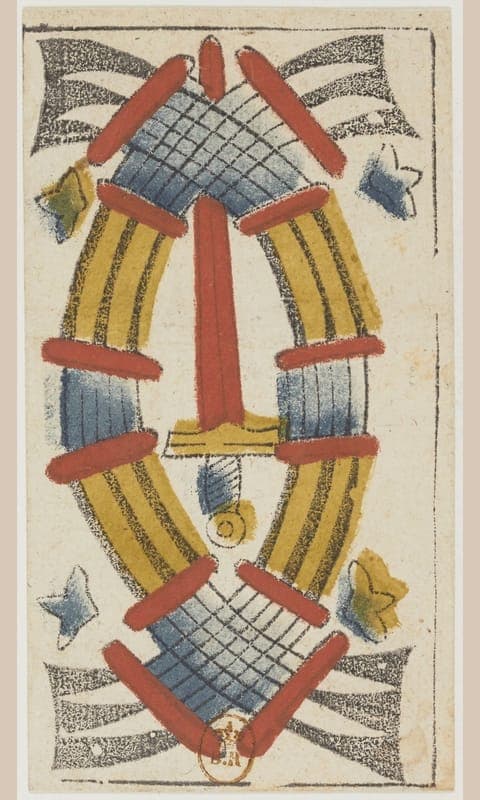
Tarot de Viéville
Jacques Viéville, c. 1650
Six curved blades form a tall oval interlaced at top and bottom, and a seventh straight sword with a red blade stands upright in the middle. Small grey and yellow star-like flowers sit in the corners.
Viéville number cards show only their suit symbols; read them through number and suit, with the written meaning as a guide.
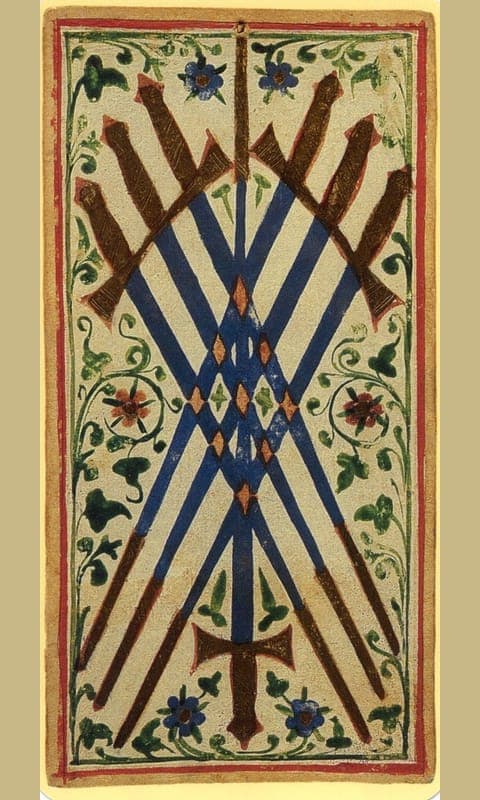
Visconti-Sforza
Bonifacio Bembo, c. 1450
Six swords cross three by three in an arched lattice, hilts at the top, with a seventh running up the centre from a hilt at the bottom. Orange and gold lozenges mark the crossings. Green vines with red and blue flowers run up the sides.
In the Visconti-Sforza deck the number cards show only their suit symbols, and the trumps are unnamed and unnumbered.
Sola Busca
c. 1491
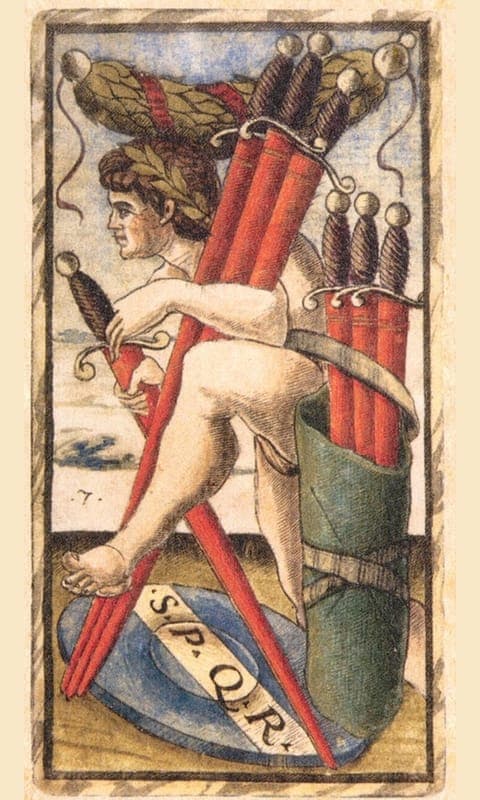
A naked youth crowned with laurel lifts one leg as he draws a sword from a bundle. Three swords stand in a green quiver beside him, a laurel garland hangs above, and a blue round shield on the ground carries a band lettered S.P.Q.R. The numeral 7 is at the left.
Soimoi
Mike Koz, 2025
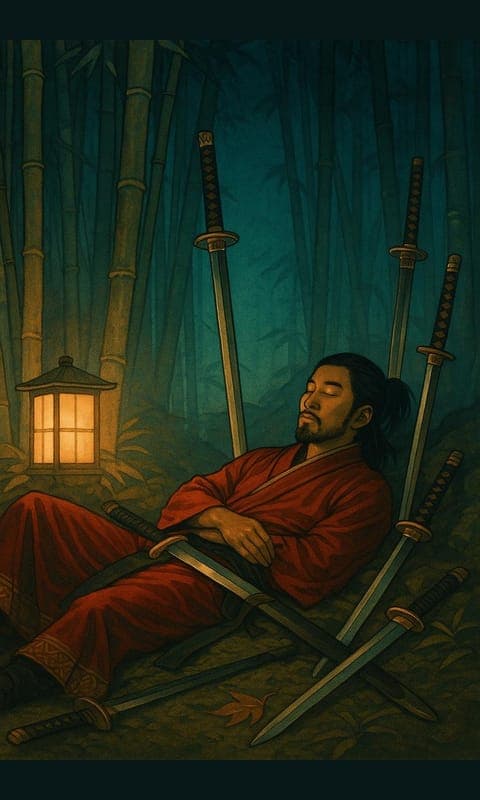
A bearded man with his hair tied back reclines against a slope in a bamboo forest at night, eyes closed and arms folded around a sword in his red kimono. Several more swords lie beside him and lean against the bank behind. A lit square lantern glows at left among the bamboo stalks.