Six of Cups in 6 decks
The same card as 6 decks draw it, five and a half centuries apart. What stays the same is the card’s core; what changes is where a reading can find something new. The meanings are written for the Rider–Waite–Smith picture; the descriptions here are of each deck’s own. Not in Oswald Wirth, which has no Six of Cups card.
Side by side
Choose any two decks and read the pictures against each other.
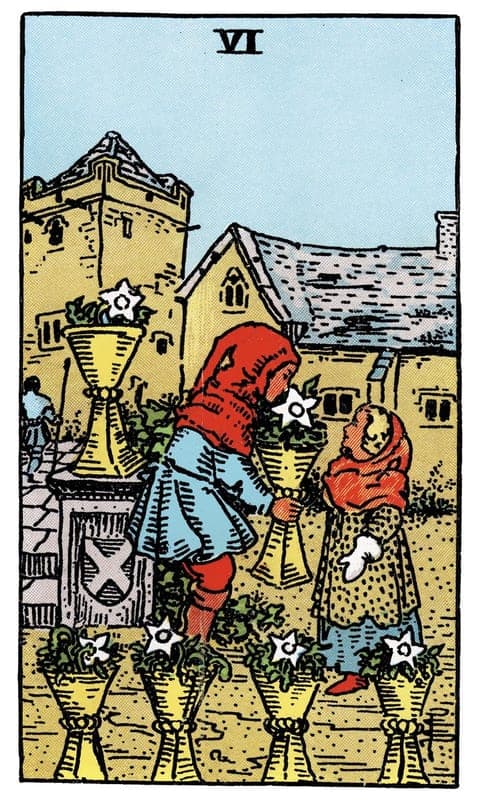
Pamela Colman Smith, 1909
In the courtyard of an old house, a larger child hands a cup filled with a white flower to a smaller one. Four more flower-filled cups stand around them and a sixth sits on a pedestal. The scene is golden and still, and a guard walks away in the background, leaving the children in peace.
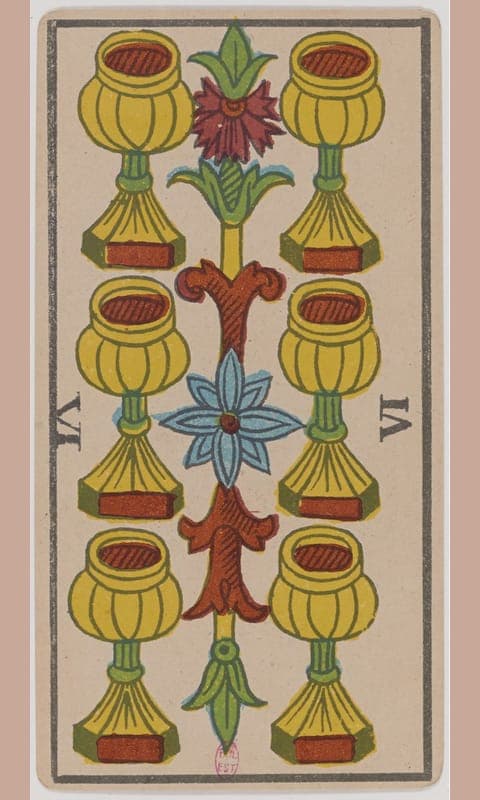
Lequart, Paris, 19th century
Six yellow goblets stand in two columns of three. Between them a single stem carries a red carnation at the top, red curling ornaments, and a pale blue star-shaped flower at the centre, ending in a green bud below. The numeral VI is printed at both sides.
Marseille number cards are read through their number and suit; the written meaning here gives the scene the Rider-Waite-Smith card adds.
Rider–Waite–Smith
Pamela Colman Smith, 1909
In the courtyard of an old house, a larger child hands a cup filled with a white flower to a smaller one. Four more flower-filled cups stand around them and a sixth sits on a pedestal. The scene is golden and still, and a guard walks away in the background, leaving the children in peace.
Tarot de Marseille
Lequart, Paris, 19th century
Six yellow goblets stand in two columns of three. Between them a single stem carries a red carnation at the top, red curling ornaments, and a pale blue star-shaped flower at the centre, ending in a green bud below. The numeral VI is printed at both sides.
Marseille number cards are read through their number and suit; the written meaning here gives the scene the Rider-Waite-Smith card adds.
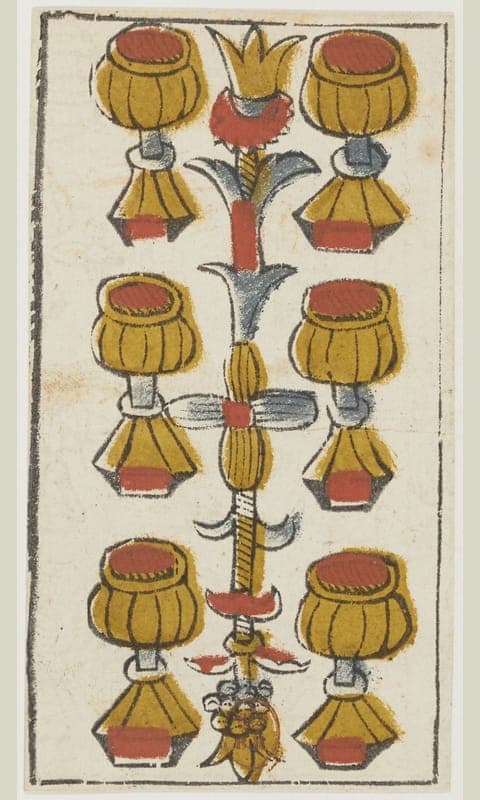
Tarot de Viéville
Jacques Viéville, c. 1650
Six cups stand in two columns of three beside a central stem. The stem carries a red and yellow flower at the top, grey leaves, a grey cross-shaped bloom halfway down and a small flower head at the bottom.
Viéville number cards show only their suit symbols; read them through number and suit, with the written meaning as a guide.
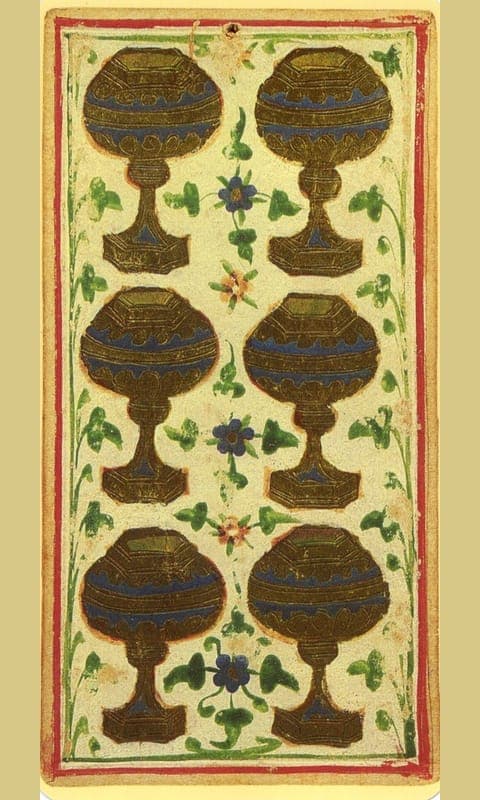
Visconti-Sforza
Bonifacio Bembo, c. 1450
Six gold goblets with blue bands stand in two columns of three. Between the columns a line of small blue and pale flowers on green stems runs down the centre. Green tendrils fill the side margins within a red border.
In the Visconti-Sforza deck the number cards show only their suit symbols, and the trumps are unnamed and unnumbered.
Sola Busca
c. 1491
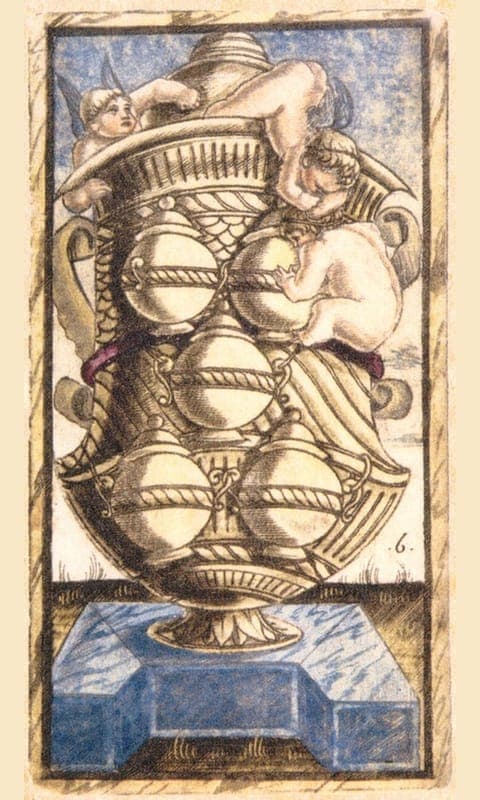
A huge ornate vessel on a blue stone base holds several round lidded jars bound with rope, showing through its open front. Three naked infants clamber over its rim and handles. The numeral 6 is at the right.
Soimoi
Mike Koz, 2025
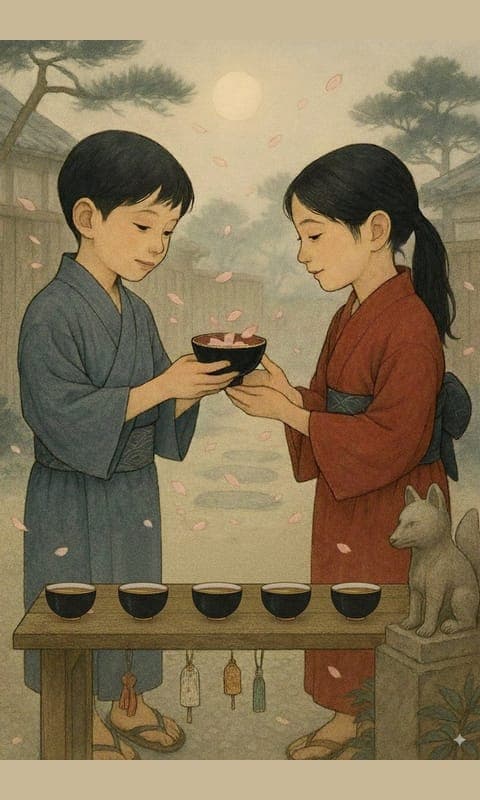
On a softly faded, sepia-toned card, a boy in a grey-blue kimono and a girl in a red kimono hand a bowl of blossom petals between them. Five dark bowls of liquid stand in a row on a wooden bench in front, with small charms hanging below it. A stone fox statue stands at right, and pine trees and a pale sun appear through the haze.