Five of Cups in 6 decks
The same card as 6 decks draw it, five and a half centuries apart. What stays the same is the card’s core; what changes is where a reading can find something new. The meanings are written for the Rider–Waite–Smith picture; the descriptions here are of each deck’s own. Not in Oswald Wirth, which has no Five of Cups card.
Side by side
Choose any two decks and read the pictures against each other.
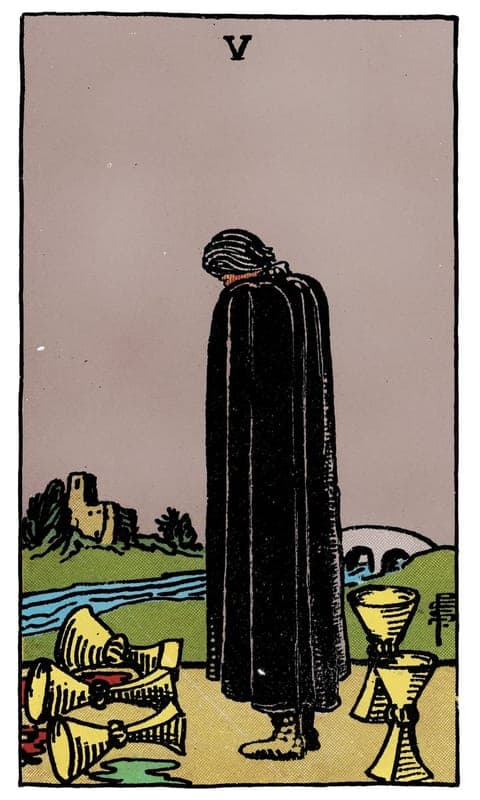
Pamela Colman Smith, 1909
A figure in a long black cloak stands with head bowed over three cups that have fallen and spilled. Behind them stand two cups still upright and full, which the figure does not turn to see. A river runs past, and a bridge leads across it to a small house in the distance.
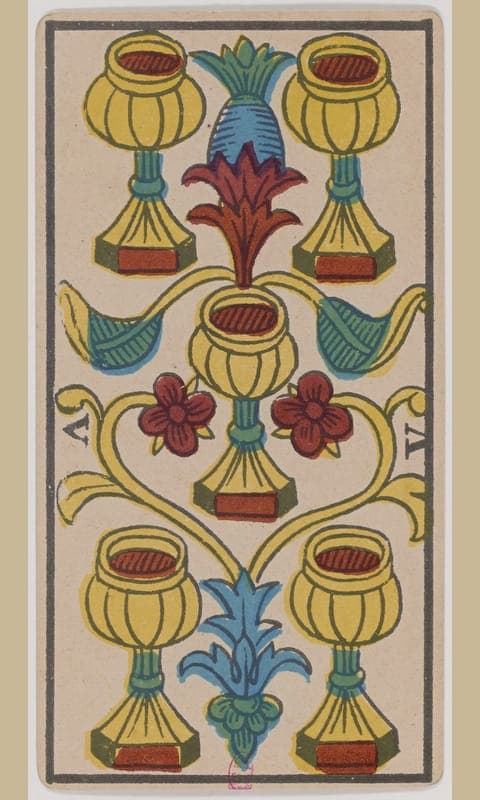
Lequart, Paris, 19th century
Four yellow goblets stand at the corners with a fifth in the centre. A blue cone-shaped flower over red leaves rises at the top, curling yellow stems carry two red rosettes beside the middle cup, and a blue plant grows at the bottom. The numeral V is printed at each side.
Marseille number cards are read through their number and suit; the written meaning here gives the scene the Rider-Waite-Smith card adds.
Rider–Waite–Smith
Pamela Colman Smith, 1909
A figure in a long black cloak stands with head bowed over three cups that have fallen and spilled. Behind them stand two cups still upright and full, which the figure does not turn to see. A river runs past, and a bridge leads across it to a small house in the distance.
Tarot de Marseille
Lequart, Paris, 19th century
Four yellow goblets stand at the corners with a fifth in the centre. A blue cone-shaped flower over red leaves rises at the top, curling yellow stems carry two red rosettes beside the middle cup, and a blue plant grows at the bottom. The numeral V is printed at each side.
Marseille number cards are read through their number and suit; the written meaning here gives the scene the Rider-Waite-Smith card adds.
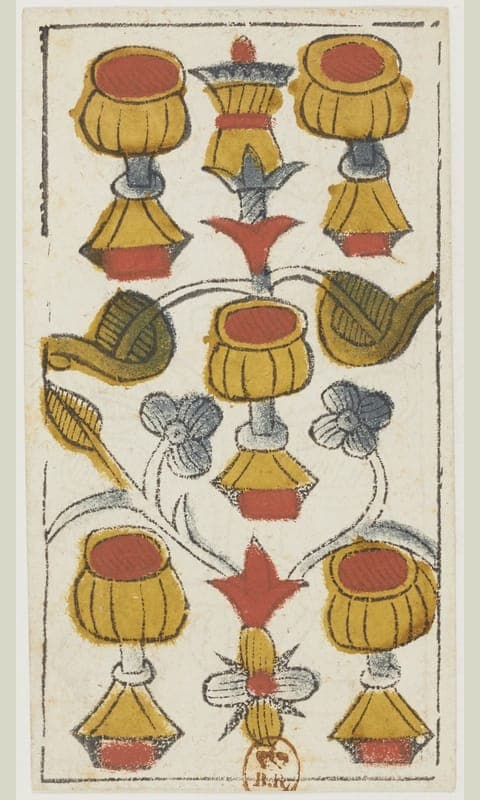
Tarot de Viéville
Jacques Viéville, c. 1650
Five cups: one in each corner and one in the centre. A crowned vase-like flower rises at the top between the upper pair, and leafy sprays, blue flowers and a red bloom at the bottom fill the space around the middle cup.
Viéville number cards show only their suit symbols; read them through number and suit, with the written meaning as a guide.
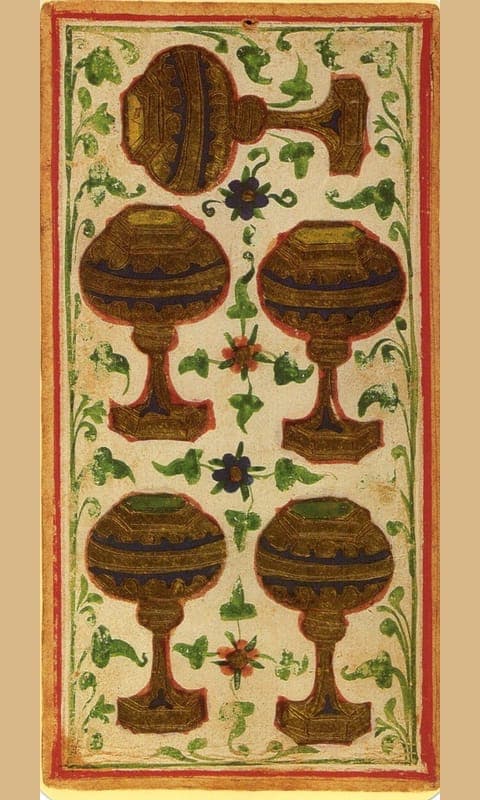
Visconti-Sforza
Bonifacio Bembo, c. 1450
Five gold goblets with blue bands: one lies on its side at the top, its foot to the right, and four stand below in two pairs. Small flowers on green stems run down the centre between them. Green leafy tendrils edge the cream ground inside a red border.
In the Visconti-Sforza deck the number cards show only their suit symbols, and the trumps are unnamed and unnumbered.
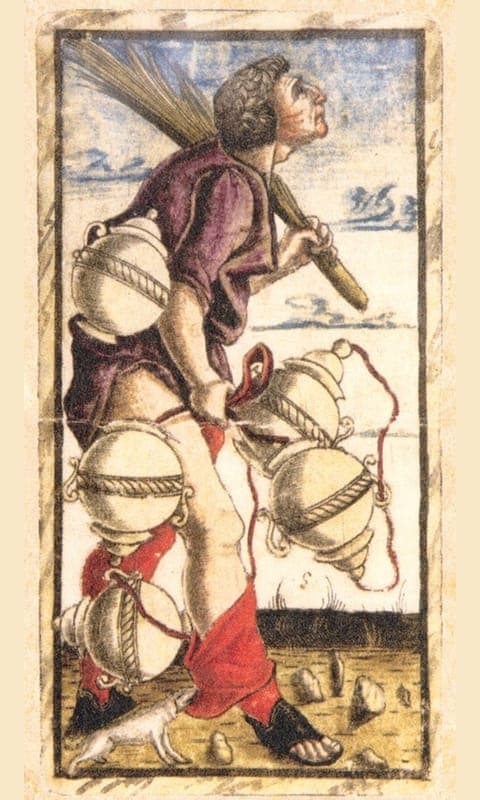
Sola Busca
c. 1491
A man in a purple tunic and red leggings looks up as he walks, a broom of twigs over his shoulder and five round lidded vessels slung around him on red cords. A small white dog follows at his heels over rocky ground. The numeral 5 is near the centre.

Soimoi
Mike Koz, 2025
A young man in a dark kimono sits slumped on a wooden bench in a night garden, his cheek resting on one hand and a short stick in the other, eyes closed. Three cups stand on the ground at his feet. At right a glowing white crane holds out a fourth, luminous cup toward him from beside a tree, while autumn leaves fall and a stone lantern glows at left.