Seven of Cups in 6 decks
The same card as 6 decks draw it, five and a half centuries apart. What stays the same is the card’s core; what changes is where a reading can find something new. The meanings are written for the Rider–Waite–Smith picture; the descriptions here are of each deck’s own. Not in Oswald Wirth, which has no Seven of Cups card.
Side by side
Choose any two decks and read the pictures against each other.
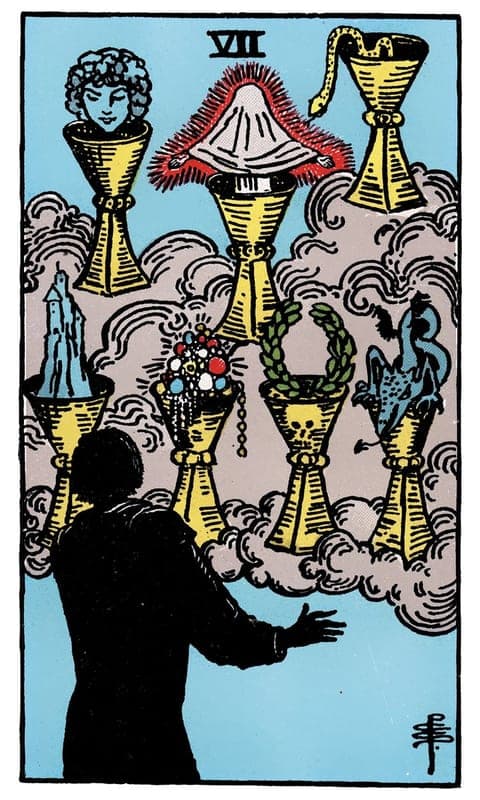
Pamela Colman Smith, 1909
A dark silhouetted figure stands before seven cups floating in a cloud. Each cup holds something different: a head, a veiled glowing figure, a serpent, a castle, jewels, a laurel wreath, and a dragon. The figure's arm is raised, uncertain which to reach for, and none of the prizes can be held while they remain in the cloud.
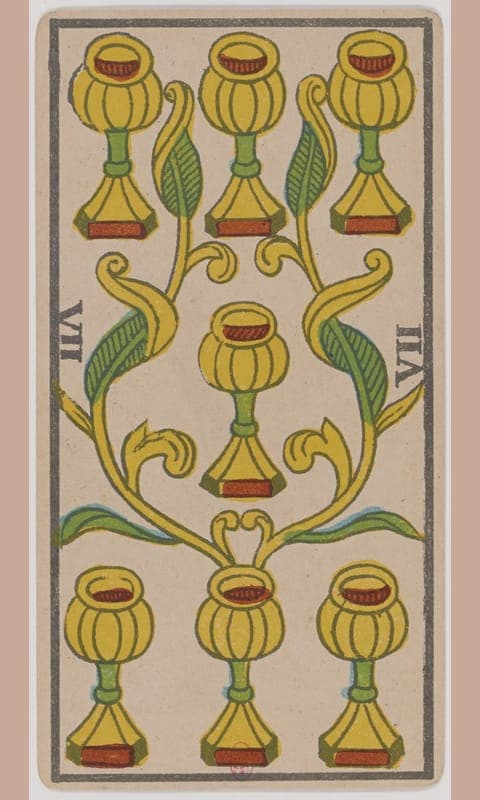
Lequart, Paris, 19th century
Seven yellow goblets are set three across the top, one in the middle and three across the bottom. Curling yellow stems with green leaves wind up from the bottom row around the central cup. The numeral VII is printed at each side.
Marseille number cards are read through their number and suit; the written meaning here gives the scene the Rider-Waite-Smith card adds.
Rider–Waite–Smith
Pamela Colman Smith, 1909
A dark silhouetted figure stands before seven cups floating in a cloud. Each cup holds something different: a head, a veiled glowing figure, a serpent, a castle, jewels, a laurel wreath, and a dragon. The figure's arm is raised, uncertain which to reach for, and none of the prizes can be held while they remain in the cloud.
Tarot de Marseille
Lequart, Paris, 19th century
Seven yellow goblets are set three across the top, one in the middle and three across the bottom. Curling yellow stems with green leaves wind up from the bottom row around the central cup. The numeral VII is printed at each side.
Marseille number cards are read through their number and suit; the written meaning here gives the scene the Rider-Waite-Smith card adds.
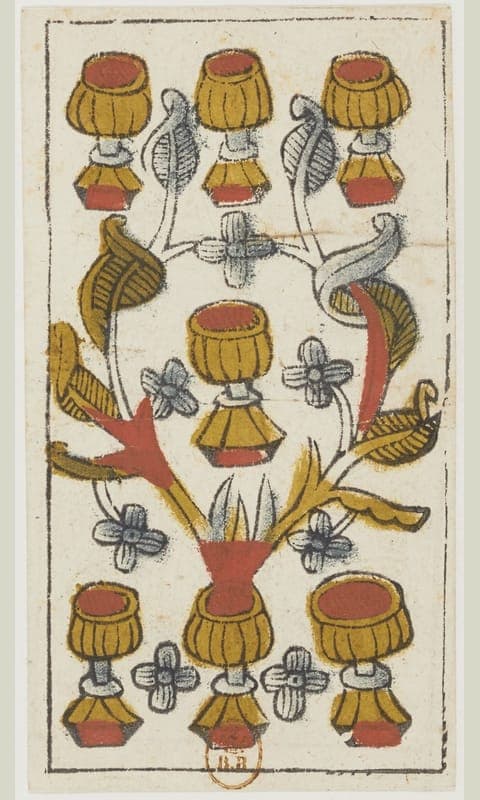
Tarot de Viéville
Jacques Viéville, c. 1650
Seven cups: three across the top, three across the bottom and one in the middle. Curving stems with yellow and grey leaves, a red flower and small blue blossoms grow up from a red vase-like base between them.
Viéville number cards show only their suit symbols; read them through number and suit, with the written meaning as a guide.
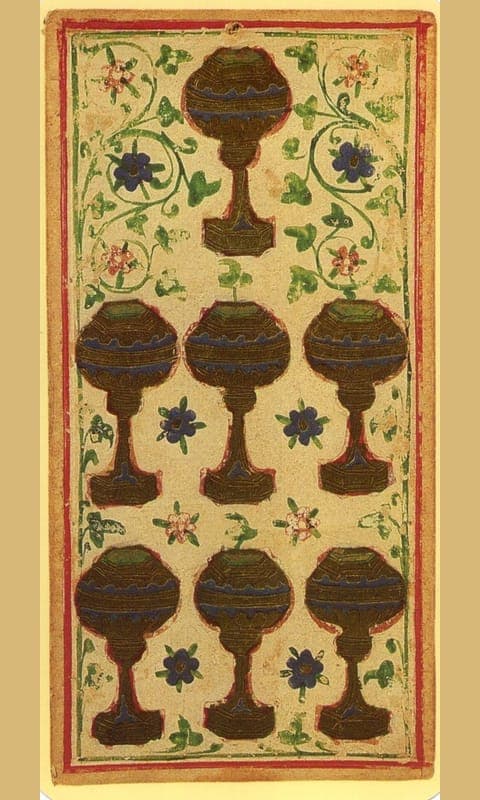
Visconti-Sforza
Bonifacio Bembo, c. 1450
Seven gold goblets with blue bands: one stands alone at the top, with two rows of three beneath. Blue and pink flowers sit between the lower cups, and green vines with flowers curl round the upper part of the card. The border is red.
In the Visconti-Sforza deck the number cards show only their suit symbols, and the trumps are unnamed and unnumbered.
Sola Busca
c. 1491
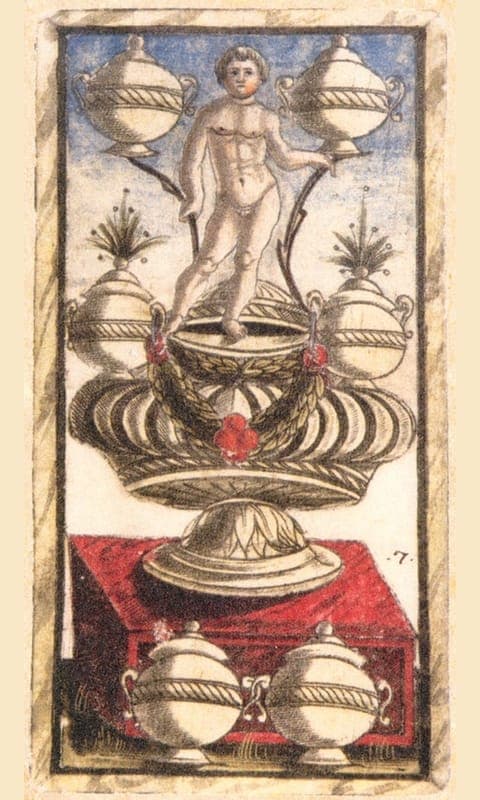
A naked boy stands in a wide fluted bowl on a stand, holding up two branches that each bear a lidded jar. Two more jars with sprays of leaves stand at his sides and two lie in front of a red box below. A laurel garland with a red flower hangs from the bowl, and the numeral 7 is at the right.

Soimoi
Mike Koz, 2025
In a bamboo grove at dusk, a boy in a red kimono with a short ponytail and a girl in an orange flowered kimono kneel facing each other on the grass. She holds out a small green cup and he reaches toward it. Six more green cups stand in a cluster on the ground before them, a pale fox sits at right, and pink petals drift down.