Two of Pentacles in 6 decks
The same card as 6 decks draw it, five and a half centuries apart. What stays the same is the card’s core; what changes is where a reading can find something new. The meanings are written for the Rider–Waite–Smith picture; the descriptions here are of each deck’s own. Not in Oswald Wirth, which has no Two of Pentacles card.
Side by side
Choose any two decks and read the pictures against each other.
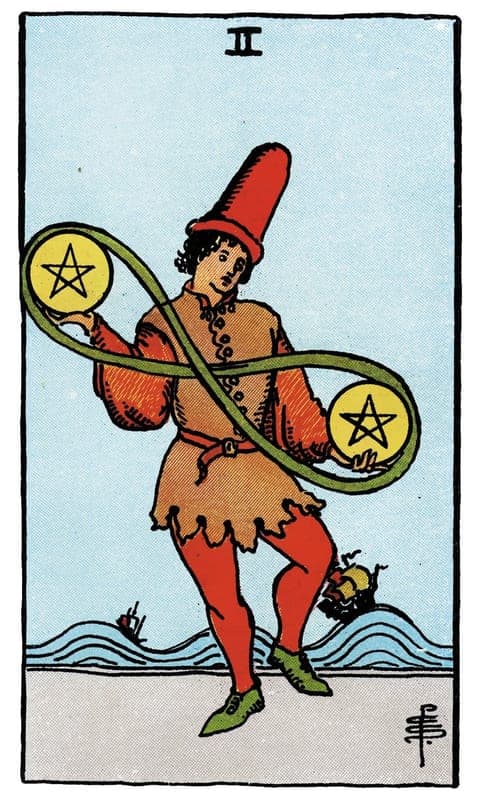
Pamela Colman Smith, 1909
A young man in a tall red hat dances on one foot while juggling two coins joined by a green ribbon in the shape of a figure eight. Behind him, two ships ride high waves on a rough sea. He is smiling; the sea is not calm.
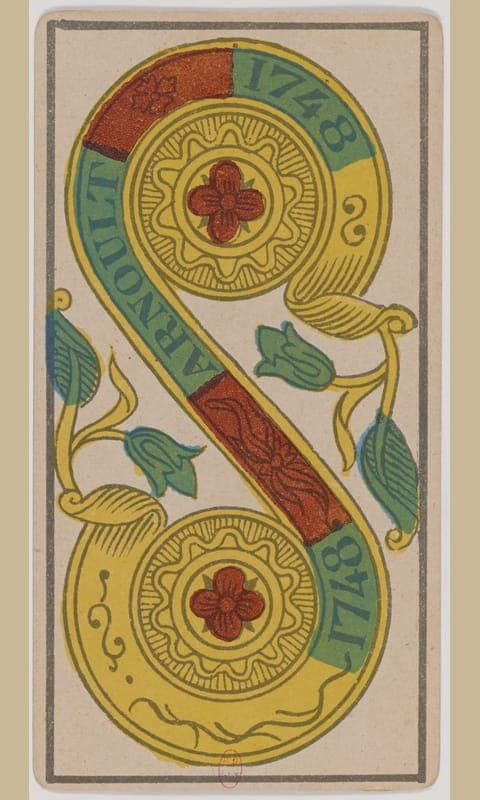
Lequart, Paris, 19th century
Two coins, each with a red four-petal flower, are linked by a long S-shaped band of yellow, green and red. The band carries the name ARNOULT and the date 1748 near the top, with 1748 repeated upside down near the bottom. Green flowers on curling stems grow from the band's middle.
Marseille number cards are read through their number and suit; the written meaning here gives the scene the Rider-Waite-Smith card adds.
Rider–Waite–Smith
Pamela Colman Smith, 1909
A young man in a tall red hat dances on one foot while juggling two coins joined by a green ribbon in the shape of a figure eight. Behind him, two ships ride high waves on a rough sea. He is smiling; the sea is not calm.
Tarot de Marseille
Lequart, Paris, 19th century
Two coins, each with a red four-petal flower, are linked by a long S-shaped band of yellow, green and red. The band carries the name ARNOULT and the date 1748 near the top, with 1748 repeated upside down near the bottom. Green flowers on curling stems grow from the band's middle.
Marseille number cards are read through their number and suit; the written meaning here gives the scene the Rider-Waite-Smith card adds.
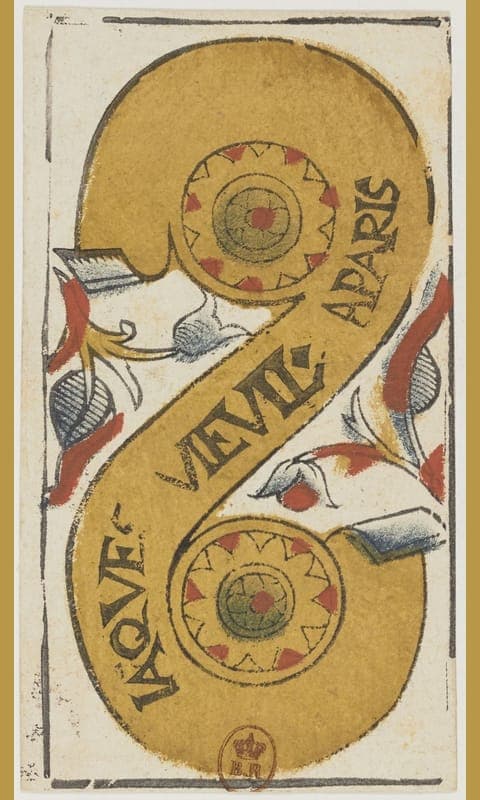
Tarot de Viéville
Jacques Viéville, c. 1650
Two coins with red-pointed rays sit in the loops of a broad yellow S-shaped band. The band is lettered IAQVES VIEVIL APARIS, and red, grey and yellow leaves curl in the gaps on either side.
Viéville number cards show only their suit symbols; read them through number and suit, with the written meaning as a guide.
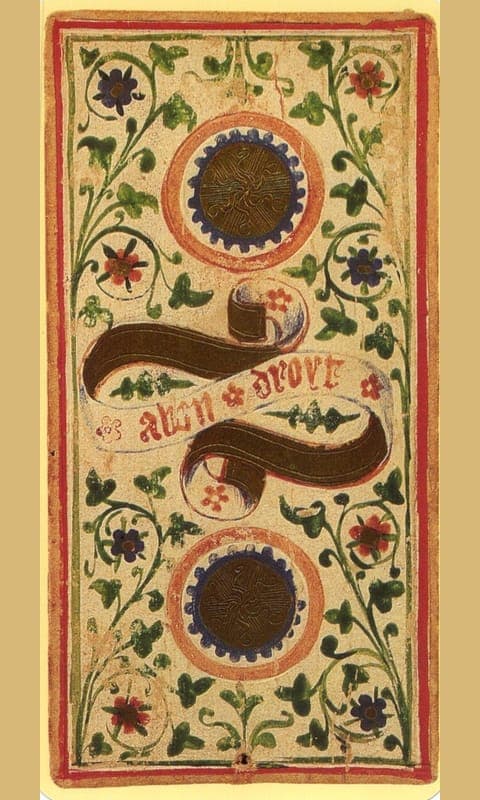
Visconti-Sforza
Bonifacio Bembo, c. 1450
Two gold coins, each set in a scalloped blue ring and an orange-red outer ring, sit one above the other. Between them a curled gold and white ribbon bears 'abon droyt' in red. Green vines with blue and red flowers fill the cream ground within a red border.
In the Visconti-Sforza deck the number cards show only their suit symbols, and the trumps are unnamed and unnumbered.
Sola Busca
c. 1491
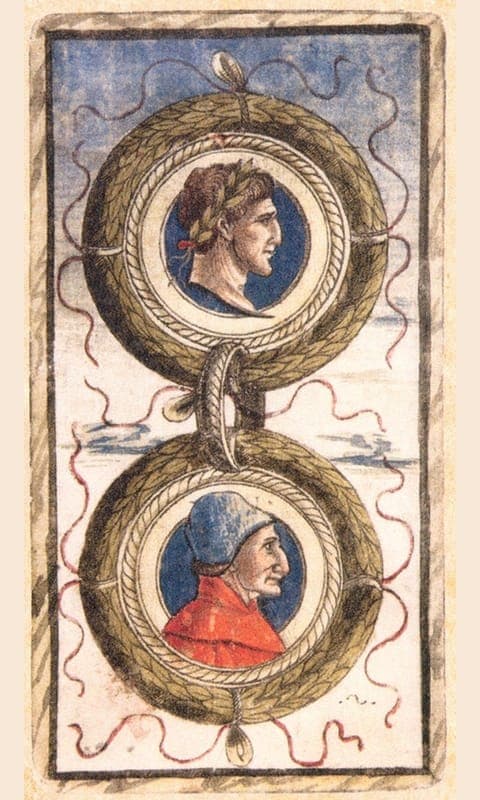
Two laurel-wreathed medallions are linked one above the other. The upper shows a laurel-crowned head in profile on blue, the lower an old man in a blue cap and red robe. Red ribbons wave on either side, and a small numeral 2 sits at the bottom right.

Soimoi
Mike Koz, 2025
A tattooed young man with his hair tied up walks forward in a red jacket and trousers with a black sash, balancing a gold coin on each raised hand. A red ribbon loops between the two coins, crossing in front of him like a figure of eight; each coin bears a three-comma swirl emblem. A tanuki sits at lower right and dim towers rise behind.