Three of Pentacles in 6 decks
The same card as 6 decks draw it, five and a half centuries apart. What stays the same is the card’s core; what changes is where a reading can find something new. The meanings are written for the Rider–Waite–Smith picture; the descriptions here are of each deck’s own. Not in Oswald Wirth, which has no Three of Pentacles card.
Side by side
Choose any two decks and read the pictures against each other.
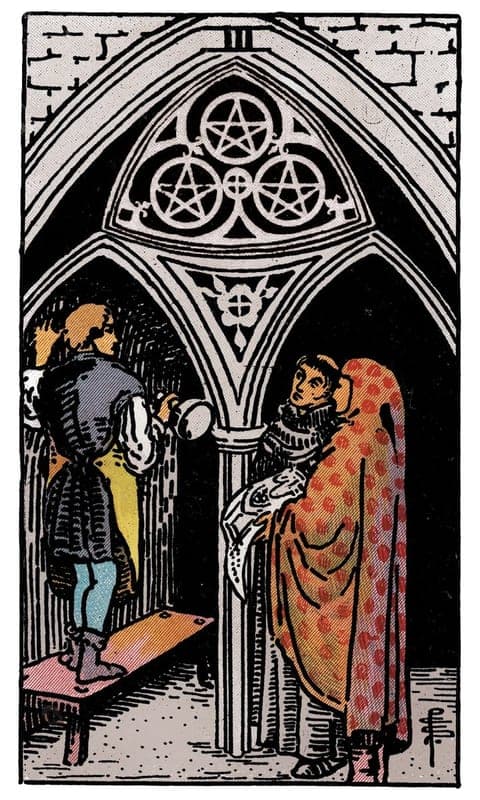
Pamela Colman Smith, 1909
A young stonemason stands on a bench in a church, chisel in hand, pausing to talk with a monk and a hooded figure who hold the architectural plans. Three pentacles are carved into the arch above them. The work is in progress and the three are looking at it together.
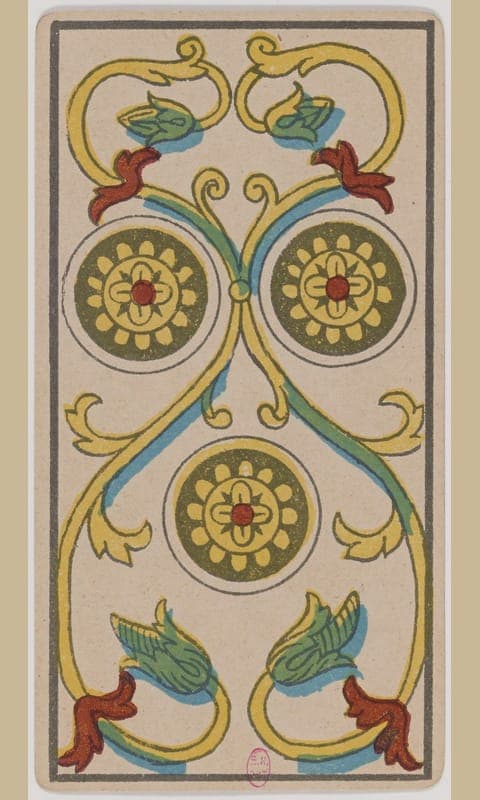
Lequart, Paris, 19th century
Three olive-green coins with yellow flower patterns and red centres are set two across the top and one below. Yellow stems shadowed in blue and green curl around them, ending in green buds and red flowers at the top and bottom corners.
Marseille number cards are read through their number and suit; the written meaning here gives the scene the Rider-Waite-Smith card adds.
Rider–Waite–Smith
Pamela Colman Smith, 1909
A young stonemason stands on a bench in a church, chisel in hand, pausing to talk with a monk and a hooded figure who hold the architectural plans. Three pentacles are carved into the arch above them. The work is in progress and the three are looking at it together.
Tarot de Marseille
Lequart, Paris, 19th century
Three olive-green coins with yellow flower patterns and red centres are set two across the top and one below. Yellow stems shadowed in blue and green curl around them, ending in green buds and red flowers at the top and bottom corners.
Marseille number cards are read through their number and suit; the written meaning here gives the scene the Rider-Waite-Smith card adds.
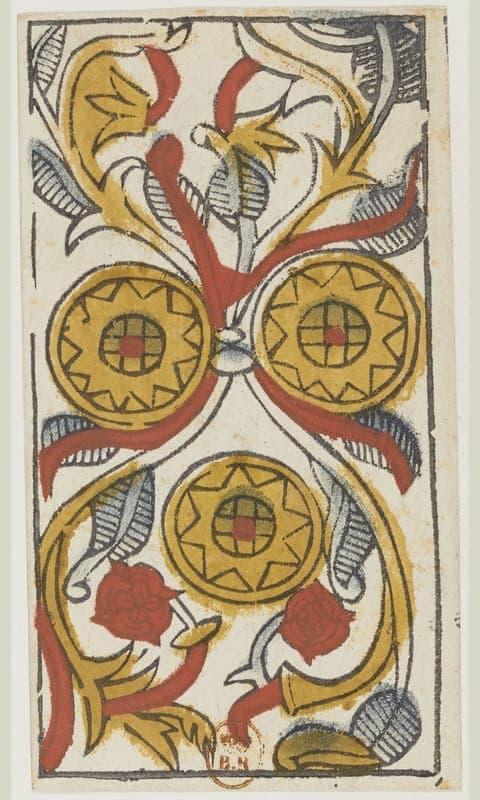
Tarot de Viéville
Jacques Viéville, c. 1650
Three coins: two side by side above and one below, set among curling yellow and red stems with grey leaves. Two red roses bloom at the bottom, and each coin has a rayed border around a small gridded centre.
Viéville number cards show only their suit symbols; read them through number and suit, with the written meaning as a guide.
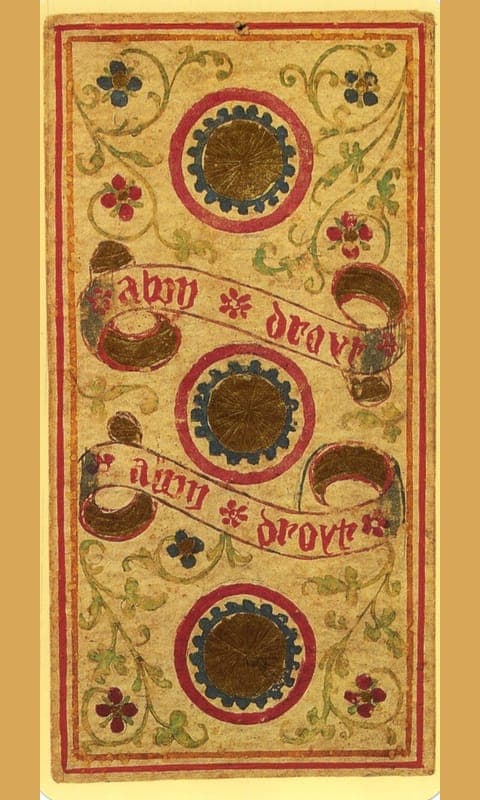
Visconti-Sforza
Bonifacio Bembo, c. 1450
Three gold coins in blue scalloped rings and red outer rings stand in a column, with two ribbons between them, each lettered 'abon droyt' in red. This card is painted in a paler, yellowish style, with thin olive vines, small red and blue flowers and double red borders.
In the Visconti-Sforza deck the number cards show only their suit symbols, and the trumps are unnamed and unnumbered.
Sola Busca
c. 1491
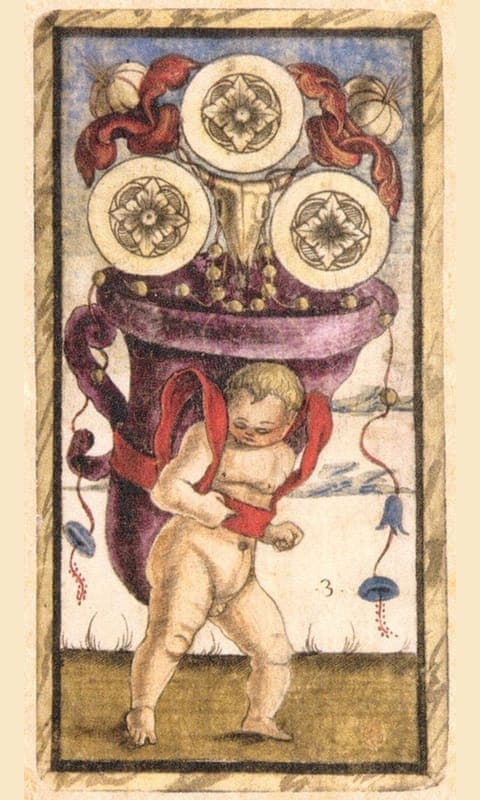
A naked infant walks forward carrying a large purple vessel on his back by red straps. Three coins with flower patterns sit on top beside an ox skull, red ribbons and two round fruits. Blue bell-shaped flowers hang from cords at the sides, and the numeral 3 is at the right.

Soimoi
Mike Koz, 2025
Three people kneel in a bamboo grove under a hanging lantern, working on three large golden discs carved with three-comma swirls. A young woman in a red headband and an older bearded man with grey hair in a topknot hold up and chisel the discs, while a younger man with a moustache taps at one with a chisel. A tanuki watches from the lower right and red leaves drift down.