The Lovers in 7 decks
The same card as 7 decks draw it, five and a half centuries apart. What stays the same is the card’s core; what changes is where a reading can find something new. The meanings are written for the Rider–Waite–Smith picture; the descriptions here are of each deck’s own.
Side by side
Choose any two decks and read the pictures against each other.
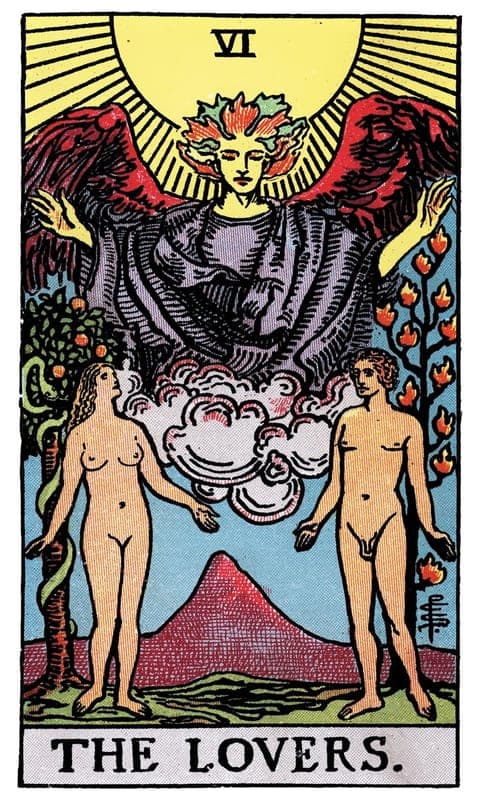
Pamela Colman Smith, 1909
A naked man and woman stand in a green garden under a great winged angel whose arms spread over them from a cloud, with the sun blazing above. Behind the woman grows a tree with a serpent coiled in it; behind the man, a tree of flames. She looks up at the angel; he looks at her. A mountain rises between them in the distance.
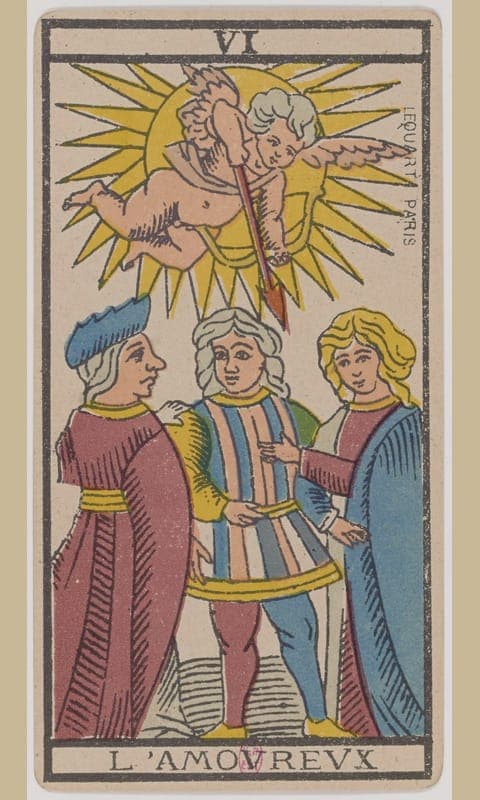
Lequart, Paris, 19th century
A winged cupid flies in a yellow sunburst at the top, aiming an arrow downward. Below stand three figures: a young man with grey hair in a striped tunic at the centre, an older figure in a blue cap and red robe on the left, and a fair-haired woman in a blue cloak on the right, each touching him. Numbered VI, titled L'AMOVREVX.
Rider–Waite–Smith
Pamela Colman Smith, 1909
A naked man and woman stand in a green garden under a great winged angel whose arms spread over them from a cloud, with the sun blazing above. Behind the woman grows a tree with a serpent coiled in it; behind the man, a tree of flames. She looks up at the angel; he looks at her. A mountain rises between them in the distance.
Tarot de Marseille
Lequart, Paris, 19th century
A winged cupid flies in a yellow sunburst at the top, aiming an arrow downward. Below stand three figures: a young man with grey hair in a striped tunic at the centre, an older figure in a blue cap and red robe on the left, and a fair-haired woman in a blue cloak on the right, each touching him. Numbered VI, titled L'AMOVREVX.
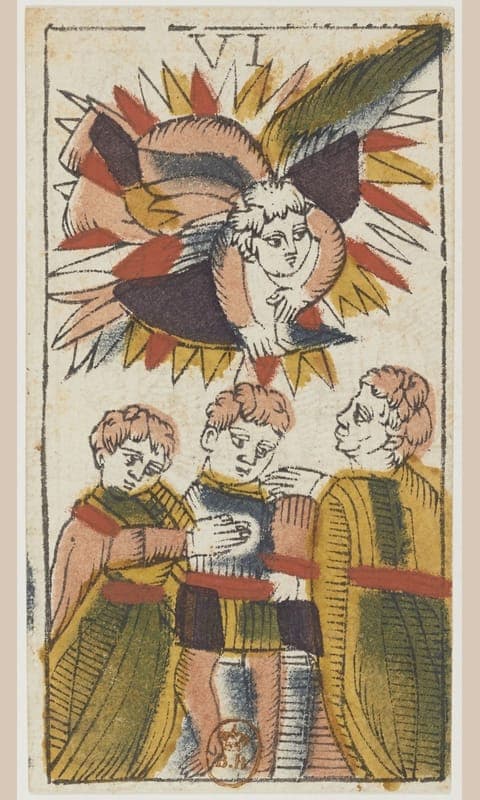
Tarot de Viéville
Jacques Viéville, c. 1650
Numbered VI, a winged child bursts from a spiky red, yellow and dark sunburst above. Below, three young figures stand together: one in the middle, with a figure on each side laying a hand on his chest or shoulder. No bow is visible in the cupid's hands.
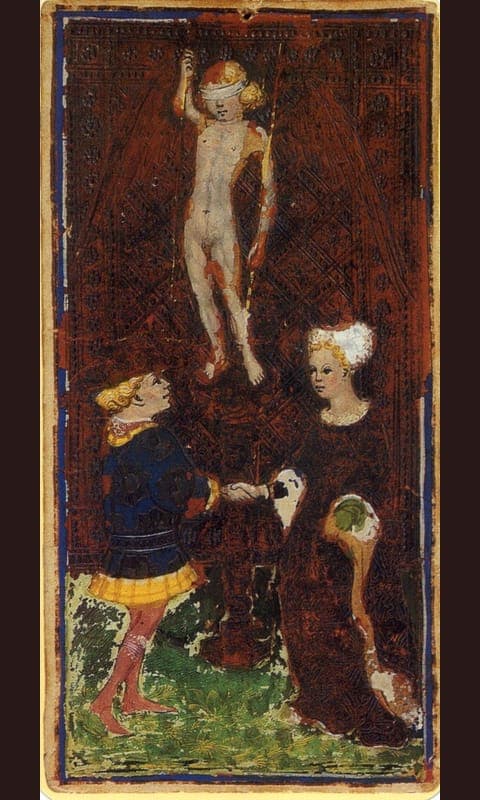
Visconti-Sforza
Bonifacio Bembo, c. 1450
A small naked figure, blindfolded and with faint red wings, stands on a pedestal holding an arrow, above a couple clasping hands. The man wears a blue doublet with a yellow skirt and red hose; the woman wears a dark red gown and a white headdress. The ground is a reddish tooled pattern, and paint has flaked across much of the card.
In the Visconti-Sforza deck the number cards show only their suit symbols, and the trumps are unnamed and unnumbered.
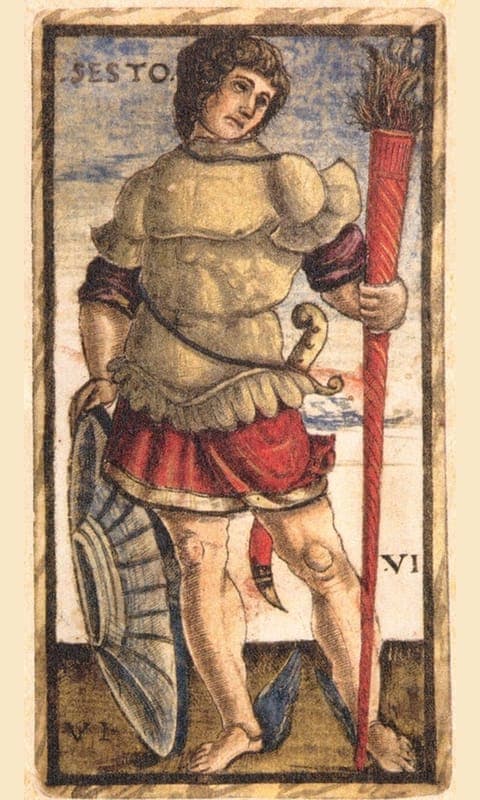
Sola Busca
c. 1491
A young man in a pale breastplate and red skirt stands barefoot, holding a tall red torch whose top burns. His left hand rests on a fluted round shield and a sword hangs at his hip. The name SESTO is at the upper left and the numeral VI appears twice, at the right and the lower left.
Sola Busca trumps are named figures matched to the standard trumps by number only.
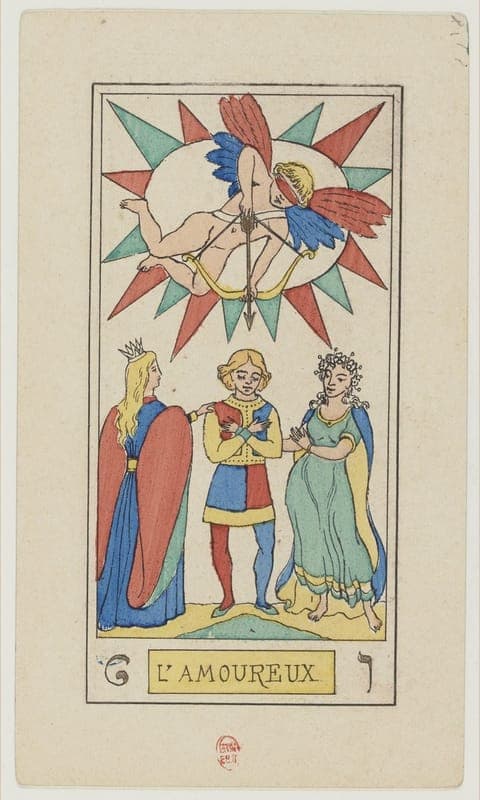
Oswald Wirth
Oswald Wirth, 1889
A young man stands with arms crossed over his chest between two women: on his right a crowned, fair-haired woman in blue and red, on his left a woman with a wreath of flowers in her hair, dressed in green. Above them a blindfolded winged child inside a radiant disc of red and green points aims an arrow downwards. Below are a numeral 6, L'AMOUREUX and the Hebrew letter vav.

Soimoi
Mike Koz, 2025
A young man in a red kimono and a young woman in a teal kimono with a red sash stand side by side at a glass balcony rail, holding hands and looking in different directions. A thin red cord runs from their hands to a seated shiba-like dog at their feet, and the man holds a slim stick. Pink petals drift across the night city, with a red torii below.