The Chariot in 7 decks
The same card as 7 decks draw it, five and a half centuries apart. What stays the same is the card’s core; what changes is where a reading can find something new. The meanings are written for the Rider–Waite–Smith picture; the descriptions here are of each deck’s own.
Side by side
Choose any two decks and read the pictures against each other.
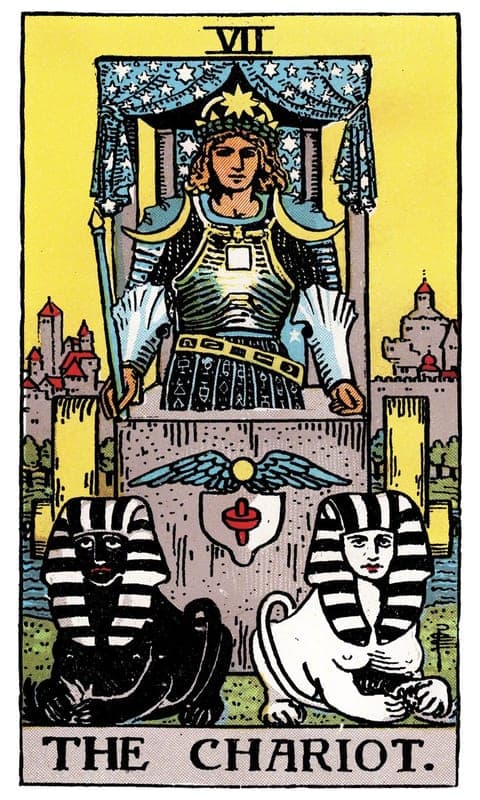
Pamela Colman Smith, 1909
An armoured prince stands in a stone chariot beneath a starry canopy, holding a wand but no reins, while two sphinxes, one black and one white, sit before him facing slightly different ways. A walled city lies behind; a river runs between him and it. His face is calm and the sphinxes are perfectly still.
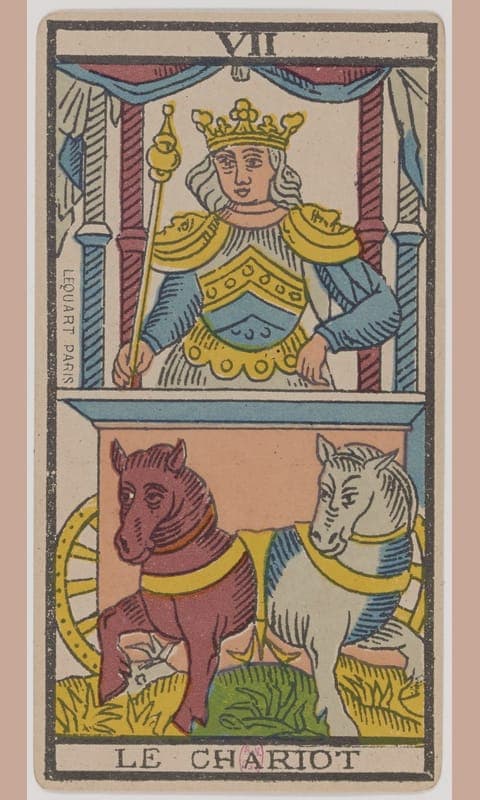
Lequart, Paris, 19th century
Numbered VII and titled LE CHARIOT, a crowned figure in armour with yellow shoulder pieces shaped like faces stands in a chariot, holding a sceptre. Striped posts hold a red and blue canopy above. In front, a red horse and a white horse wear yellow collars, and a yellow wheel shows at each side. Grass covers the ground.
Rider–Waite–Smith
Pamela Colman Smith, 1909
An armoured prince stands in a stone chariot beneath a starry canopy, holding a wand but no reins, while two sphinxes, one black and one white, sit before him facing slightly different ways. A walled city lies behind; a river runs between him and it. His face is calm and the sphinxes are perfectly still.
Tarot de Marseille
Lequart, Paris, 19th century
Numbered VII and titled LE CHARIOT, a crowned figure in armour with yellow shoulder pieces shaped like faces stands in a chariot, holding a sceptre. Striped posts hold a red and blue canopy above. In front, a red horse and a white horse wear yellow collars, and a yellow wheel shows at each side. Grass covers the ground.
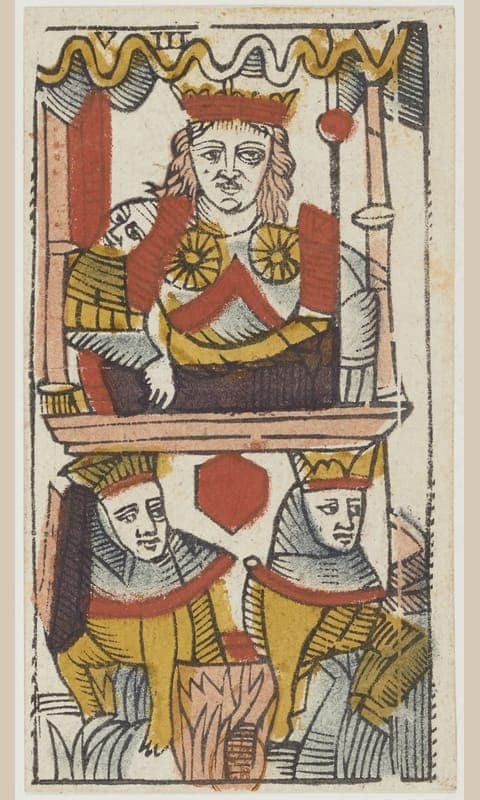
Tarot de Viéville
Jacques Viéville, c. 1650
Numbered VIII at the top, a crowned figure with long hair stands in a car under a scalloped canopy, wearing armour with sunburst shoulder pieces. Below, two hooded draught creatures with crowned human faces pull the car, a red hexagon between them.
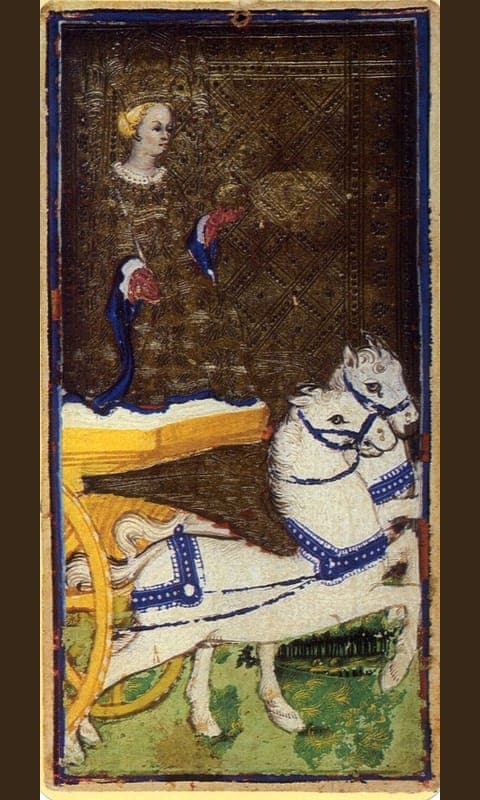
Visconti-Sforza
Bonifacio Bembo, c. 1450
A fair-haired woman in a gold gown with blue sleeves stands on a yellow chariot, holding a slender rod and reaching towards a gold shape tooled into the background. Two white horses in blue harness pull the chariot, its large yellow wheel at the left. They cross a green meadow with a small line of trees in the distance.
In the Visconti-Sforza deck the number cards show only their suit symbols, and the trumps are unnamed and unnumbered.
Sola Busca
c. 1491
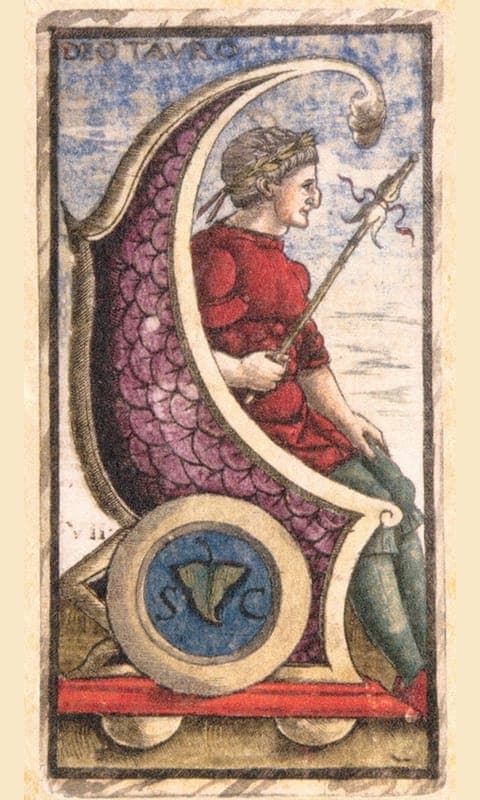
A laurel-crowned man in a red tunic sits holding a ribboned spear in a tall chariot shaped like a curling scaled shell. Its round wheel shows a leaf between the letters S and C, and the whole stands on a red base. The name DEOTAVRO is at the top and VII shows faintly at the left.
Sola Busca trumps are named figures matched to the standard trumps by number only.
Oswald Wirth
Oswald Wirth, 1889
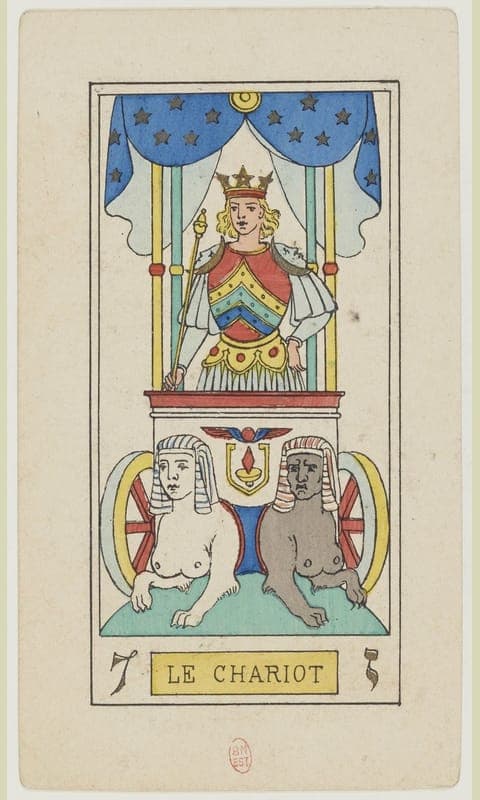
A crowned young man in armour stands in a square chariot beneath a blue canopy scattered with stars, holding a sceptre. The chariot's front shows a winged disc above an emblem. Instead of horses, two sphinxes in striped headdresses lie before the wheels, one white and one dark grey. Below are the number 7, LE CHARIOT and the Hebrew letter zayin.
Soimoi
Mike Koz, 2025
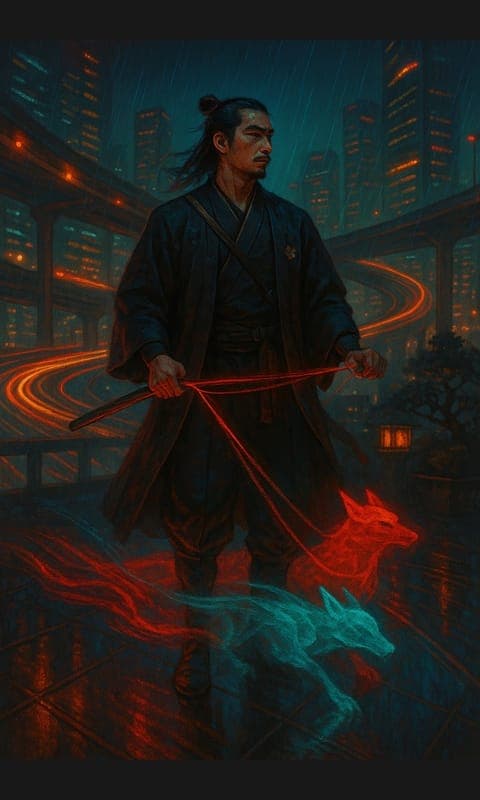
A man with his hair tied in a topknot strides forward in rain, wearing a dark wide-sleeved coat and holding a sword at waist height. Two glowing red cords run from his hands to two spectral wolves or foxes, one burning red and one pale teal, that race beside him. Curving elevated roads streaked with orange light loop between skyscrapers behind him.