Ten of Pentacles in 6 decks
The same card as 6 decks draw it, five and a half centuries apart. What stays the same is the card’s core; what changes is where a reading can find something new. The meanings are written for the Rider–Waite–Smith picture; the descriptions here are of each deck’s own. Not in Oswald Wirth, which has no Ten of Pentacles card.
Side by side
Choose any two decks and read the pictures against each other.
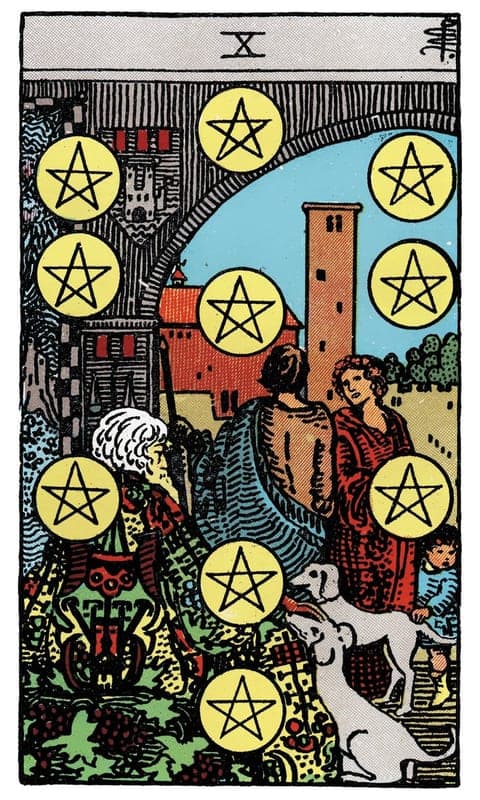
Pamela Colman Smith, 1909
An old man in a richly patterned robe sits with two white dogs at the gateway of a town, while a young couple stand talking in the arch and a child reaches toward one of the dogs. Ten pentacles are arranged across the scene in the pattern of the Tree of Life. Three generations, and none of them is looking at the coins.
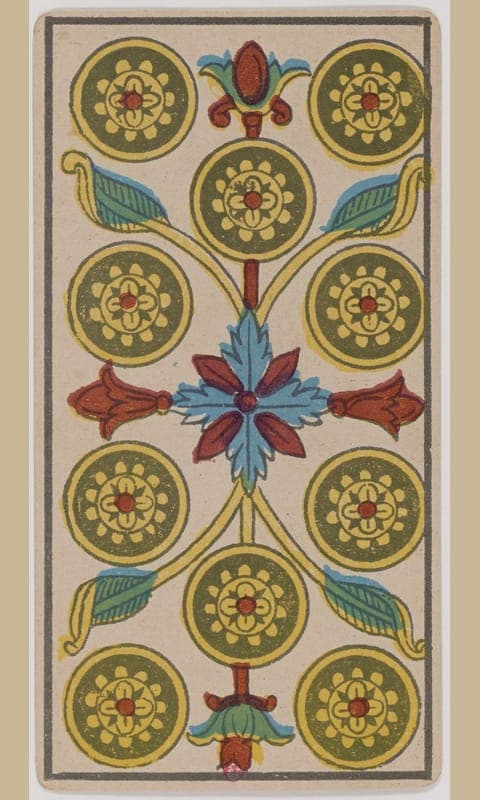
Lequart, Paris, 19th century
Ten coins are set as two columns of four with two more in the centre column, one high and one low. A blue and red star flower sits in the middle with red tulips pointing out to each side, and curling green leaves reach to the edges. Small flowers cap the top and bottom.
Marseille number cards are read through their number and suit; the written meaning here gives the scene the Rider-Waite-Smith card adds.
Rider–Waite–Smith
Pamela Colman Smith, 1909
An old man in a richly patterned robe sits with two white dogs at the gateway of a town, while a young couple stand talking in the arch and a child reaches toward one of the dogs. Ten pentacles are arranged across the scene in the pattern of the Tree of Life. Three generations, and none of them is looking at the coins.
Tarot de Marseille
Lequart, Paris, 19th century
Ten coins are set as two columns of four with two more in the centre column, one high and one low. A blue and red star flower sits in the middle with red tulips pointing out to each side, and curling green leaves reach to the edges. Small flowers cap the top and bottom.
Marseille number cards are read through their number and suit; the written meaning here gives the scene the Rider-Waite-Smith card adds.
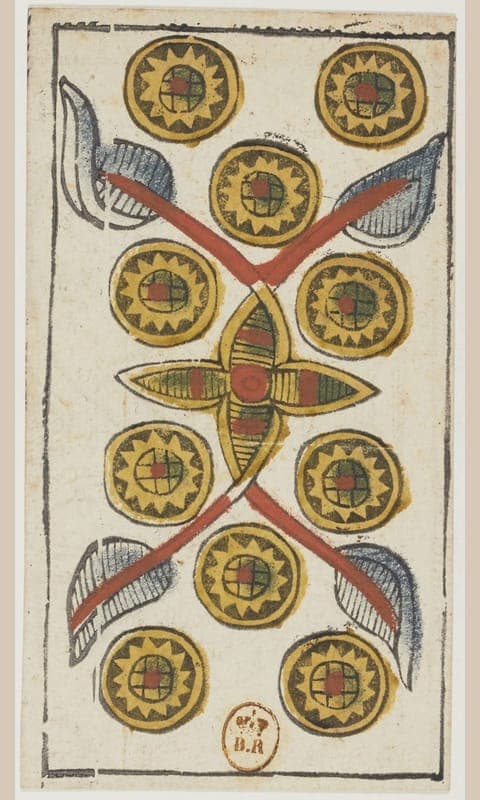
Tarot de Viéville
Jacques Viéville, c. 1650
Ten coins: pairs at the top and bottom, single coins above and below a central pointed four-armed ornament, and pairs on either side of it. Two red bands cross in an X through the centre, with grey leaves at the sides.
Viéville number cards show only their suit symbols; read them through number and suit, with the written meaning as a guide.
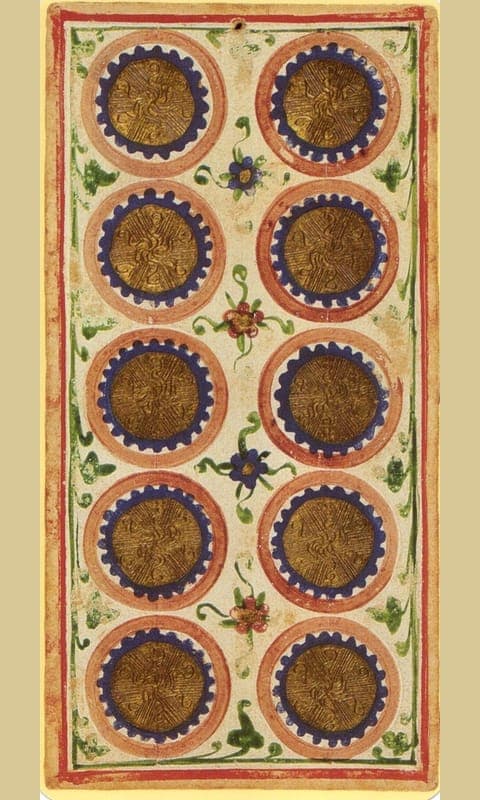
Visconti-Sforza
Bonifacio Bembo, c. 1450
Ten gold coins in scalloped blue rings and salmon outer rings fill the card in five rows of two. Small blue and red flowers on green stems run down the centre between the columns. Green sprigs line the margins within a red border.
In the Visconti-Sforza deck the number cards show only their suit symbols, and the trumps are unnamed and unnumbered.
Sola Busca
c. 1491
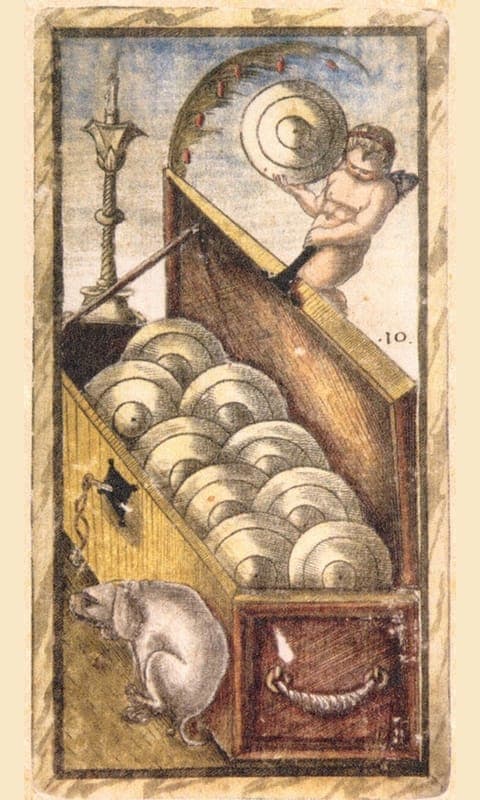
A large open chest is filled with coins, and a winged infant leans on its raised lid holding up another coin. A candlestick with a lit candle stands behind and a curving branch arches overhead. A pale pig-like animal lies curled at the foot of the chest. The numeral 10 is at the right.
Soimoi
Mike Koz, 2025
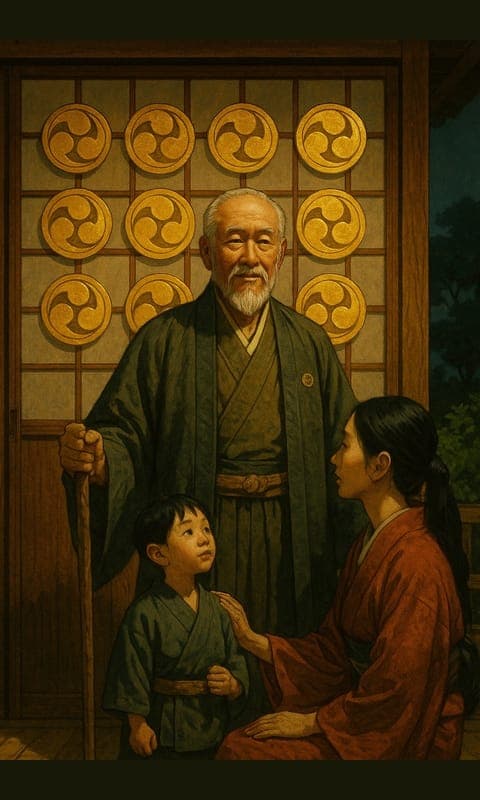
A smiling old man with white hair and a beard stands in a green kimono and jacket, leaning on a wooden cane before sliding paper doors. Ten gold discs with three-comma swirls are mounted on the doors behind him in three rows. A small boy in green looks up at him, and a young woman in red kneels beside the boy with her hand on his shoulder.