Six of Pentacles in 6 decks
The same card as 6 decks draw it, five and a half centuries apart. What stays the same is the card’s core; what changes is where a reading can find something new. The meanings are written for the Rider–Waite–Smith picture; the descriptions here are of each deck’s own. Not in Oswald Wirth, which has no Six of Pentacles card.
Side by side
Choose any two decks and read the pictures against each other.
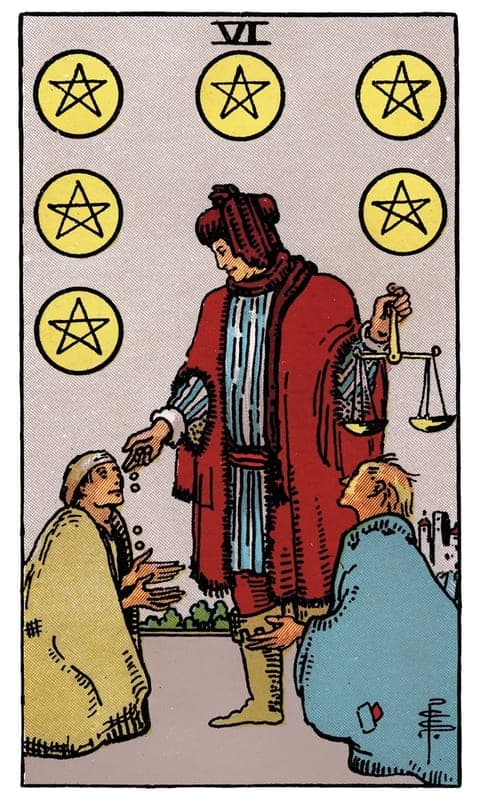
Pamela Colman Smith, 1909
A richly dressed merchant stands holding a set of scales in one hand and dropping coins into the palm of a kneeling beggar with the other, while a second beggar kneels waiting. Six pentacles float in the air around them. The scales are level.
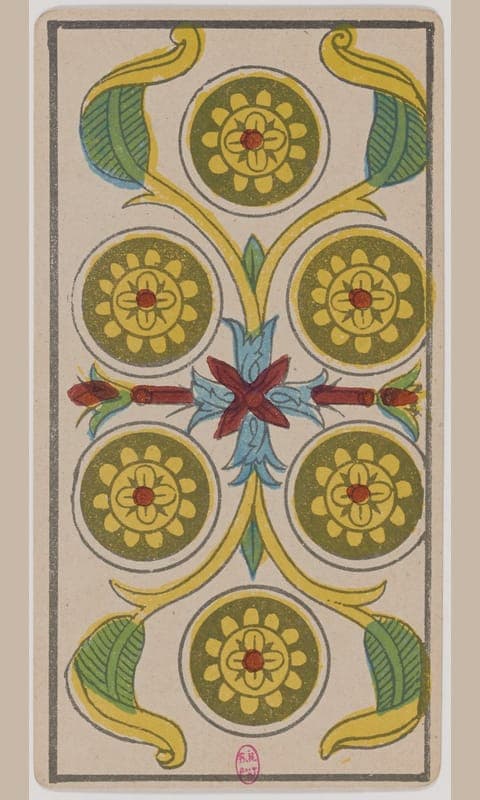
Lequart, Paris, 19th century
Six coins are arranged one at the top, two pairs in the middle and one at the bottom. At the centre a red and blue cross-shaped flower sends out red rods that end in small red buds at each side. Yellow stems with green leaves curl to the four corners.
Marseille number cards are read through their number and suit; the written meaning here gives the scene the Rider-Waite-Smith card adds.
Rider–Waite–Smith
Pamela Colman Smith, 1909
A richly dressed merchant stands holding a set of scales in one hand and dropping coins into the palm of a kneeling beggar with the other, while a second beggar kneels waiting. Six pentacles float in the air around them. The scales are level.
Tarot de Marseille
Lequart, Paris, 19th century
Six coins are arranged one at the top, two pairs in the middle and one at the bottom. At the centre a red and blue cross-shaped flower sends out red rods that end in small red buds at each side. Yellow stems with green leaves curl to the four corners.
Marseille number cards are read through their number and suit; the written meaning here gives the scene the Rider-Waite-Smith card adds.
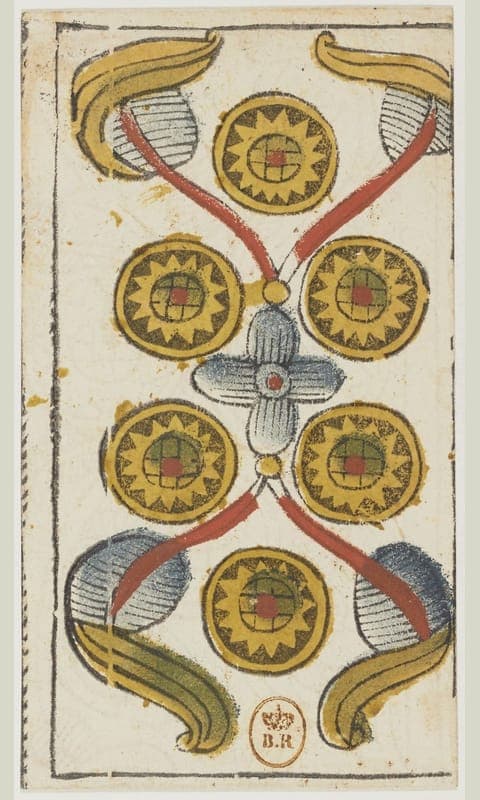
Tarot de Viéville
Jacques Viéville, c. 1650
Six coins are arranged in a tall hexagon around a central grey four-petalled flower: one at the top, two pairs at the sides and one at the bottom. Red stems and large yellow and grey leaves curl at the corners.
Viéville number cards show only their suit symbols; read them through number and suit, with the written meaning as a guide.
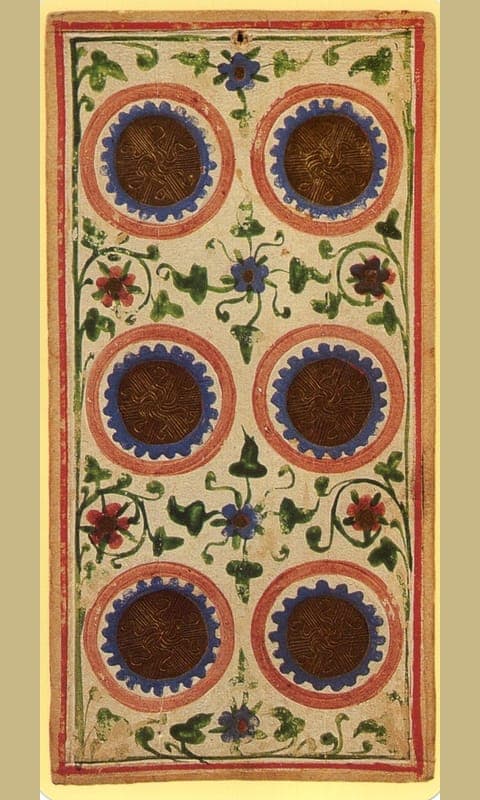
Visconti-Sforza
Bonifacio Bembo, c. 1450
Six gold coins in scalloped blue rings and salmon outer rings are set in two columns of three. Between the pairs, small blue and red flowers sit on green stems, and green vines run down the sides. There is no ribbon.
In the Visconti-Sforza deck the number cards show only their suit symbols, and the trumps are unnamed and unnumbered.
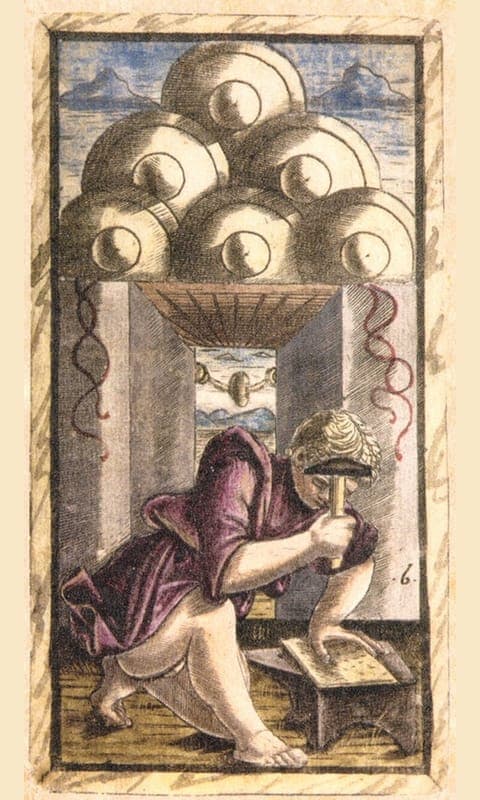
Sola Busca
c. 1491
A curly-haired man in a purple tunic kneels at an anvil, striking with a hammer. Above him six large coins are stacked on a lintel over an open doorway, through which a distant landscape shows. The numeral 6 is at the right.

Soimoi
Mike Koz, 2025
A man with long hair in a topknot, a tattoo on his neck, stands in a red kimono among bamboo, holding up a pair of balance scales. Each pan carries three gold coins with three-comma swirls, and the scales hang level. His other hand is open below them, a small torii glows in the distance, and red maple leaves fall around him.