Five of Pentacles in 6 decks
The same card as 6 decks draw it, five and a half centuries apart. What stays the same is the card’s core; what changes is where a reading can find something new. The meanings are written for the Rider–Waite–Smith picture; the descriptions here are of each deck’s own. Not in Oswald Wirth, which has no Five of Pentacles card.
Side by side
Choose any two decks and read the pictures against each other.
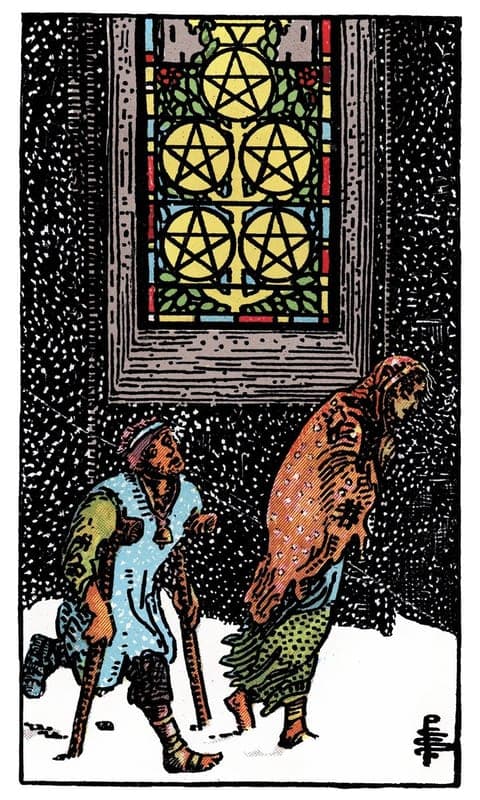
Pamela Colman Smith, 1909
Two ragged figures struggle through falling snow at night, one on crutches with a bandaged foot, the other barefoot in a thin shawl. Above them glows a stained-glass window showing five pentacles arranged like a tree. They pass beneath the lit window without looking up at it.
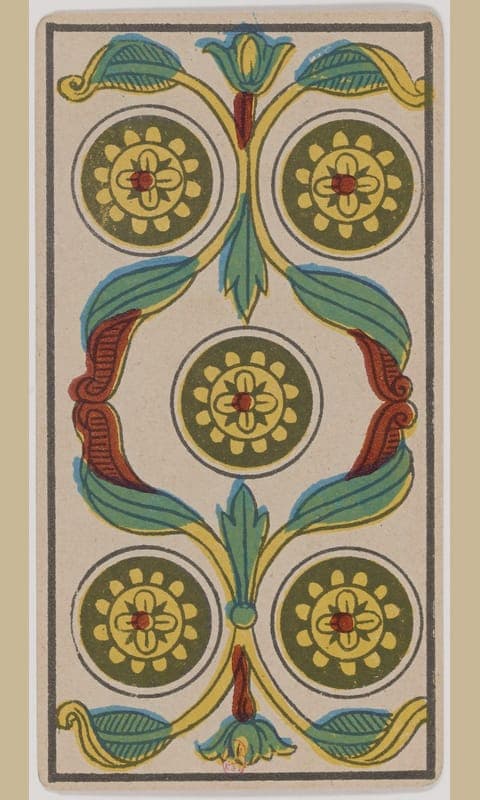
Lequart, Paris, 19th century
Four coins sit at the corners with a fifth in the centre, ringed by green leaves and red scrolls on either side. A yellow stem runs up and down from the centre, ending in green buds over red stalks at the top and bottom, with curling leaves at the corners.
Marseille number cards are read through their number and suit; the written meaning here gives the scene the Rider-Waite-Smith card adds.
Rider–Waite–Smith
Pamela Colman Smith, 1909
Two ragged figures struggle through falling snow at night, one on crutches with a bandaged foot, the other barefoot in a thin shawl. Above them glows a stained-glass window showing five pentacles arranged like a tree. They pass beneath the lit window without looking up at it.
Tarot de Marseille
Lequart, Paris, 19th century
Four coins sit at the corners with a fifth in the centre, ringed by green leaves and red scrolls on either side. A yellow stem runs up and down from the centre, ending in green buds over red stalks at the top and bottom, with curling leaves at the corners.
Marseille number cards are read through their number and suit; the written meaning here gives the scene the Rider-Waite-Smith card adds.
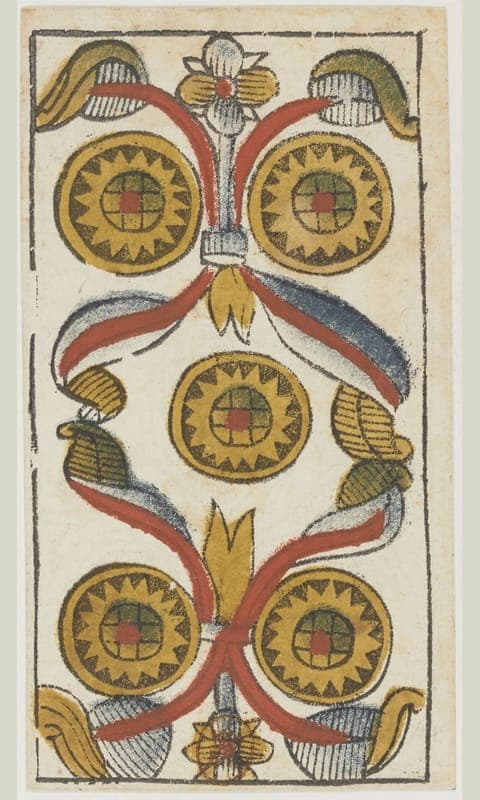
Tarot de Viéville
Jacques Viéville, c. 1650
Five coins: one in each corner and one in the centre, framed by curling red and grey ribbons. Flowers sit at the top and bottom, and yellow and grey leaves curl at the sides and corners.
Viéville number cards show only their suit symbols; read them through number and suit, with the written meaning as a guide.
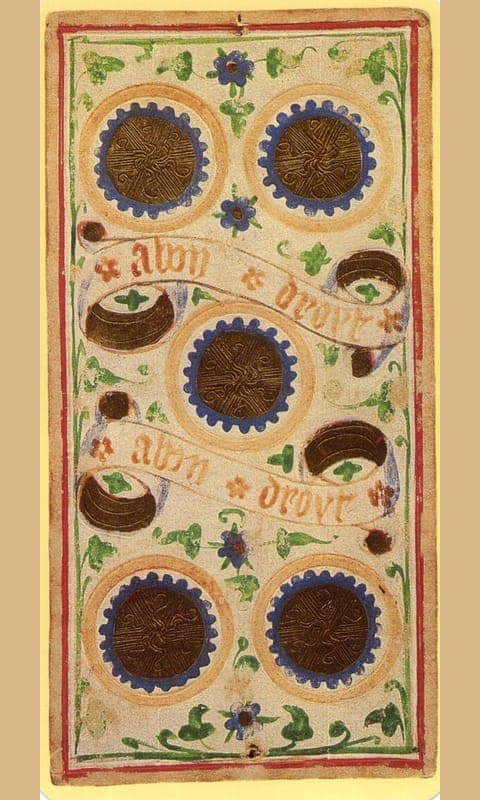
Visconti-Sforza
Bonifacio Bembo, c. 1450
Five gold coins in blue scalloped rings: two at the top, one in the centre and two at the bottom. Two ribbons, gold and white, run across between them, each lettered 'abon droyt' in orange-red. Small blue flowers and green sprigs fill the cream ground.
In the Visconti-Sforza deck the number cards show only their suit symbols, and the trumps are unnamed and unnumbered.
Sola Busca
c. 1491
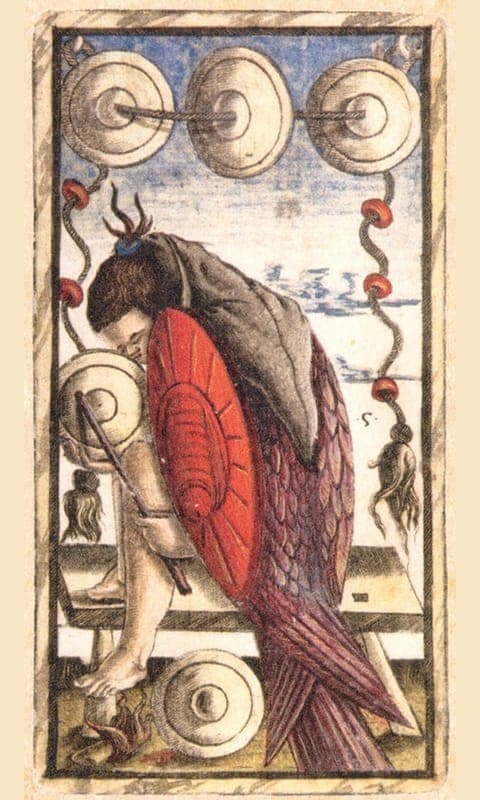
A figure huddles under a dark cloak and a red ribbed shield, with a long tail of purple-red feathers, holding a stick. Three coins hang on a rod at the top, one more is at the left and one lies on the ground near a small fire. Red beads and tassels hang on cords, and 5 is at the right.
Soimoi
Mike Koz, 2025
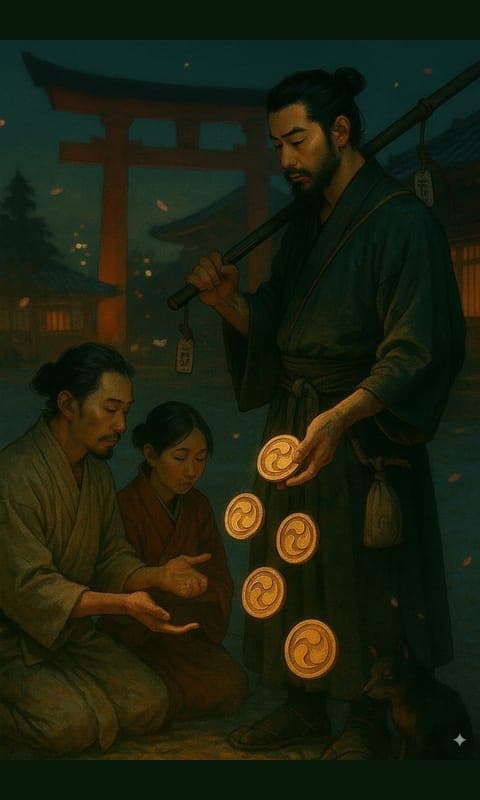
Before a red torii and shrine buildings at night, a bearded man with a topknot stands carrying a pole over his shoulder hung with paper charms, and lets five gold coins fall from his hand. A kneeling man holds out cupped hands to receive them while a girl kneels beside him with her head bowed. A dark cat sits at his feet; the scene resembles the Rider-Waite-Smith Six of Pentacles.