Three of Cups in 6 decks
The same card as 6 decks draw it, five and a half centuries apart. What stays the same is the card’s core; what changes is where a reading can find something new. The meanings are written for the Rider–Waite–Smith picture; the descriptions here are of each deck’s own. Not in Oswald Wirth, which has no Three of Cups card.
Side by side
Choose any two decks and read the pictures against each other.
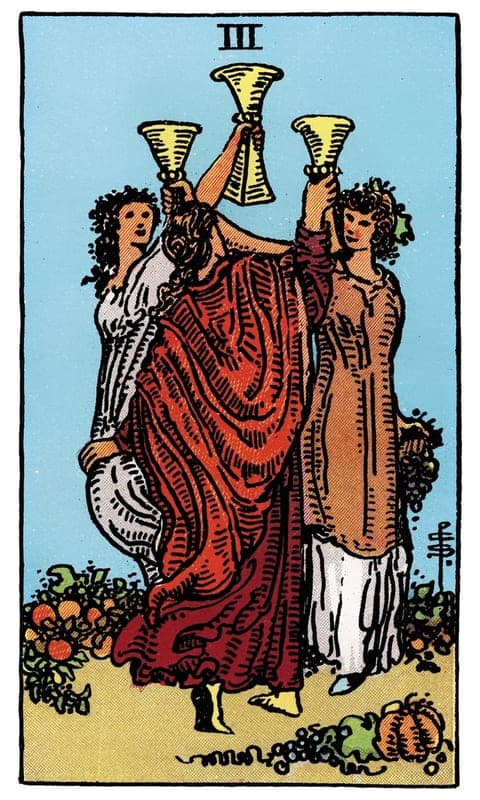
Pamela Colman Smith, 1909
Three women dance in a ring with their cups raised high, surrounded by vines heavy with grapes and gourds at their feet. They are not looking at the viewer but at one another. The harvest is in and the pleasure is shared, not private.
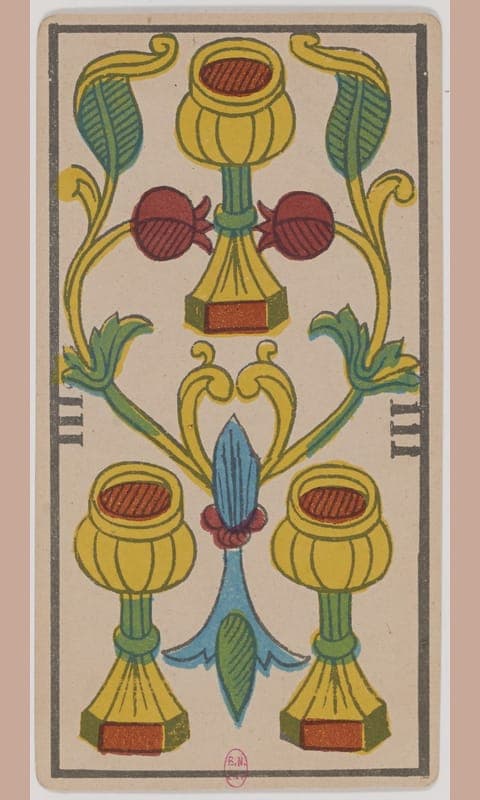
Lequart, Paris, 19th century
One yellow goblet stands at the top and two at the bottom. Curling yellow stems with green leaves frame them, and two red pomegranates flank the upper cup. A blue plant with red berries rises between the lower pair. The numeral III is printed at each side.
Marseille number cards are read through their number and suit; the written meaning here gives the scene the Rider-Waite-Smith card adds.
Rider–Waite–Smith
Pamela Colman Smith, 1909
Three women dance in a ring with their cups raised high, surrounded by vines heavy with grapes and gourds at their feet. They are not looking at the viewer but at one another. The harvest is in and the pleasure is shared, not private.
Tarot de Marseille
Lequart, Paris, 19th century
One yellow goblet stands at the top and two at the bottom. Curling yellow stems with green leaves frame them, and two red pomegranates flank the upper cup. A blue plant with red berries rises between the lower pair. The numeral III is printed at each side.
Marseille number cards are read through their number and suit; the written meaning here gives the scene the Rider-Waite-Smith card adds.
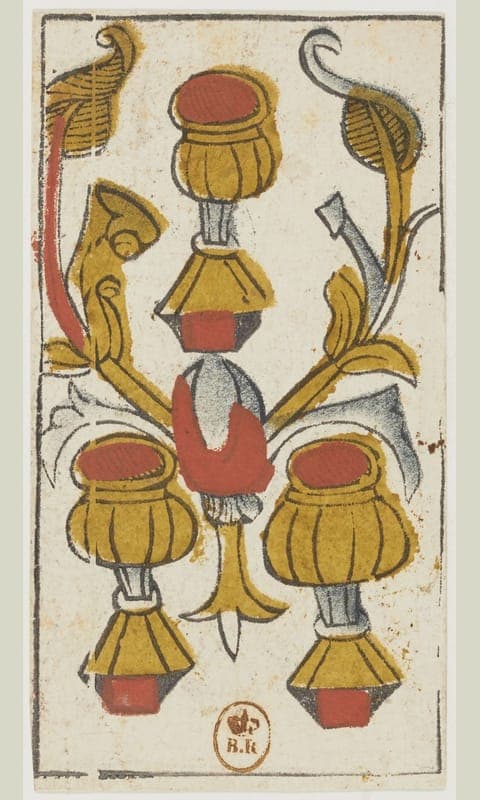
Tarot de Viéville
Jacques Viéville, c. 1650
Three cups: one on top and two below, linked by curling stems. A grotesque mask-like face grows from the left stem, yellow leaves and grey fronds fill the sides, and a red and grey bud sits at the centre.
Viéville number cards show only their suit symbols; read them through number and suit, with the written meaning as a guide.
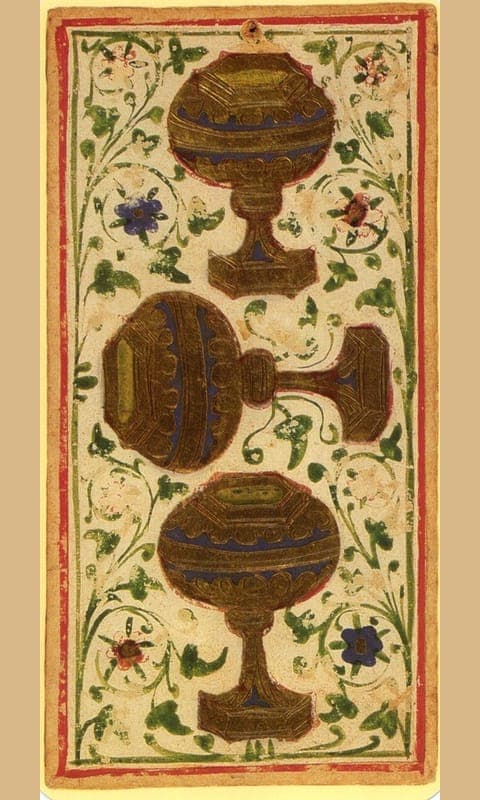
Visconti-Sforza
Bonifacio Bembo, c. 1450
Three gold goblets with blue bands are set one above another; the middle cup lies on its side, its foot pointing right. There is no ribbon. Green vines with blue, red and pale flowers wind around them on the cream ground, framed in red.
In the Visconti-Sforza deck the number cards show only their suit symbols, and the trumps are unnamed and unnumbered.
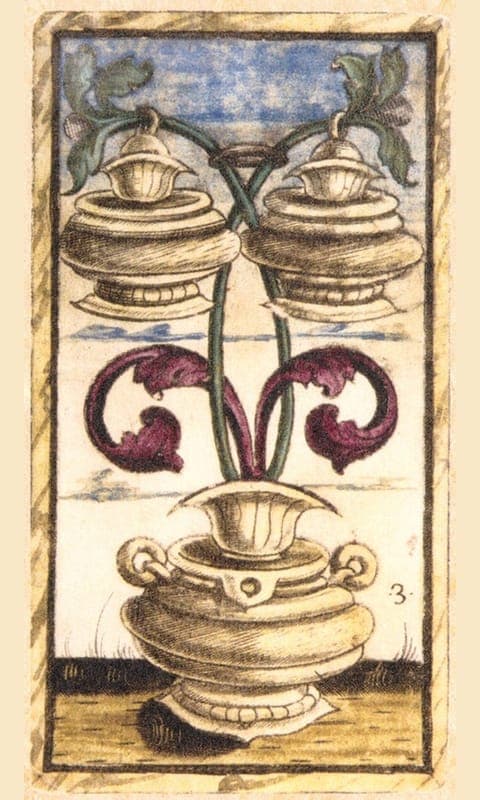
Sola Busca
c. 1491
A lidded pot with ring handles stands on the ground, and from it two green stems curve up, each holding a stacked covered vessel. Purple acanthus leaves curl outward in the middle and green leaves sprout at the top. The numeral 3 is at the right.

Soimoi
Mike Koz, 2025
Three young people in dark blue patterned kimonos raise small white cups together on a wooden bench, laughing. The man in the middle stands with his cup held high, and the two women sit either side; a plate of round sweets rests on the bench. Glowing red paper lanterns and trailing purple wisteria hang above, and a tanuki figure sits at lower right.