Ten of Wands in 6 decks
The same card as 6 decks draw it, five and a half centuries apart. What stays the same is the card’s core; what changes is where a reading can find something new. The meanings are written for the Rider–Waite–Smith picture; the descriptions here are of each deck’s own. Not in Oswald Wirth, which has no Ten of Wands card.
Side by side
Choose any two decks and read the pictures against each other.
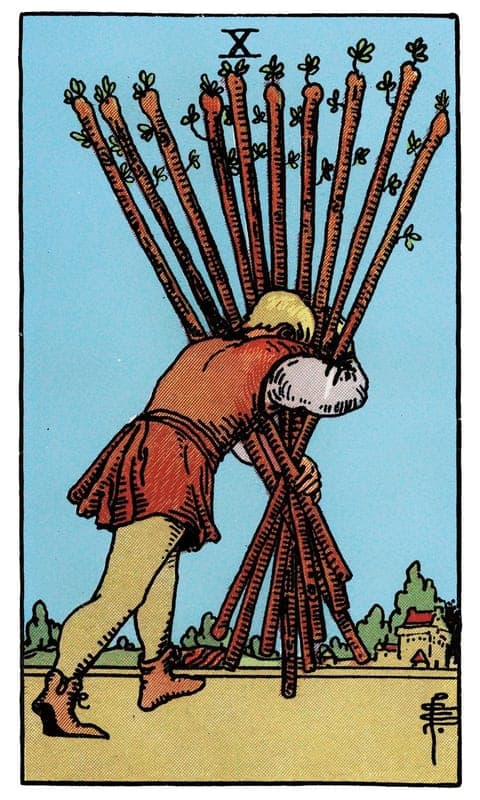
Pamela Colman Smith, 1909
A man bent nearly double carries ten heavy staffs bundled in his arms, so many that they block his view of the road. A town with houses and a field stands not far ahead. He is close to arriving and cannot see it.
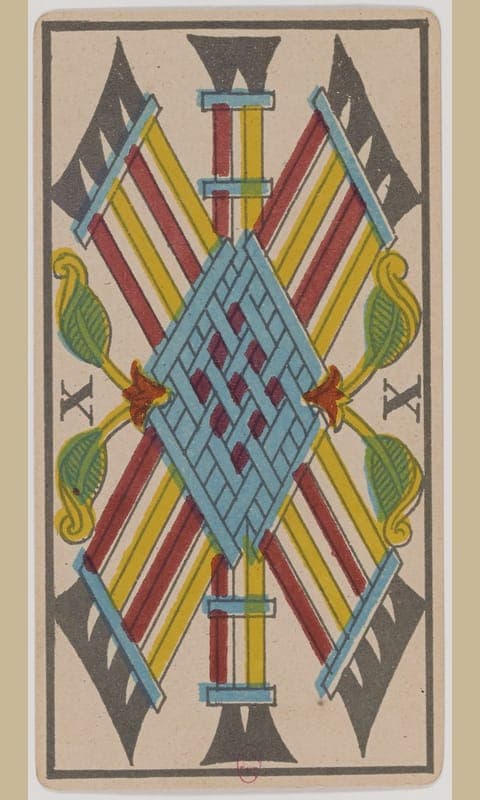
Lequart, Paris, 19th century
Eight crossed staves and two upright ones, one red and one yellow, meet in a large blue lattice with small red diamonds. A curling leaf and a red flower sprout at each side, beside the numeral X. Grey flared ends spread at the top, bottom and corners.
Marseille number cards are read through their number and suit; the written meaning here gives the scene the Rider-Waite-Smith card adds.
Rider–Waite–Smith
Pamela Colman Smith, 1909
A man bent nearly double carries ten heavy staffs bundled in his arms, so many that they block his view of the road. A town with houses and a field stands not far ahead. He is close to arriving and cannot see it.
Tarot de Marseille
Lequart, Paris, 19th century
Eight crossed staves and two upright ones, one red and one yellow, meet in a large blue lattice with small red diamonds. A curling leaf and a red flower sprout at each side, beside the numeral X. Grey flared ends spread at the top, bottom and corners.
Marseille number cards are read through their number and suit; the written meaning here gives the scene the Rider-Waite-Smith card adds.
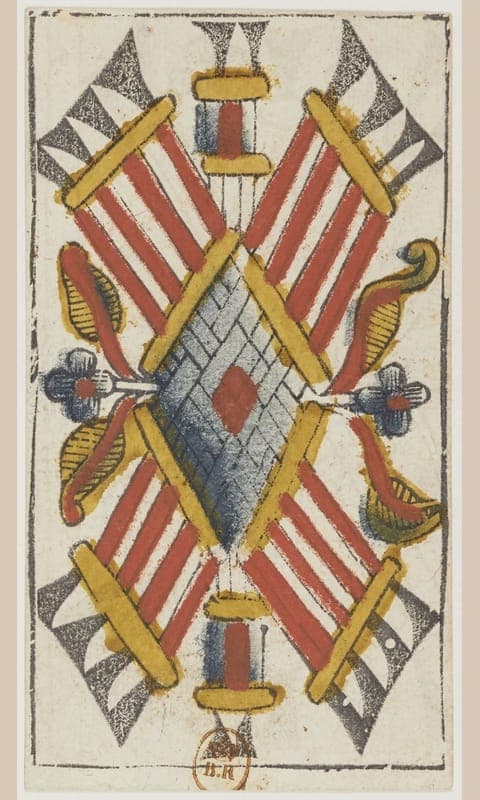
Tarot de Viéville
Jacques Viéville, c. 1650
Eight batons in two crossing groups form a lozenge around a woven grey centre with a red diamond, and two short batons sit above and below. Curling red and yellow leaves and blue flowers fill the sides.
Viéville number cards show only their suit symbols; read them through number and suit, with the written meaning as a guide.
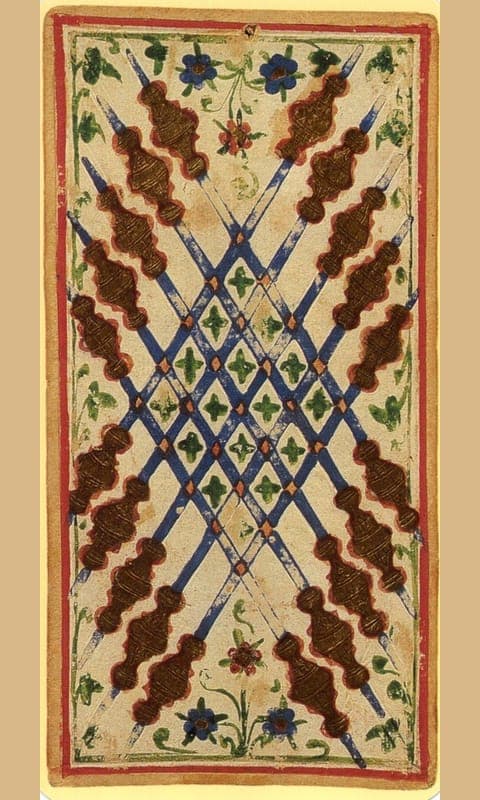
Visconti-Sforza
Bonifacio Bembo, c. 1450
Ten staves with dark gold baluster ends cross five by five into a close lattice; the blue paint on the shafts is worn and patchy. Green four-leaf sprigs fill the diamonds and orange lozenges mark the crossings. Blue and red flowers decorate the top and bottom of the cream ground.
In the Visconti-Sforza deck the number cards show only their suit symbols, and the trumps are unnamed and unnumbered.
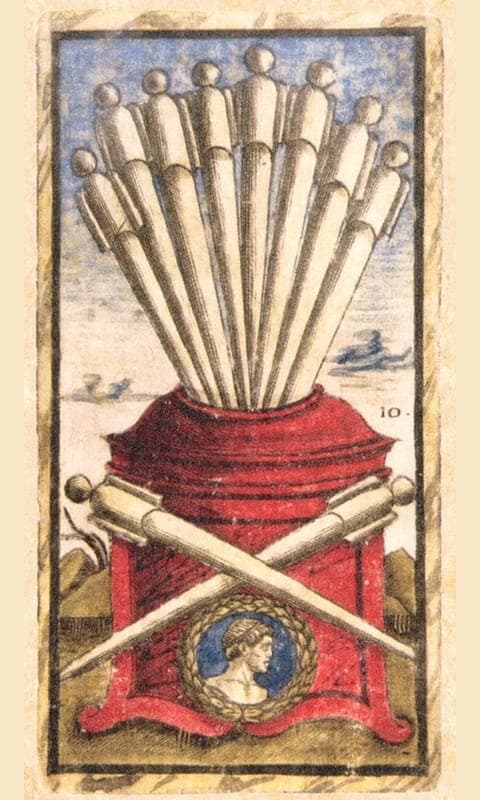
Sola Busca
c. 1491
Ten staves fan upwards from a red vase-like pedestal. Two more staves lie crossed in front of it, above a laurel medallion showing a man's head in profile on a blue ground. Hills show in the distance and the numeral 10 is at the right.

Soimoi
Mike Koz, 2025
Seen from behind, a man in a red kimono with a dark sash and a topknot stands in an autumn bamboo forest, his empty hands at his sides and his head turned slightly down. A stack of bamboo poles bound with cord lies on the ground beside him. Red maple leaves fall from a tree at left and cover the forest floor.