Ten of Swords in 6 decks
The same card as 6 decks draw it, five and a half centuries apart. What stays the same is the card’s core; what changes is where a reading can find something new. The meanings are written for the Rider–Waite–Smith picture; the descriptions here are of each deck’s own. Not in Oswald Wirth, which has no Ten of Swords card.
Side by side
Choose any two decks and read the pictures against each other.
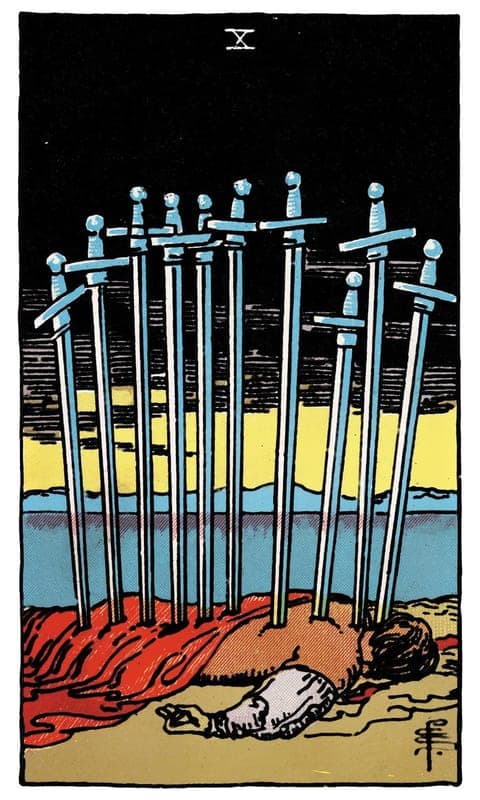
Pamela Colman Smith, 1909
A figure lies face down on the ground with ten swords standing in their back, under a sky that is black at the top and turning gold at the horizon. Calm water lies beyond. The hand nearest the viewer is making a quiet gesture of blessing.
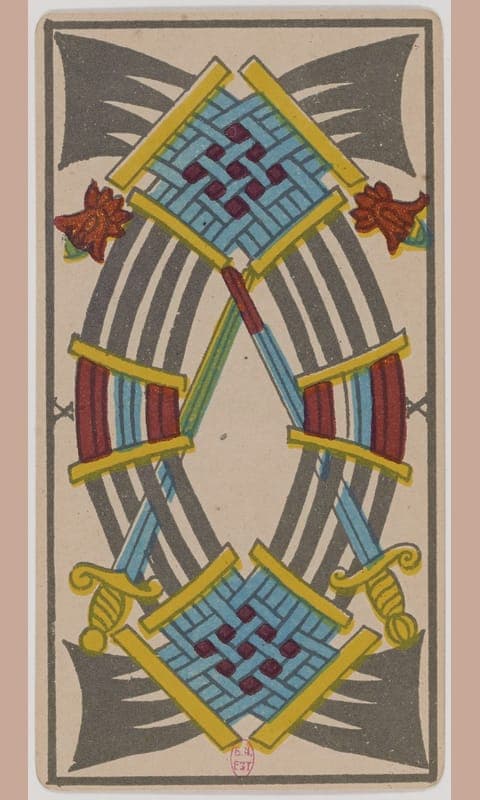
Lequart, Paris, 19th century
Eight curved grey blades form a quadruple oval with blue woven crossings full of red diamonds. Inside, two straight blue swords with red tips cross, their yellow hilts at the lower sides. Red flowers appear only at the two upper sides. A small X is printed at each side.
Marseille number cards are read through their number and suit; the written meaning here gives the scene the Rider-Waite-Smith card adds.
Rider–Waite–Smith
Pamela Colman Smith, 1909
A figure lies face down on the ground with ten swords standing in their back, under a sky that is black at the top and turning gold at the horizon. Calm water lies beyond. The hand nearest the viewer is making a quiet gesture of blessing.
Tarot de Marseille
Lequart, Paris, 19th century
Eight curved grey blades form a quadruple oval with blue woven crossings full of red diamonds. Inside, two straight blue swords with red tips cross, their yellow hilts at the lower sides. Red flowers appear only at the two upper sides. A small X is printed at each side.
Marseille number cards are read through their number and suit; the written meaning here gives the scene the Rider-Waite-Smith card adds.
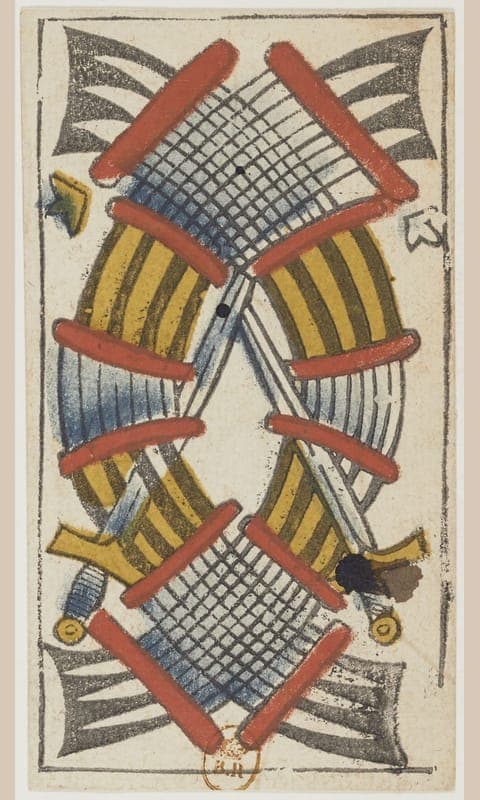
Tarot de Viéville
Jacques Viéville, c. 1650
Eight curved blades form a broad oval interlaced at top and bottom, and two straight swords cross diagonally through the centre. A dark blot or stain lies near the right-hand hilt in the scan.
Viéville number cards show only their suit symbols; read them through number and suit, with the written meaning as a guide.
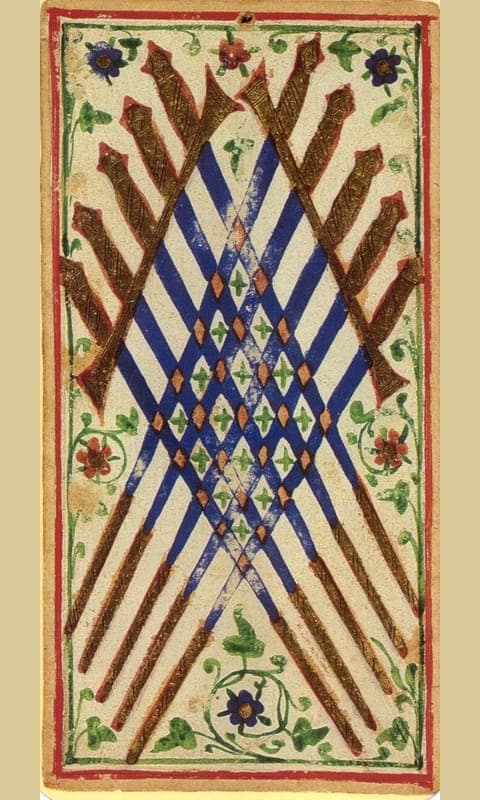
Visconti-Sforza
Bonifacio Bembo, c. 1450
Ten swords cross five by five, brown hilts forming a steep arch at the top and blue blades woven into a tight diamond lattice dotted with orange lozenges and green sprigs. The brown points fan out at the bottom. A few flowers sit in the corners within a red border.
In the Visconti-Sforza deck the number cards show only their suit symbols, and the trumps are unnamed and unnumbered.
Sola Busca
c. 1491
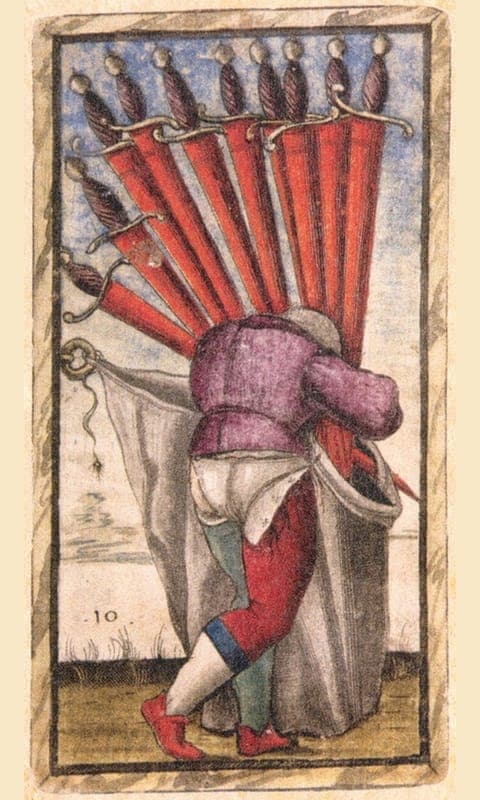
A man in a purple doublet, white breeches and red and green hose leans into a large white sack, ten swords fanned out above and behind him. His face is hidden. The numeral 10 is at the lower left.
Soimoi
Mike Koz, 2025
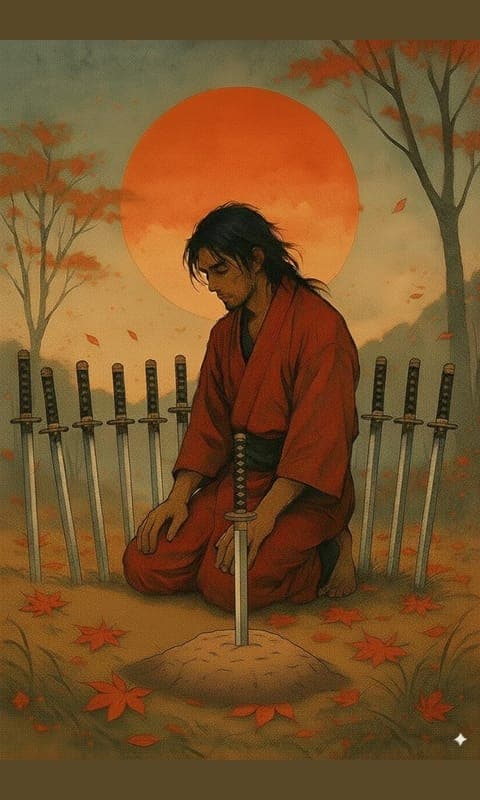
On a faded, warm-toned card, a long-haired man in a red kimono kneels before a small mound of earth with a single sword planted upright in it, his head bowed. Nine more swords stand in a row behind him, six on the left and three on the right. A large orange sun hangs behind him between autumn trees; unlike the Rider-Waite-Smith card, no one lies pierced.