Seven of Wands in 6 decks
The same card as 6 decks draw it, five and a half centuries apart. What stays the same is the card’s core; what changes is where a reading can find something new. The meanings are written for the Rider–Waite–Smith picture; the descriptions here are of each deck’s own. Not in Oswald Wirth, which has no Seven of Wands card.
Side by side
Choose any two decks and read the pictures against each other.
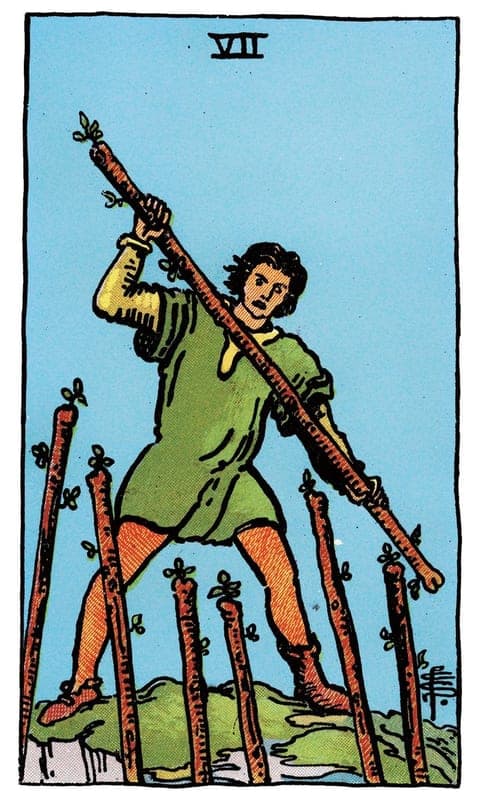
Pamela Colman Smith, 1909
A man stands on a rise with a staff held crosswise, braced against six staffs that rise toward him from below. His feet are set and his face is determined, though he wears mismatched shoes as if he dressed in a hurry. He has the advantage of height and is outnumbered.
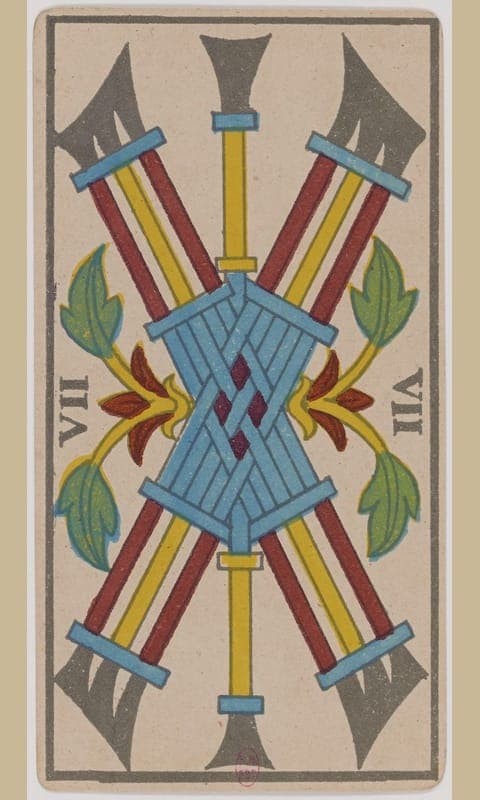
Lequart, Paris, 19th century
Six crossed staves in red and yellow with one upright yellow staff meet at a blue lattice holding four red diamonds. Green leaves on yellow stems and red buds grow out to either side of the centre. Grey flared ends mark each staff, and the numeral VII is printed at both sides.
Marseille number cards are read through their number and suit; the written meaning here gives the scene the Rider-Waite-Smith card adds.
Rider–Waite–Smith
Pamela Colman Smith, 1909
A man stands on a rise with a staff held crosswise, braced against six staffs that rise toward him from below. His feet are set and his face is determined, though he wears mismatched shoes as if he dressed in a hurry. He has the advantage of height and is outnumbered.
Tarot de Marseille
Lequart, Paris, 19th century
Six crossed staves in red and yellow with one upright yellow staff meet at a blue lattice holding four red diamonds. Green leaves on yellow stems and red buds grow out to either side of the centre. Grey flared ends mark each staff, and the numeral VII is printed at both sides.
Marseille number cards are read through their number and suit; the written meaning here gives the scene the Rider-Waite-Smith card adds.
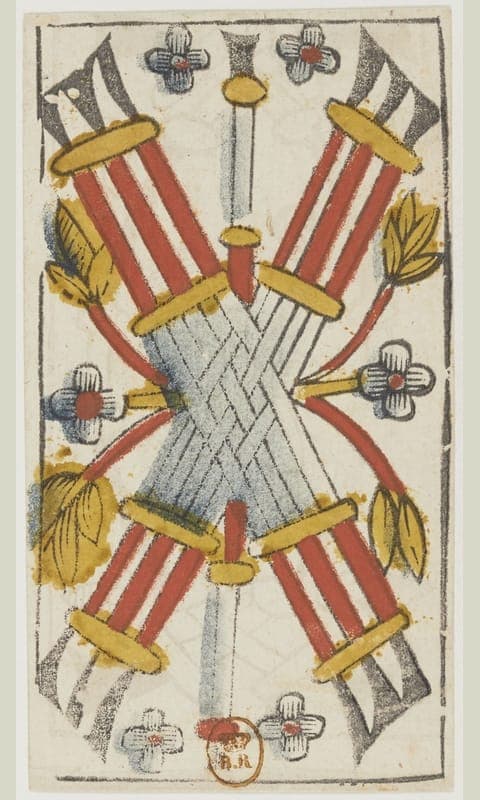
Tarot de Viéville
Jacques Viéville, c. 1650
Two bundles of three red batons cross over a seventh grey baton running down the centre, all woven together where they meet. Yellow leaf sprays grow at the sides and small blue four-petalled flowers sit in the corners.
Viéville number cards show only their suit symbols; read them through number and suit, with the written meaning as a guide.
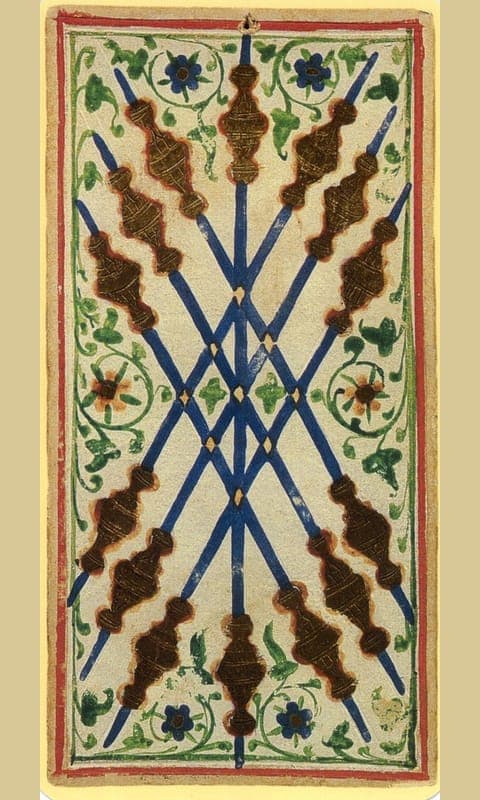
Visconti-Sforza
Bonifacio Bembo, c. 1450
Seven blue staves with dark gold baluster ends cross in a lattice, three on each diagonal and one upright through the centre. Small gold lozenges mark the crossings. Green vines with blue and orange flowers run around the cream ground; there is no ribbon.
In the Visconti-Sforza deck the number cards show only their suit symbols, and the trumps are unnamed and unnumbered.
Sola Busca
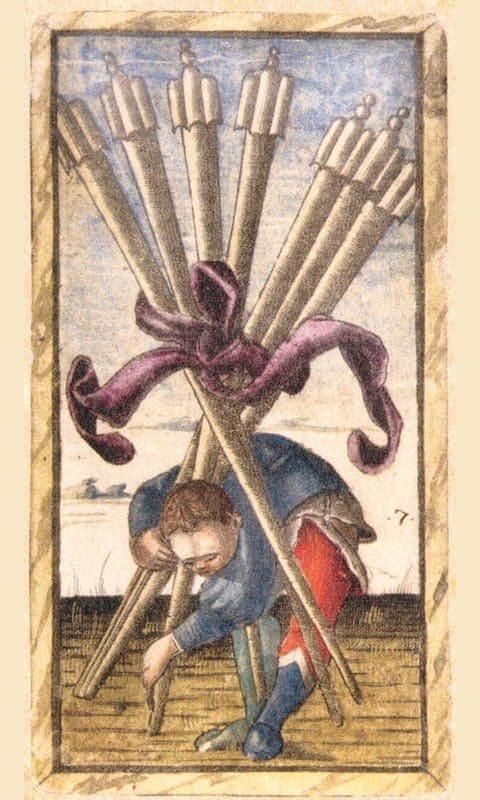
c. 1491
A man in blue bends double under seven long staves that cross over his back, tied together at the top with a large purple ribbon. He looks down at the ground, wearing red and blue hose. The numeral 7 is at the right.
Soimoi
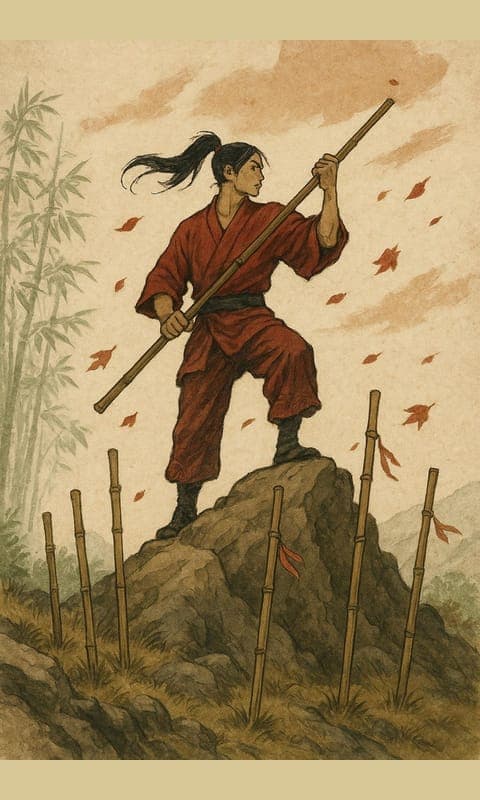
Mike Koz, 2025
On a sepia, paper-like ground, a young man with a long black ponytail, in red clothes and black boots, stands braced on top of a rock, gripping a long bamboo staff across his body. Six shorter bamboo stakes stand in the ground below him, some tied with red ribbons. Bamboo grows at left, and red leaves blow across a pale sky with pinkish clouds.