Death in 7 decks
The same card as 7 decks draw it, five and a half centuries apart. What stays the same is the card’s core; what changes is where a reading can find something new. The meanings are written for the Rider–Waite–Smith picture; the descriptions here are of each deck’s own.
Side by side
Choose any two decks and read the pictures against each other.
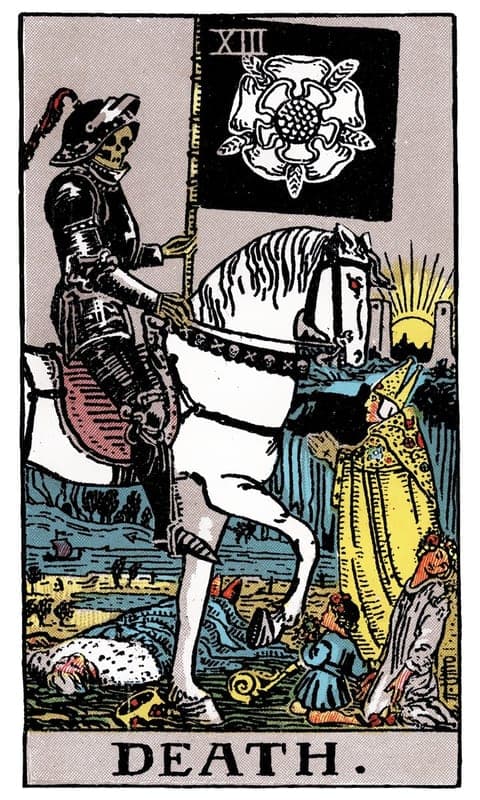
Pamela Colman Smith, 1909
A skeleton in black armour rides a white horse carrying a black banner with a white rose. A king lies dead beneath the hooves, a bishop stands pleading, a woman turns her face away and a child kneels offering flowers. Behind them a river flows toward two towers, and the sun rises or sets between them.
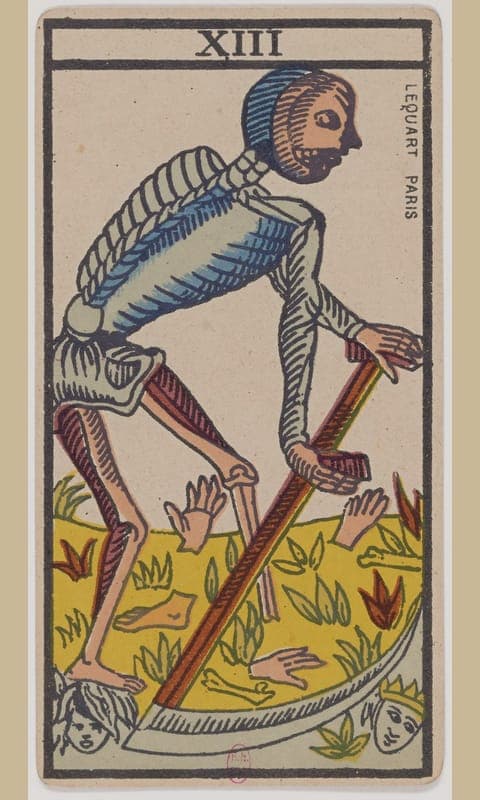
Lequart, Paris, 19th century
Numbered XIII with an empty title band, a skeleton with a blue-capped skull bends forward, sweeping a scythe with a red handle across yellow ground. Severed hands, feet and bones lie in the soil among green and red sprouts. Two heads lie at the bottom, one of them crowned. The card has no name.
Rider–Waite–Smith
Pamela Colman Smith, 1909
A skeleton in black armour rides a white horse carrying a black banner with a white rose. A king lies dead beneath the hooves, a bishop stands pleading, a woman turns her face away and a child kneels offering flowers. Behind them a river flows toward two towers, and the sun rises or sets between them.
Tarot de Marseille
Lequart, Paris, 19th century
Numbered XIII with an empty title band, a skeleton with a blue-capped skull bends forward, sweeping a scythe with a red handle across yellow ground. Severed hands, feet and bones lie in the soil among green and red sprouts. Two heads lie at the bottom, one of them crowned. The card has no name.
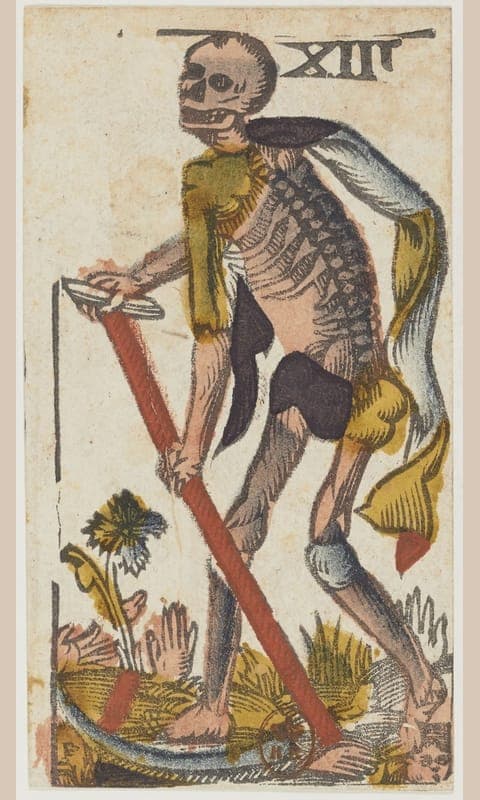
Tarot de Viéville
Jacques Viéville, c. 1650
Numbered XIII with no name, a skeleton draped with a yellow and grey scarf strides to the right, sweeping a scythe with a long red handle. Heads and hands lie among the grass at his feet, and a single flower grows at the left.
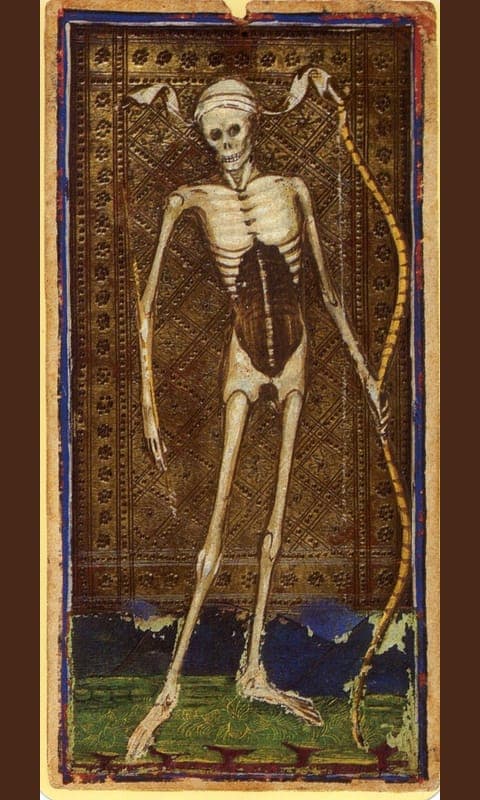
Visconti-Sforza
Bonifacio Bembo, c. 1450
A skeleton stands on green ground before dark blue hills, a white cloth band tied round its skull with the ends fluttering. It holds a tall yellow bow, striped in places, in its left hand, while its right arm hangs down holding a thin shaft. The torso is shaded dark brown. Behind is gold tooled with lattice and rosettes.
In the Visconti-Sforza deck the number cards show only their suit symbols, and the trumps are unnamed and unnumbered.
Sola Busca
c. 1491
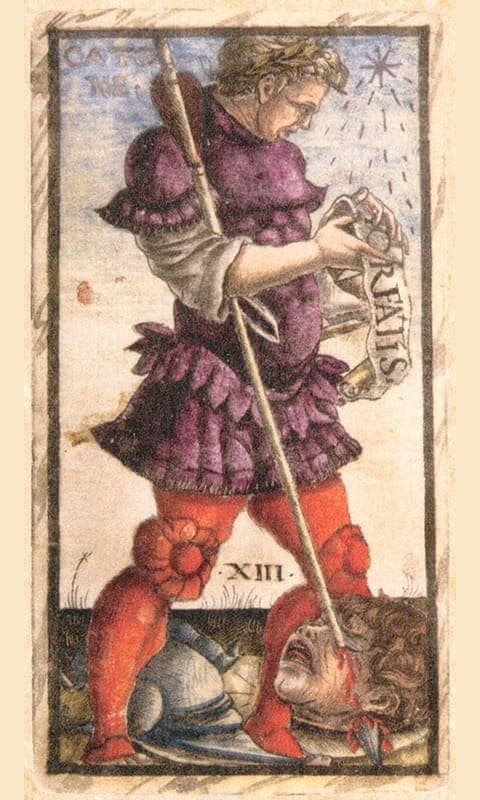
A laurel-crowned man in purple and red drives a spear down through a severed head lying on the ground beside armour. He holds a scroll whose visible letters read RTATIS, and a rayed star at the upper right sheds a shower of marks. The name CATONE is at the top in two lines and XIII by his legs.
Sola Busca trumps are named figures matched to the standard trumps by number only.
Oswald Wirth
Oswald Wirth, 1889
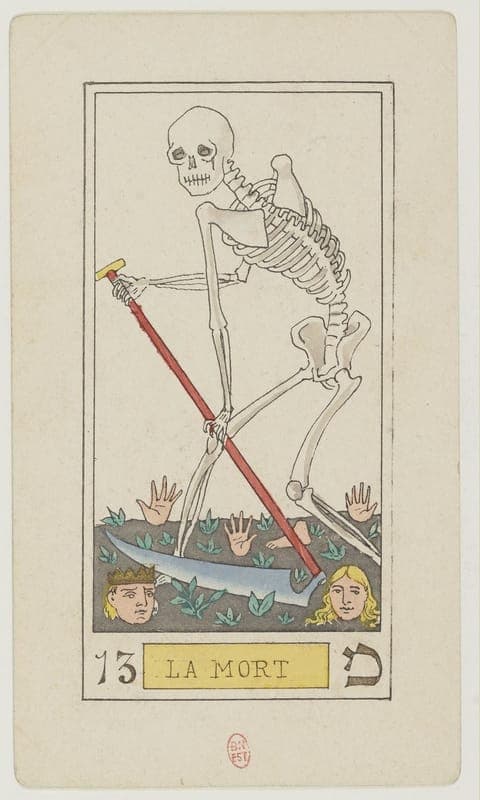
A skeleton swings a scythe with a red handle across dark ground sprouting green leaves. A crowned head and a fair-haired head lie on the ground, and hands and a foot push up from the earth around them. Unlike the Marseille card, which leaves it unnamed, this card is titled LA MORT, with the number 13 and the Hebrew letter mem.
Soimoi
Mike Koz, 2025
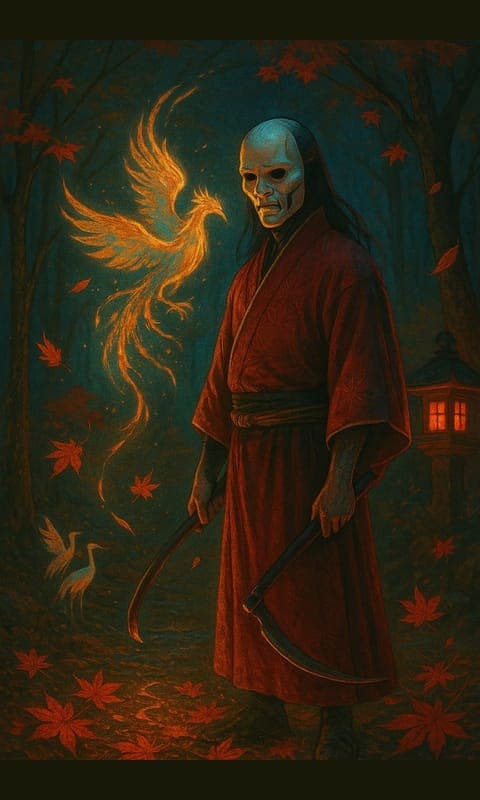
A tall figure with a pale skull-like mask and long dark hair stands in a red kimono in an autumn wood, holding a curved scythe-like blade in each hand. A blazing golden phoenix rises beside him, and two white cranes stand in the shadows at lower left. Red maple leaves fall and carpet the ground, and a lit stone lantern glows at right.